Here are a few charts from Heinz Heislers book Advanced Engine
Tech and others. The first chart shows that; as the fuel air ratio gets
real lean and the pressure lowers in the combustion chamber
at high altitude the voltage required to fire the plugs goes up.
Klaus has exploited this situation to lean his engine out
at high altitude and improve the BSFC to remarkable levels
by increasing the spark voltage. He has achieved as much as
100 MPG at 130 MPH and 60 MPG at more reasonable cruising speeds.
This is a piston engine where the spark plugs are at one end
of the fire and the piston is at the other end.
In our case we have a moving combustion chamber where the fire
travels along side the spark plugs for quite some time. IMHO We want
the spark plugs to continue to fire for as long as the unburned
and burning mixture is still present moving past the plugs. That takes
8.3 ms at six thousand RPM cruise RPM. See chart 2.
A capacitor discharge ignition system is very good at firing
spark plugs fouled with 100 LL but it only fires for .2 ms. Even
an inductive system (Chevy LS1 coil) or stock Mazda ignition
only fires for about .8 ms.
IMHO NO WHERE LONG ENOUGH FOR WHAT WE NEED!
IMHO we need an ignition system to fire for 8.3 ms or 300 degrees.
TEN times as long. MSD makes a multiple spark capacitor
discharge ignition system widely used by Mazda rotary
engine racers but it only works up to 3000 RPM. After that it
is "one strong spark" says MSD. Not enough in IMHO. This is why
I am doing a m.s.d. ignition system with several pre-charged
capacitors fired in rapid sequence by a cheap single chip computer.
I hope this is a break through in improving the BSFC of
the rotary engine. I think it is worth a try.
Patent applied for :)
--------------------------------------------------
This is the range of rotor positions I intend repeatedly firing the spark
plug. Mostly the leading plug (lower plug) as one does not want to risk
igniting the mixture in the following chamber.
Paul Lamar
Good going Paul. We need the long duration. Will be very interesting.
Sure wish we access to the Mazda factory development notes and a supplyof
the three sparkplug rotor housings the Mazda factory built for the R26B
LeMan's engines to improve efficiency.
Steve Beckham
Steve,
Heck I would just like to be able to buy factor P-port housings for a
reasonable price!
2 plug or 3 I don't care.
Paul,
I think the long spacing idea is a good one. The only concern that I have
is actual
spark duration. Modern coils and CD ignition may improve things there. At
Kawasaki
in the 2 stroke era there were many single-spark CDIs. We found that the
super short
spark duration was a problem when lighting lean mixtures. Kawasaki had
tried surface
gap spark plugs, which had no side wire. The business end of the plug
looked like a little
target with the center electrode as the bullseye,a ceramic stripe andthem
the case
of the plug outside that. the surface gap plugs didn't work well because
they carbon
tracked easily and then there was a conductor for the spark to jump
through. Later
the choice was a standard plug with an incredibly large gap, around .100
inches!
Surprisingly this worked well because there was plenty of voltage to fire
the gap, and
with the long (length) spark they were more likely to actually hit someof
the mixture
molecules! The large gap standard plugs with single shot CDI lasted tothe
end of the
2-cycle era. If the duration of the spark can be improved you will have
better results
when firing the lean mixtures we want to run to improve BSFC on the
rotary.
Bill Jepson
Bill, regarding your note about problems associated with firing lean
mixtures with short duration CD, we experienced the same problem withlean
mixtures and found the inductive worked much better all round. Ourengines
were tuned for lower rpm peak power. I think the factory used a custom
electronic CD with their LeMans engine. One of the file reference books
shows a CD ignition in the ex-Le Mans three rotor 1986 IMSA GTO beforethey
later switched to the four rotor for GTO. But it appears the factory was
using CD for these engines even before going to the three sparkplugengines.
But longer duration inductive system worked better for our engines.
Steve Beckham
Steve,
As Paul and many others among our group have said, many thanks for sharing
your wealth of experience with rotary installations. Can't beat hands on
experience. Getting back to the CDI vs Conventional ignition, the rotary
is a unique case because the spark plugs can't protrude into the chamber
at all. Since the sliding seals prevent that I would think that a plug
that presented the electrodes as close as possible would be best. I read
that VW was experimenting with a no-side-wire plug and a pointedprojection
on the piston to fire to. I don't know if they ever used it inproduction.
The spark actually jumped to the piston. I thought that this type ofsystem
would be perfect for the rotary. The plug could be closer to the rotor
without a side wire and the long spark would be perfect to ignite the
lean mixture. Having the plug closer would even bump the compression a
little. Just thinking out loud but it seems like a possibility.
Bill Jepson
We are going to fire the lower plug
over and over again. I called AEM and it does not fire
more than once past 3000 RPM according to the electronic
tech guy. He kept saying there was not enough time
but he was incorrect about that. I don't think they
designed it for a rotary where the rotor is moving one
third as fast as the shaft.
Paul Lamar
Hi Paul,
The info you got from the AEM tech guy agrees with the writings in
the PDF installation manual. According to part of that manual,
they are trying to get sparks accomplished over 20 deg of crankshaft
rotation. Above 3000 RPM the time available over 20 deg is too
short for the capacitors to cycle thru a discharge/recharge thus
limiting the number of firings. Sounds like their short comming may
be in the use of only 2 capacitors. Perhaps your new design should
plan on sequentially firing a dozen or so capacitors, that way the
capacitors have the time until the next rotor face passage to
recharge, you won't be trying to fire any single capacitor more
than once per combustion event. You'll need to compare the recharge
time available between combustion events and the discharge/recharge
time required for the particular capacitor you think will supply
enough energy for the coil you select. Dave M
Maybe not a dozen as I think that will add too much circuitry.
I am still thinking about the best way to fire four or five.
-------------------------------------------------------
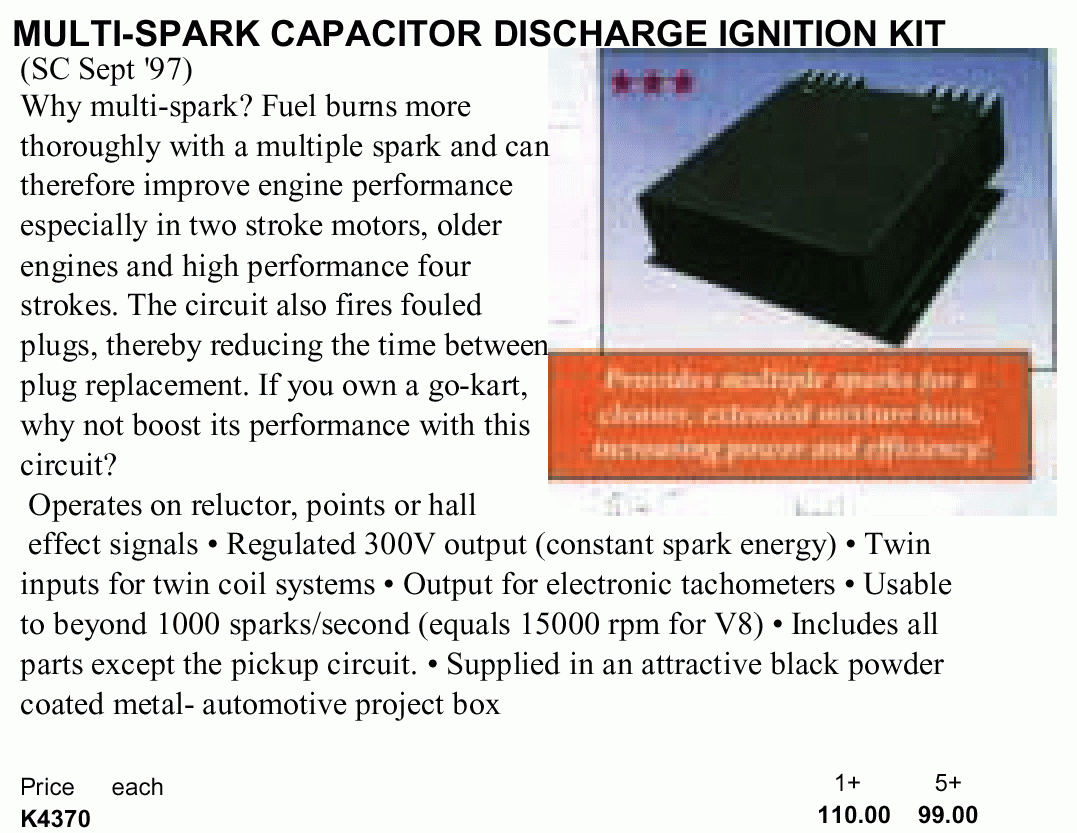
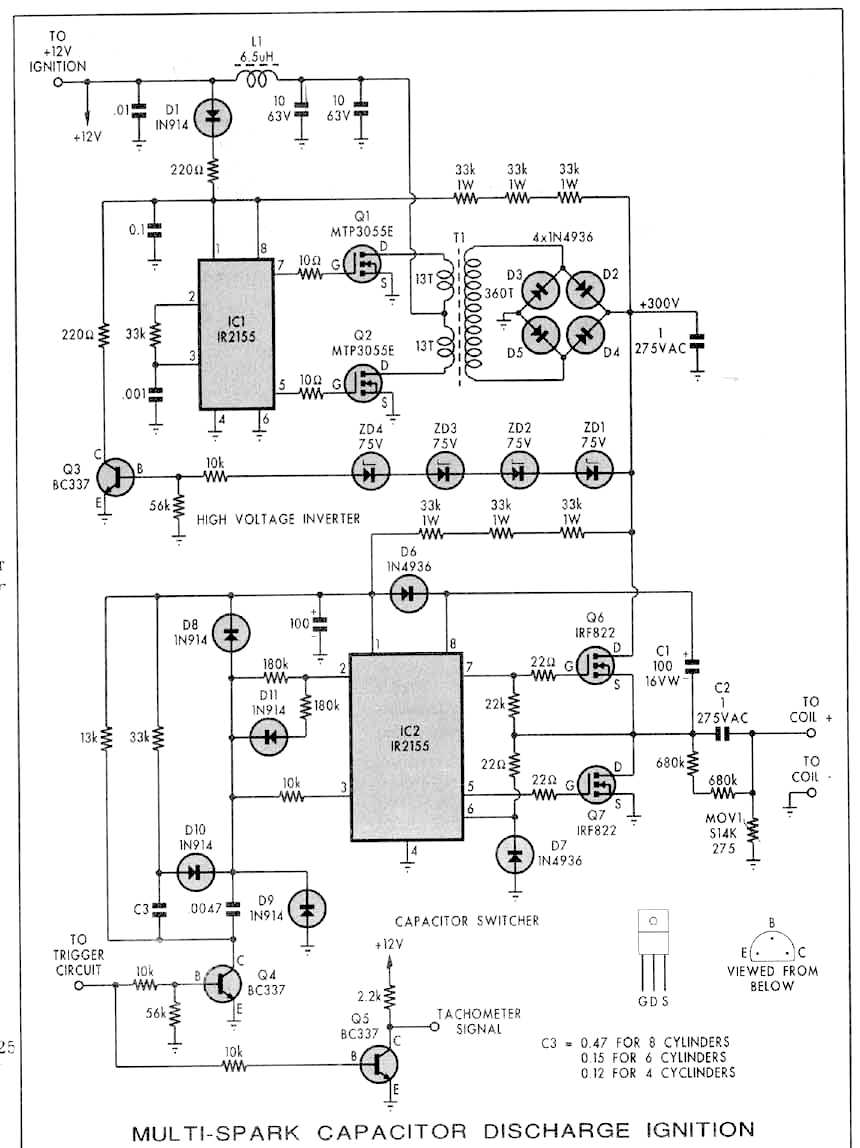
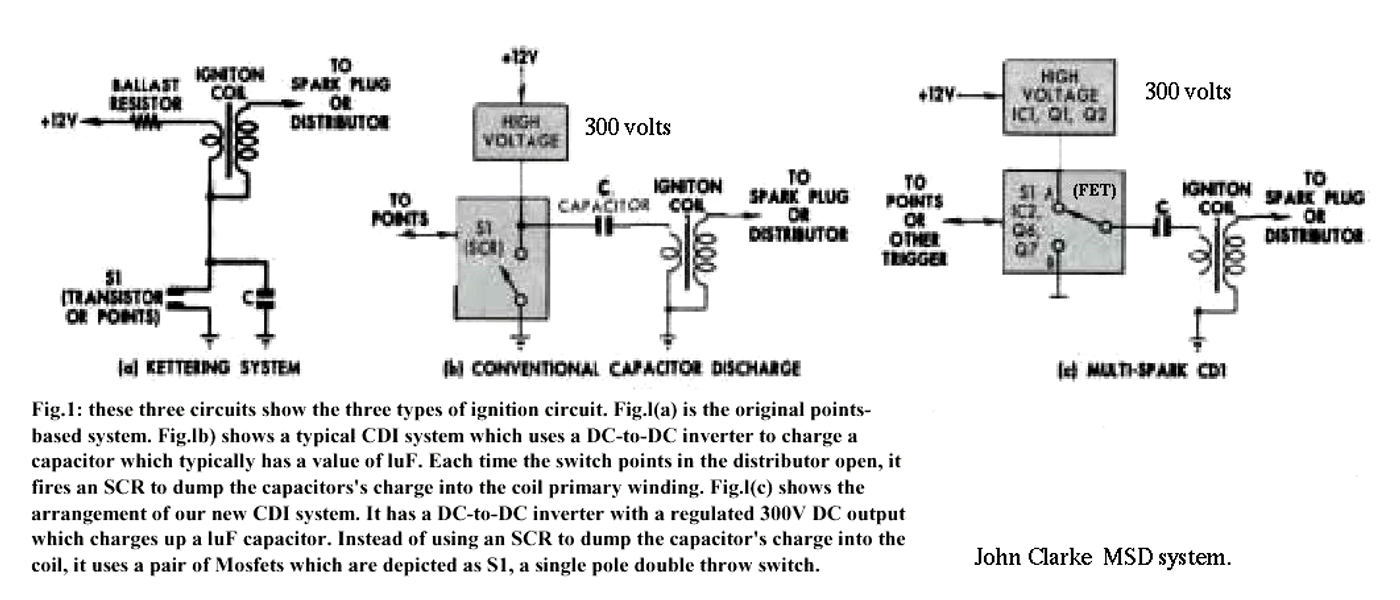
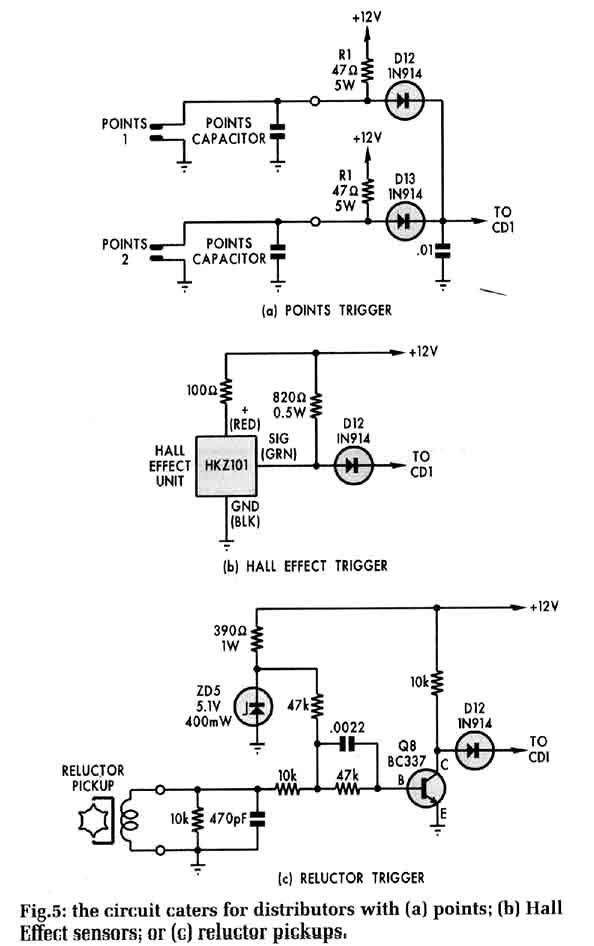
Aden Lindsay from Perth sent me this multi spark CD system
years ago and I forgot I had it. I did not pay enough attention
at the time as we were using other ignition systems. I'll dig it up out
at the hangar and set it up on the bench and test it. Claims to work
on a V8 up to 15000 RPM. What makes this work as a multi spark is
the totem pole capacitor switching circuit.
Two of these (one per rotor) ought to give us 4 sparks at up to 9000 RPM
The new style crank angle sensors will simplify the trigger circuits
shown.
Thanks Aden.
Paul Lamar
--
The Rotary Engine NewsLetter. Powered by Linux.
ACRE NL web site.
http://www.rotaryeng.net
Youtube key word UTUBPLEASE
Copyright 1998-2008 All world wide rights reserved.