I just watched the Bahrain Form 1 GP on my TVIO.
The Honda, AKA Brawn, won again. The who's who of race
car builders were in the back of the back. Brawn is running the
same Mercedes engines as Mclaren but Mclaren with Hamilton is not doing
nearly
as well. The down force is pretty much the same as they both have to run
the same stupid rear wing. They are also running the so called "super
diffuser" several other teams are also running. The Toyota's qualified first
and
second with a couple of young fearless drivers. The guys driving
the Brawn are geezers by comparison :) Apparently the Honda engineers
did their home work last years when it comes to chassis dynamics.
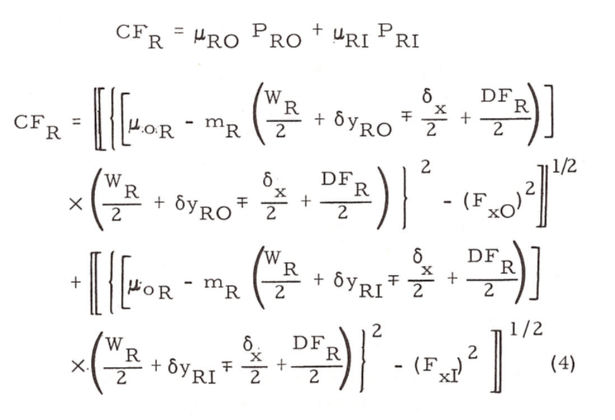
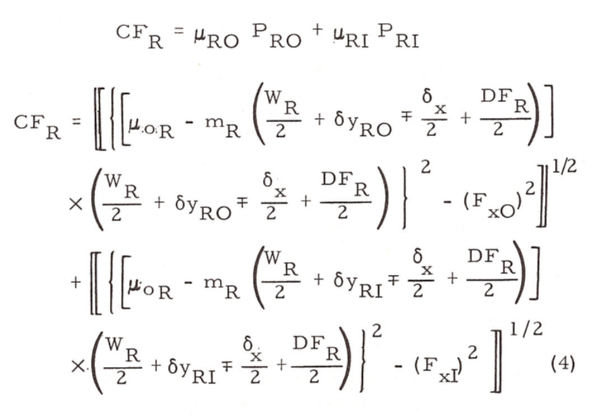
They must have read and understood my 1968 AIAA paper I uploaded to
the ACRE web site last year :)
http://www.rotaryeng.net/AIAA-Paper.pdf
This paper was republished in December 2008 by Bernoulli Aerodynamics
International.
http://www.racetechmag.com/bernoulli/index.asp
Not early soon enough to affect the Honda design.
Just to give you an idea how out to lunch some of the other F1 teams
are in this regard one team is asking for narrower front tires to improve
the balance. Shesss!
Quiz: Can anybody that has read my paper tell me why this is a bad idea? :)
Paul Lamar
With all my respect, Paul.
Why do You think that reducing front tire width in order to alter overall
balance is stupid?
BTW - in terms of downforce. With new ugly rear wing overall downforce
levels
had not been reduced as much as anticipated. This years lap times suggest
that.
One thing that BGP car is doing better than others is using their tire. Pure
speed - Toyota and RB are up there and even a bit better on single lap. But
race pace is another thing.
Cheers
Ted
Well I did not use that word in that context.
Did you read my paper?
Paul Lamar
Does it have anything to do with increased low speed
instability due to decreased tire loads?
Vlad
It's been 24 hours and nobody has figured it out so here is the answer.
One can always reduce the overall grip on the front regardless of the ratio
of front to rear tire grip. One can do this in several ways. One is increase
the roll stiffness on the front relative to the rear at low speed and/or
reduce the front down force at high speed relative to the rear. That
is obvious and trivial.
One Form 1 team is running no rear side springs this year (along with no
rear roll bar, only rear center spring and damper) in an attempt to get
all the power over steer out of the car.
That silly high mounted/high drag rear wing is causing a huge aerodynamic
induced pitch up moment on the car. That unloads the front suspension.
A simple thing to do to reduce the high speed front grip is a slight
increase in rear wing angle. That of course increases the drag.
If that is not enough move some static weight forward.
A reduction in front tire width will be an overall reduction in grip.
Paul Lamar
Hi Paul,
I've just seen your Q&A session on FT Tire width, interesting.
The current F1 slick tires needs a weight distribution of nearly 50%, with a
downforce distribution between 46% and 48% (Depending on track and driver
needs).
With the cars as they have been up until now, with 80 to 100Kg of ballast to
get to the 605Kg minimum weight, it was not that difficult to do that WD,
but with the advent of KERS, which adds an average of 30 to 40Kg, mainly in
the rear part of the cars, achieving a 49 to 50% WD is very difficult. Cars
running without the KERS (Brown, Red Bull, Williams (for now) and Toyota
(for now)) have a distinctive advantage over Ferrari, McLaren, Renault and
BMW who had the resources to develop such a system and are running it.
I agree with you that for a given car, if you have the possibility to move
weight forward to accommodate the tyres, that is what you should do and
obviously reducing FT tire capacity will make the cars go slower.
But, and here is the but, if you are given tires that need 49-50% WD but due
to the rules, engines, materials or whatever, you cannot achieve more that
45-46%, then you will never manage to heat the FT tires to be balanced with
the RR, you will not be able to move DF to the FT (Without inducing
instability) hence the understeer and under-performance.
The solution to that, to make sure the KERS cars are not at a disadvantage
to the non-KERS cars, is to reduce the FT Tire capacity, by reducing width
and spring rate. That will certainly make ALL cars slower and less dependent
in FT downforce, which in turn it may not by a bad thing for the show!!
Remember the last few years of turbo cars? In 1988 I run an F1 car with a
DFV with tires developed for the turbo cars, with RR Tires bigger and
stiffer, hence my nimble aspirated car had to run so much weight and aero to
the rear, just to be balanced, it was a joke, but never achieve the tire
temperatures that the turbo cars had, hence to be any forward than 15th was
a miracle.
So, to answer your question, yes, reducing FT tire capacity is a bad thing,
from the performance standpoint, but to 'equalize' a formula, it may well be
the way to go to get cars behaving balanced.
Regards,
Sergio
I don't think 50/50 is the optimum. If you go through the numbers
on mechanical grip alone while accelerating it is more like 40/60.
The Porsche 911 has proven that for years. 40/60 becomes near 50/50
on braking.
Do you have any tire data showing the max coef. of friction
as a function of vertical load. The slick race tire data I have shows a linear
reduction in coef. of friction with load and a circular function of
lateral traction verses longitudinal traction. What that means is to get
squirt out of the low speed corners you need more weight on the rear.
It is particularly important on high power to weight ratio race cars
like Formula 1 and CanAm.
http://www.rotaryeng.net/Road-and-Track-69a.pdf
I read the KERS is installed on the front of the engine
near the CG and it drives through the crankshaft. I don't know
where they put the batteries. The whole equation would change
if the FIA allowed the KERS to be used for 10 seconds instead of
only 6 seconds. Right now it is a performance wash. Some are
doing as well without it as others are doing with it.
Paul Lamar
--
The Rotary Engine NewsLetter. Powered by Linux.
ACRE NL web site.
http://www.rotaryeng.net
Youtube key word UTUBPLEASE
Copyright 1998-2008 All world wide rights reserved.