These guys had a booth at Sun N Fun but I can't figure
out if they are setting up a stock scam or just naive.
Swift Engineering has a track record but the Samson company
is management heavy with light weight engineering.
http://www.samsonmotorworks.com/gallery/switchblade/
The ducted fan (if it flies) is not going to give them 22 mpg
that is for sure.
Freedom motors is another Moller stock scam. As far as I can tell it
is a phantom company. Nothing produced.
Preliminary Specifications:
# Estimated MGTOW = 1360 LB (Maximum Gross Take-off Weight)
# LENGTH = 15- 6
# WIDTH = 6- 4
# HEIGHT = 4-1
# SEATS = 2
# MAXIMUM SPEED = 95 mph on wheels, 140 mph flying
# RANGE = 500 miles ground, 220 miles air
# MPG = Estimated 48 mpg ground, 22 mpg air
# WINGSPAN = 19 5 main, 6- 4 canard
# WING AREA = 88 S.F.
# WING LOADING = 16 psf
# ENGINE = 120 hp Freedom Motor twin rotor
# ESTIMATED TBO = 2500 hours (Time Between Major Overhauls)
# FUEL = regular unleaded automobile gasoline (any fuel capable)
# FUEL CAPACITY = 10.1 gallons including reserve
# STALL SPEED = 55 mph
10 gallons of fuel is not going to get you 220 miles.
With a BSFC of .5 or worse for a charge cooled rotary engine
100 HP is 50 pounds per hour or 8 gallons an hour or
1.25 hours or 125 miles at 100 MPH. Freedom motors is
probably lying to Swift about the fuel burn.
The canard span is too short so the main wing will stall first.
Apparently there is no real facility as they are not publishing a brick
and mortar address or email address. They want you to use the browser
to send them your name and address.
I hope this does not turn out to be another black eye on the rotary
engine.
Paul Lamar
I agree with everything except the comment about the canard span being
too short - causing the main wing to stall first. Whether the wing
stalls first is dependent on the CG and the lift coefficients of the
wing and canard. Then again, it really appears they were trying for a
three lifting surface aircraft - like the Piaggio Avanti - which
actually is a good machine. Ask Klaus - maybe you already did?
I wonder if the published wing area includes the canard. For
comparison, the Varieze, which is a similarly sized vehicle has a
total wing area of 66 sq-ft and a MTOW of 1050lbs. 16 lb/sq-ft is in
line with the same wing loading. The Varieze's best glide speed is up
around 90mph - pretty fast.
The ducted fan has to be one of the most poorly understood design
features.. In almost all contexts it's terrible for fuel efficiency
and top speed all else being equal. It's only use is to increase low
speed thrust from an installation which where adequate prop diameter
is very difficult to achieve due to other design constraints.
Regards,
Matt-
The angle where stall occurs is a function of the aspect ratio mostly.
http://www.grc.nasa.gov/WWW/K-12/airplane/kitedown.html
That is why Rutan uses high aspect ratio canards so they stall before
the main wing.
The aft horizontal surface will be be in the wake of the fuselage
at the angles of attack in question.
Paul Lamar
Paul,
If the CL of wing and canard were the same then your statement about aspect
ratio would be correct; but the way a stall of the aft wing is prevented is
by being sure that the canard is always operating at a higher CL; this is
done by CG positioning. In fact, it is general rule for aircraft with tandem
lifting surfaces (that is, nearly all aircraft) that the fore surface must
operate at a higher CL than the aft in order for the vehicle to be
longitudinally stable (this is a separate issue from stalling, of course).
On the sharp-edged scoop, I don't understand why people keep doing it. I'm
going to ask somebody smarter than I.
Peter Garrison
I am going to respectively disagree with this.
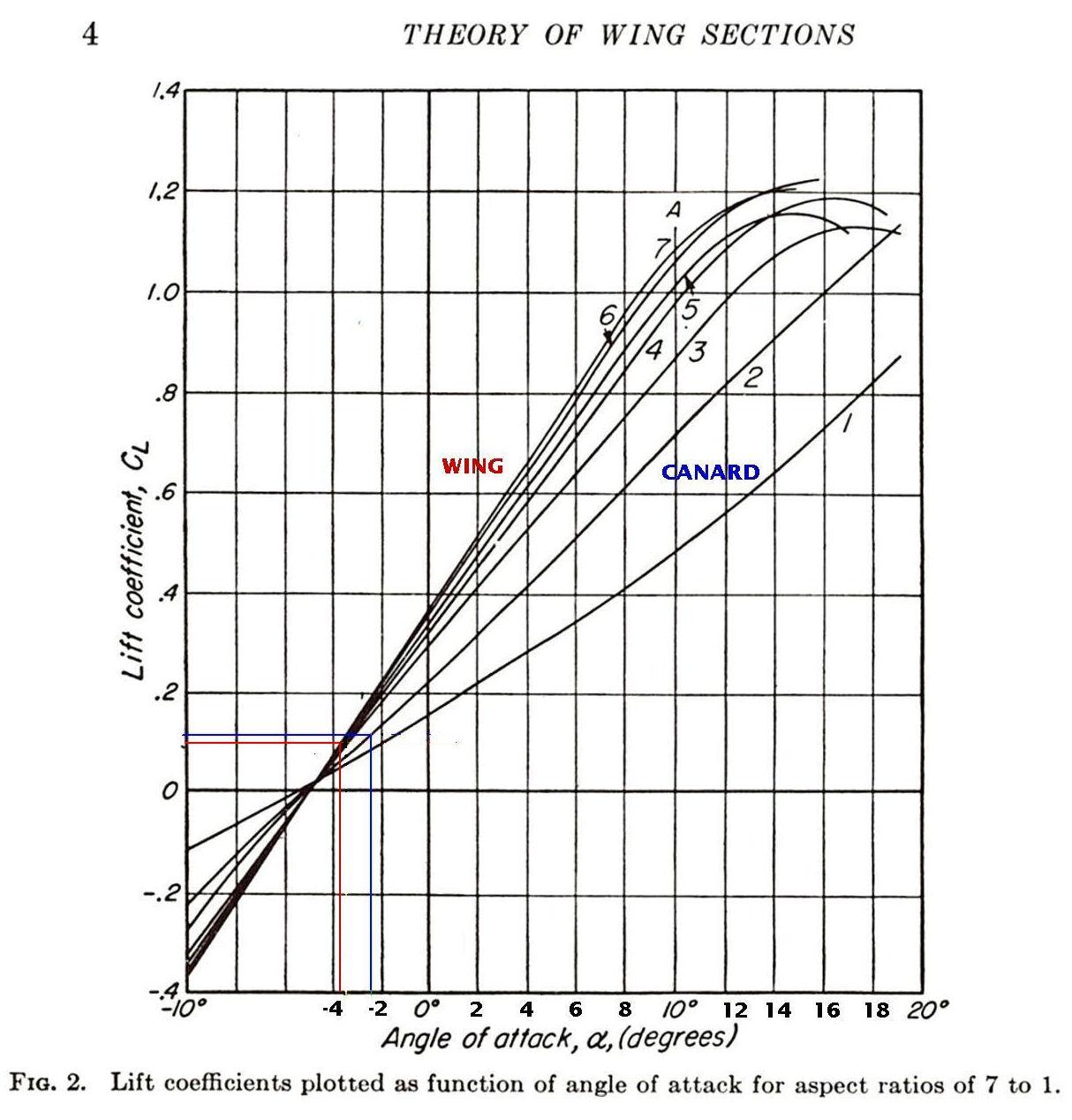
Here is a chart from Von Doenhoff.
Two surfaces, both with the same airfoil and camber.
Lets say the canard Cl was .12 (blue) and the wing Cl is .1 (red).
Lets say the wing starts out at -3.5 degrees angle of attack .
The canard starts out at -2.5 degrees angle of attack.
Therefor the canard has a one degree higher angle of
attack at cruise as well as a 20% higher coef. of lift (Cl).
The wing aspect ratio is 7 and the canard aspect ratio is 2.
When the wing stalls at 14 degrees the canard is
still a long way from stalling. It probably won't stall
until well over 20 degrees. The key is the rate of change
of Cl with angle of attack is lower for the low aspect
ratio canard. Really all one cares about is; what is
the canard is doing when the main wing stalls?
BTW This is caused by the large vortexes over the top of
the canard tips. These contain super low pressure in their
cores which acts on the top of the canard to delay the stall.
This phenomena is very pronounced on delta wings and sharp
strakes found on the leading edges of recent fighter planes.
Paul Lamar
--
The Rotary Engine NewsLetter. Powered by Linux.
ACRE NL web site.
http://www.rotaryeng.net
Youtube key word UTUBPLEASE
Copyright 1998-2008 All world wide rights reserved.