The P-port is the best way to go for rotary aircraft engines
as it is an easy and sure 250 HP at 7500 RPM take off with a simple
to make intake manifold. Low cost Holley 2 brl carb or expensive fuel
injection can be used.
I am trying to come up with a simple way of using
an O-ring for the outer p-port seal. This would be replaceable
and less prone to error than bonding the tube in place with JB-weld
or epoxy. It would also expand and contract as the relative temperature
of the Mazda rotor housing and the SS intake tube changes.
We need a flat surface perpendicular to the tube to mount the O-ring.
The goal was to use the same mill set up used for boring
the 2 inch hole for the SS tube welded to the steel rotor housing liner.
A simple mill and a lathe are all that is required to do this.
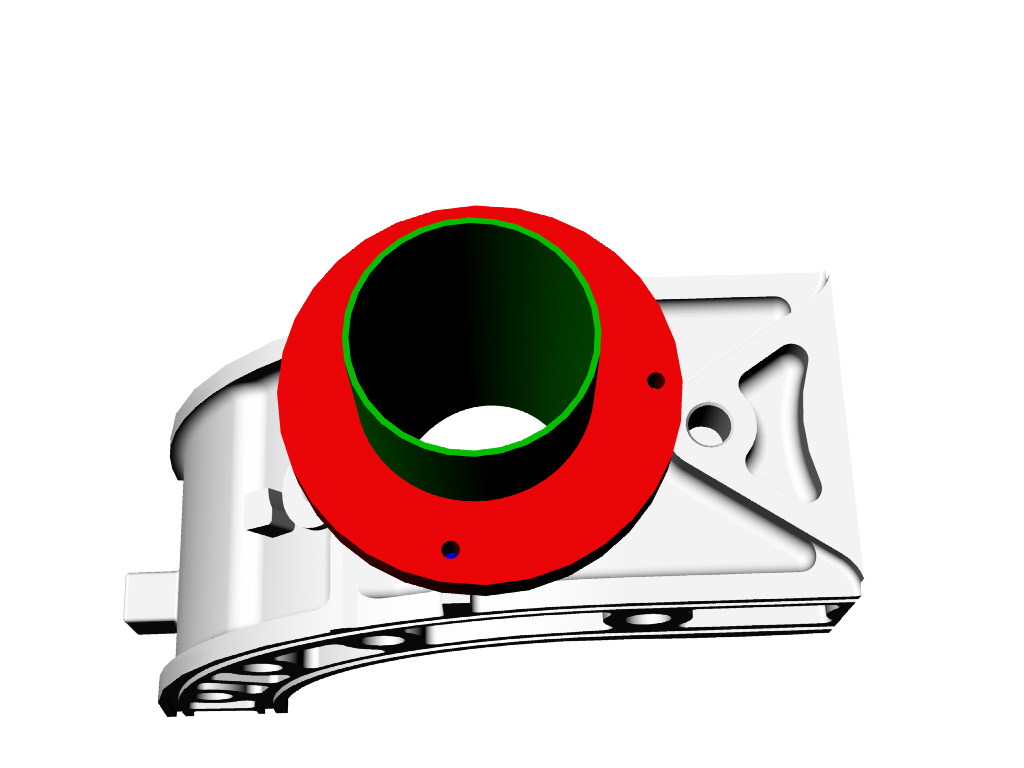
This is what I have come up with so far. A 2.5 inch diameter aluminum
cylinder will be pre machined to slip into a hole in the outer water
jacket wall. It will then be tig welded in before the final two inch
hole is bored in the rotor housing.
A flat collar will slip over the tube and be held in place by small machine
screws installed in drilled and taped holes in the rotor housing.
This collar will compress the O-ring and hold it in place
around the SS tube.
I am open to other ideas. I would like to avoid the high cost of an NC
mill and complications to make 3D surfaces to hold the O-ring.
We are currently adding Al material to a junk rotor housing using tig to see if
it warps the side sealing area. This might be the lowest cost solution
if it does not warp the housing. A lot of heat is needed to do this
however.
Paul Lamar
If the Aluminum collar is tig welded to the outside housing around
the P-Port, is it necessary to still have a stainless steel insert
and have that insert welded to the inside steel surface?
Seems to me your are accomplishing the intent - a P-Port with out
the complexity of welding and grinding a SS tube to the inside
surface. With what you are proposing a simple smoothing of the
inside surface wall is all that is needed and you still have
P-Port performance. Now you can drill and tap the flat surface
of the collar for an intake flange and you are done.
Excellent idea!
Or am I missing something?
Wade
Yes because the tig welded SS tube to the rotor housing liner forms
the inner water seal. There are two areas that need sealing.
If it were not for the inner seal coolant would leak into the
combustion chamber.
Paul Lamar
Paul,
Some observations/ideas (maybe worth nothing):
1) When it is time to replace the O-ring, will it be possible to "dig it
out" of the cavity and get all the debris out so that the replacement O-ring
will seal properly? It seems like the idea should work, but it will be good
to design in maintainabilty from the start.
2) One of the "fail safe" advantages of the rotary is that when the
coolant is lost the engine continues to produce some power for awhile.
Something to think about--in the planned arrangement, the O-ring is
providing some amount of mechanical support to the intake port tube where it
leaves the housing. Will the O-ring survive the temps of a run-dry rotor?
There may well be some accompanying vibration (including detonation or other
abnormal happenings), and it will be important to assure the intake tube is
mechanically supported so a bad situation doesn't get worse.
3) What if, instead of welding a plain tube to the inside portion of the
housing, it were possible to weld a part (flange) with female threads--or
even tap the inner portion of the rotor housing to accept the intake tube.
The intake tube would have male threads and would pass through the water
jacket, threading into this. The tube that is inserted would have a
shoulder on it that would compress a gasket against the outer housing as it
was tightened. The advantages: The tube is removable, the outer gasket is
easily serviced, the intake tube will be held rigidly in place on the inside
(threaded in place) and in tension against the outer portion of the housing.
There's by no lateral "wiggling" due to o-ring compression. The
disadvantage: I don't know if this is practical to fabricate, and it
certainly won't be as straightforward as you are doing now.
Mark Waldron
1) Yes very easy to replace the O-ring as it is in a just a corner.
2) Teflon encapsulated silicon O-rings are good to 500 F.
However the intake tubes run ice cold due to fuel evaporation.
The O-ring does not provide any mechanical support. The steel tube
is a slip fit in the rotor housing. I'll have to add a 3D for that.
3)The straight in geometry (ideal for aerodynamic reasons) is no
conducive to that approach. It is also costly in terms of machining.
The current port can be made with nothing more than a drill press
and hole saw.
--------------------------------------------------------
Here is what I have in mind for the O-ring clamp.
Paul Lamar
--
The Rotary Engine NewsLetter. Powered by Linux.
ACRE NL web site.
http://www.rotaryeng.net
Youtube key word UTUBPLEASE
Copyright 1998-2008 All world wide rights reserved.