N512SR took a jaunt around the airport under her own power for the first
time today, including a visit to the main runway to see if she wanted to let
her tail fly.
K00V was completely socked in by fog all day, and lacking any instrument
approaches or departures, we thought it was a splendid day to give it a
whirl without getting in anyone's way. After getting the exhaust system
redesigned & relocating the O2 sensor, the engine ran quite well. For the
first time, we started seeing O2 readings that responded predicatbly to
manual mixture variations. Needs some MAP adjustment at the low end, but
for the first time we were able to run smoothly above 5000 rpm. The much
smaller exhaust tube noticeably reduced engine noise, but I still wouldn't
call the engine quiet. All told, she wandered around the airport for 15
minutes or so. Max oil and water temps during this time were about 180F.
She got up to 40mph indicated on the runway, but the brakes / main gear
alignment had her moving a bit squirrely, so Terry didn't try to get the
tail up. Terry reports temps dropped while rolling down the runway. EGTs
peaked a little shy of 1200F
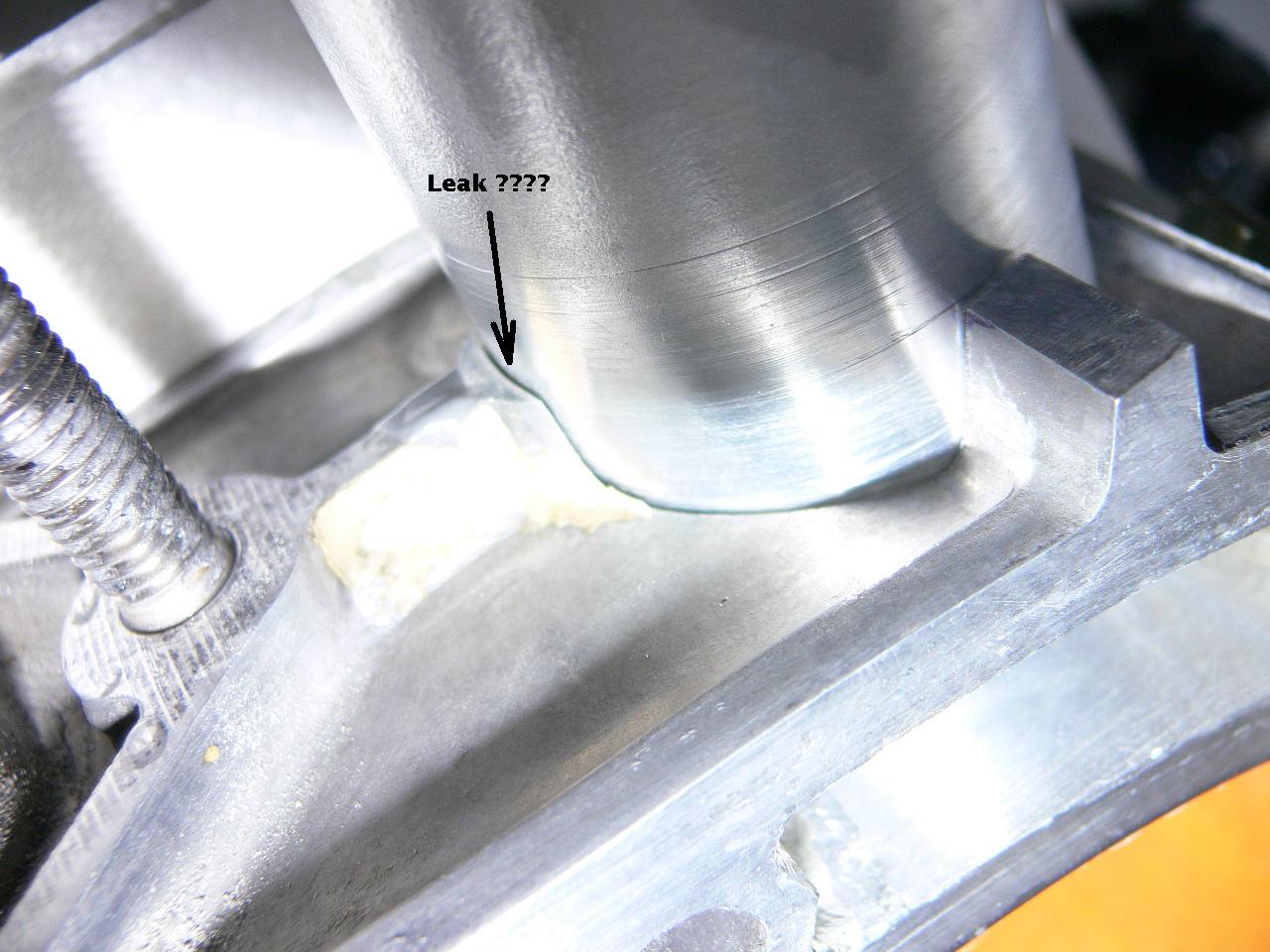
The forward pport tube is leaking steadily unfortunately. There is no
indication of leakage inside the engine (no white smoke to be seen & no
fluid ejected while hand propping) but the fluid level leading to the water
pump is dropping steadily. Looks like the fluid gets cooked off as it leaks
while the engine is running (thus no puddles or drips while running). Fluid
puddles on the top of the exhaust flange after running, indicating it leaks
even with no water pressure.
Absent the pport leak, we'd be gearing up for first flight.
Mark (Rocky Mtn High)
You will need a few things to fix the leak.
A vacuum pump,
a vacuum gage (McMaster Carr part #3935K52 For $12.30)
and some pro seal from Aircraft Spruce.
Drain the coolant.
Remove the water pump and make a plate to block
off the water pump connection to the block.
Install a fitting in the block off plate for the vacuum pump.
Install another 1/8 inch pipe fitting in the plate for a vacuum gage.
Seal all other openings to the water jacket such as the coolant
drain and the heater connection. Start the vacuum pump
and suck in some alcohol where the leak is to clean
out the passage. You should be able to hear air going
through the leak using a small hose stuck in your ear.
Keep the pump going and keep feeding in
small quantities of alcohol. The air flowing in the leak will
dry the alcohol. Stop feeding in alcohol and feed in a tiny bit of ProSeal.
Aircraft Spruce has a 2 oz kit for $17. Buy it from AC spruce to be sure
your getting the right tank sealing stuff.
http://www.aircraftspruce.com/catalog/cspages/proseal.php
BTW There seems to be a lot of confusion out
there about Pro-Seal. It appears several companies are using the name.
I think this is the right company. It is used to seal fuel
tanks and it stays flexible.
http://www.bergdahl.com/PRC_ByTheNumber.htm
Listen to the leak and check the vacuum gage. The vacuum reading
should increase. (Higher vacuum, lower absolute pressure)
Shut off the pump and wait 24 hours. Turn on
the pump and check for the leak again. Listen with a tube stuck in
your ear. If it is still leaking repeat another application of a tiny
amount of Pro seal with the pump going. When it appears to be sealed.
Remove the vac gage and pressurize the block to 50 psi using a tubeless tire
valve mounted in the pump block off plate and see if it
holds the pressure over night.
Vacuum pumps can be borrowed or rented from HVAC shops. They all have
them. They are used to dehydrate AC systems.
http://www.robinair.com/acsolutions/acvacuum/acvacuum.php
http://www.climatedoctors.com/items/item.aspx?itemid=429924
Paul Lamar
--
The Rotary Engine NewsLetter. Powered by Linux.
ACRE NL web site.
http://www.rotaryeng.net
Youtube key word UTUBPLEASE
Copyright 1998-2008 All world wide rights reserved.