For certain cowlings this 180 degree tuned manifold might fit
better. It is more compact. It is based on a 3 inch center line radius 180 degree
2" tubing bend. the center line distance is 6 X 3.1416 or 18.8 inches.
We need 24 so this comes out about right.
It is easier to make as there are fewer
tig welds than the front mounted configuration.
It is also really trick looking :)
Paul Lamar
Looks nice.. What about having a very short "block hugger" style
intake manifold to the carb for better packaging and then a
plenum + long tube combo to give the needed length?
Vlad
It is possible that might work but the origin of the pulse that
energizes the intake manifold takes place right at the port.
I suspect that moving the carb near the port may seriously
affect the tuned system. I have not tried it however. For the
same reason you don't want to put the venturi and the butterfly
throttle somewhere in the middle of the runners. When the slide
throttle on the other hand is wide open for take off and for high altitude
cruise so it has no effect..
Paul Lamar
I see your point, however, I'm going to play devil's advocate. Looking at
the relatively short runner length on domestic v8 intake manifolds, one
could easily craft a tubular intake manifold for the rotary that is the same
length or more likely longer and still have it be very "block hugger" -ish.
Given that many producers like Edelbrock, Dart, World Products, Weiand are
producing intake manifolds of such a short length, tuning the carburetor
must not be a problem. Now take a short runner style manifold and attach a
plenum with long tubes that lead to a filter such as those produced by
Spectre and you 'could' potentially offset the power band short manifold
back to a more desired rpm. While comparing a domestic v8 to a rotary is an
apples to oranges exercise, you get the idea. Just adding fuel to the fire.
Vlad
Those V8 spider manifolds are old tech. New V8's use long runners.
A piston engine cylinder fires half as often as as rotor and the intake
time is only about 90 degrees compared to about 270 degrees for the
rotary so the optimum lenght of the intake pipe is different. Probably close
to twice as long at the same RPM Like the Dodge ram charge. I see a few
properly tuned V8's these days.. The new LSx Chevy engines have the runners
wrapped up in the lifter valley.
Paul Lamar
Old tech they may be, but that's the name of the game when it comes to
carbs. The point is that no matter how old the design and technology, they
work.. They worked back when they were state of the art and still do today,
otherwise, no one would produce them. I would agree that mounting the carbs
as far away from exhaust is good for both efficiency and safety, however,
you also have to consider how you're going to route carb heat.
Vlad
Silly me, I forgot where I had seen this whole "shorty/block hugger" intake
manifold. Racing Beat made them for older SA22 RX7's. Here is a link of what
I mean:
http://www.mazdatrix.com/r-holley.htm or
http://www.racingbeat.com/FRmazda1.htm under "Holley Intake Kit." Seems like
it worked for them. Just use a kit like that with an added plenum to lower
the power band.
Vlad
Those are side port manifolds. They work but are totally unsuitable
for our A/C needs IMHO. P-ports have 20% more power across the board. I think
Steve Beckham, Carry, Richard Sohn, several other people on here that have
built and dynoed p-port engines and Power Sport may agree with me. Since the
pumping losses are higher they will probably burn more fuel in the process
all other things being equal.
I am done doing R&D on intake systems so good luck. I basically copied
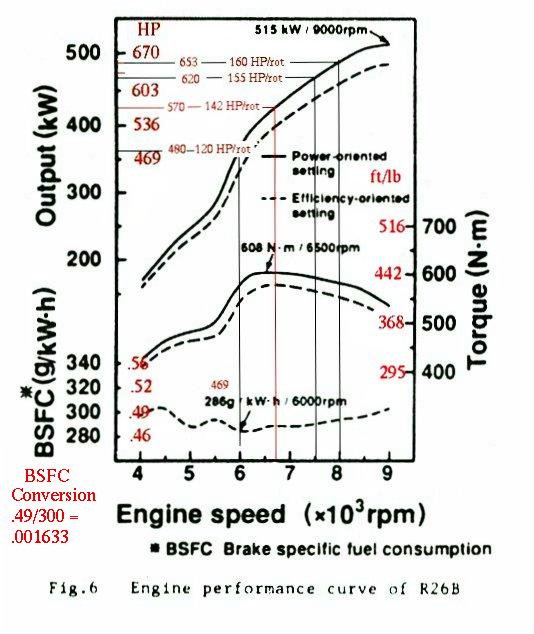
the Mazda Lemans p-port engine as they have achieved more HP per rotor and spent more
money in the process than anyone else. Particularly at 7500 RPM where we need
it.
Please put it on a dyno and tell us what you find out.
Paul Lamar
--
The Rotary Engine NewsLetter. Powered by Linux.
ACRE NL web site.
http://www.rotaryeng.net
Youtube key word UTUBPLEASE
Copyright 1998-2008 All world wide rights reserved.