OK I finally got caught up on all my back email and had time to take
a closer look at the megabytes of data we got running up Mark's
P-port engine hooked up to the data acq. The main purpose of the trip
was to figure out why the p-port engine was running so poorly on Tracy's
EFI system.
We discovered this problem early on when we had Mark's p-port engine
on the Mazdatrix dyno with Tracy's EFI system. I gave up trying to tune
Tracy's system because of the cost per day of the dyno. We slapped a Weber
51 mm on there and Dave Lemon and John had the p-port engine running fine
in about 5 minutes. It generated over 240 HP at 7500 RPM as I recall. That
just delayed the Tracy EFI p-port tuning problem until it came time for Mark
to tune his P-port engine with a prop load. He is still not there as the prop he
has is too narrow and is not loading down the engine enough.
I suspected it had something to do with where we were sampling
the intake manifold pressure. I had the bright idea before I left for
Denver to make some pressure taps to screw into the unused oil injector
ports in the rotor housing. I used a couple of 10 mm .125 thread metric
bolts I had lying around. I used short pieces of aluminum tubing to act
as a seal. That turned out to be the hot tip when using
Tracy's EFI system with p-ports.
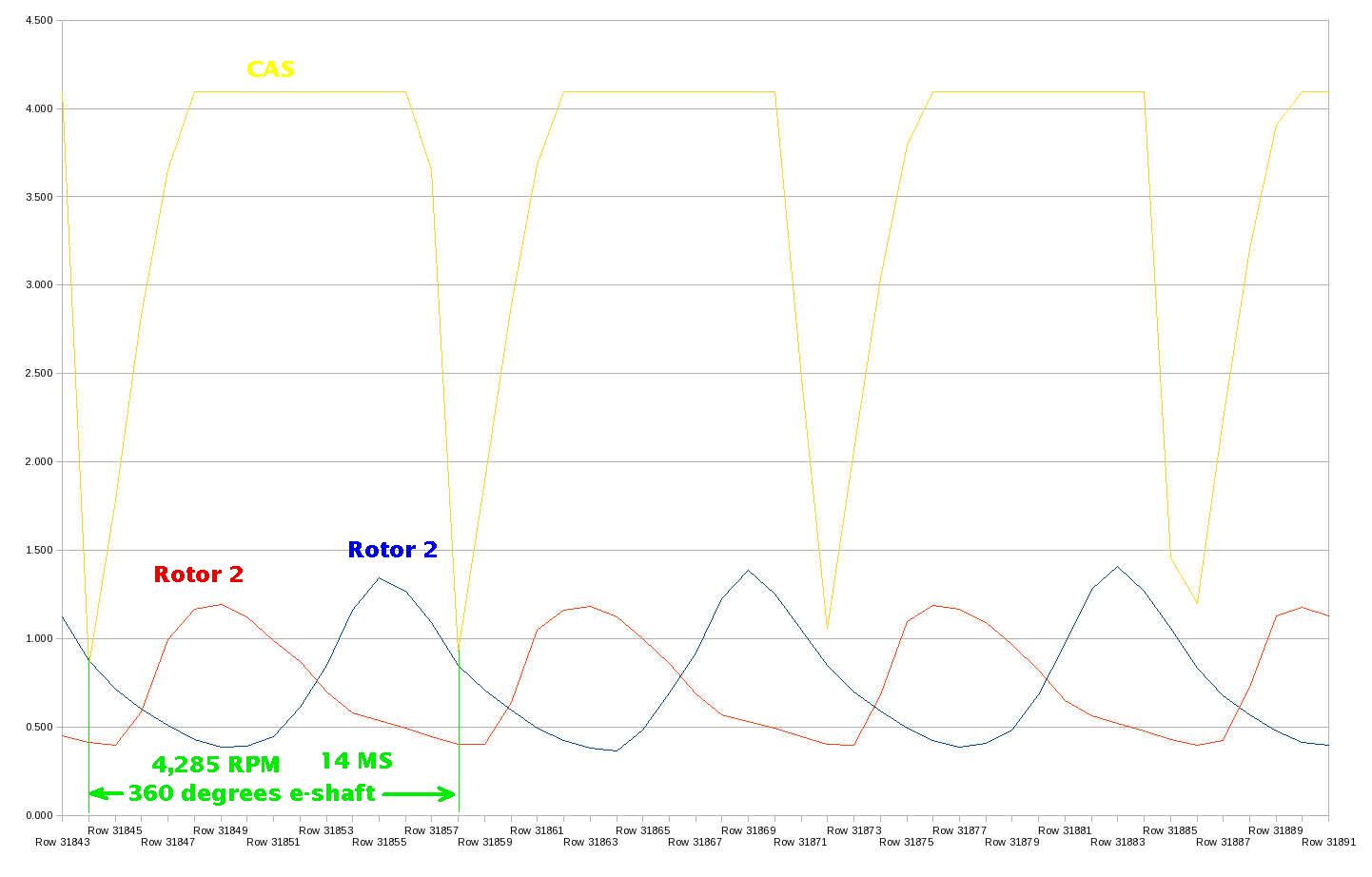
We ran one test with the engine running off the rotor housing taps while
taking data on the tubing taps. We did this because the engine ran ten
times better running off the R-housing taps than it did running off the
tubing taps but we wanted to see what the air was doing inside the tuned
runners anyway. What the pressure waves looked like. That is called
final-run-plot.jpg.
The position of the waves relative to each other determines the HP the engine
is going to generate at that RPM. This changes with changing RPM's.
The optimum position of the pressure peaks appears to be around bottom
dead center of the e-shaft. What we still don't
know is where or when Tracy samples the data. If we can smooth this
data then where or when Tracy samples the data does not matter
nearly as much.
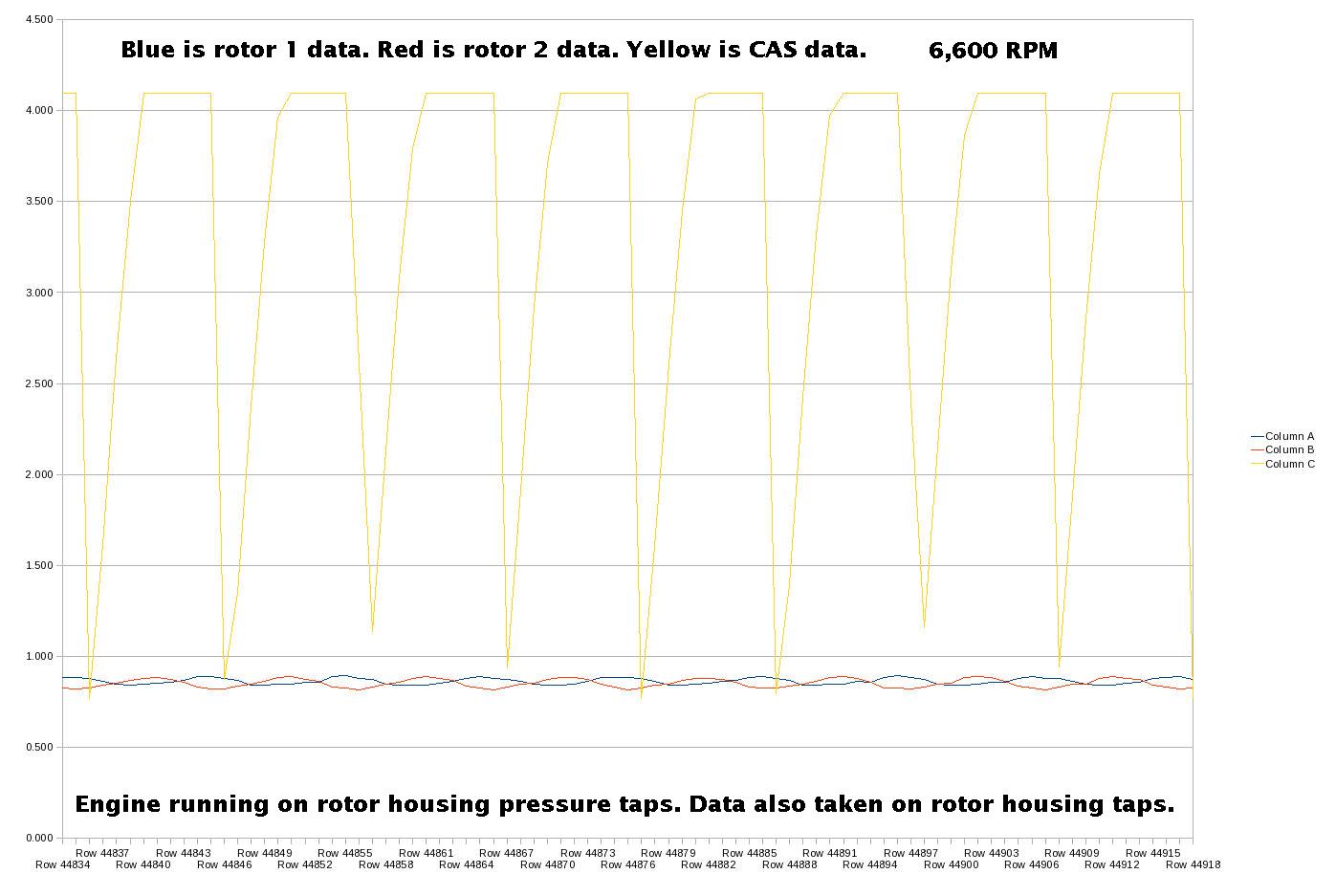
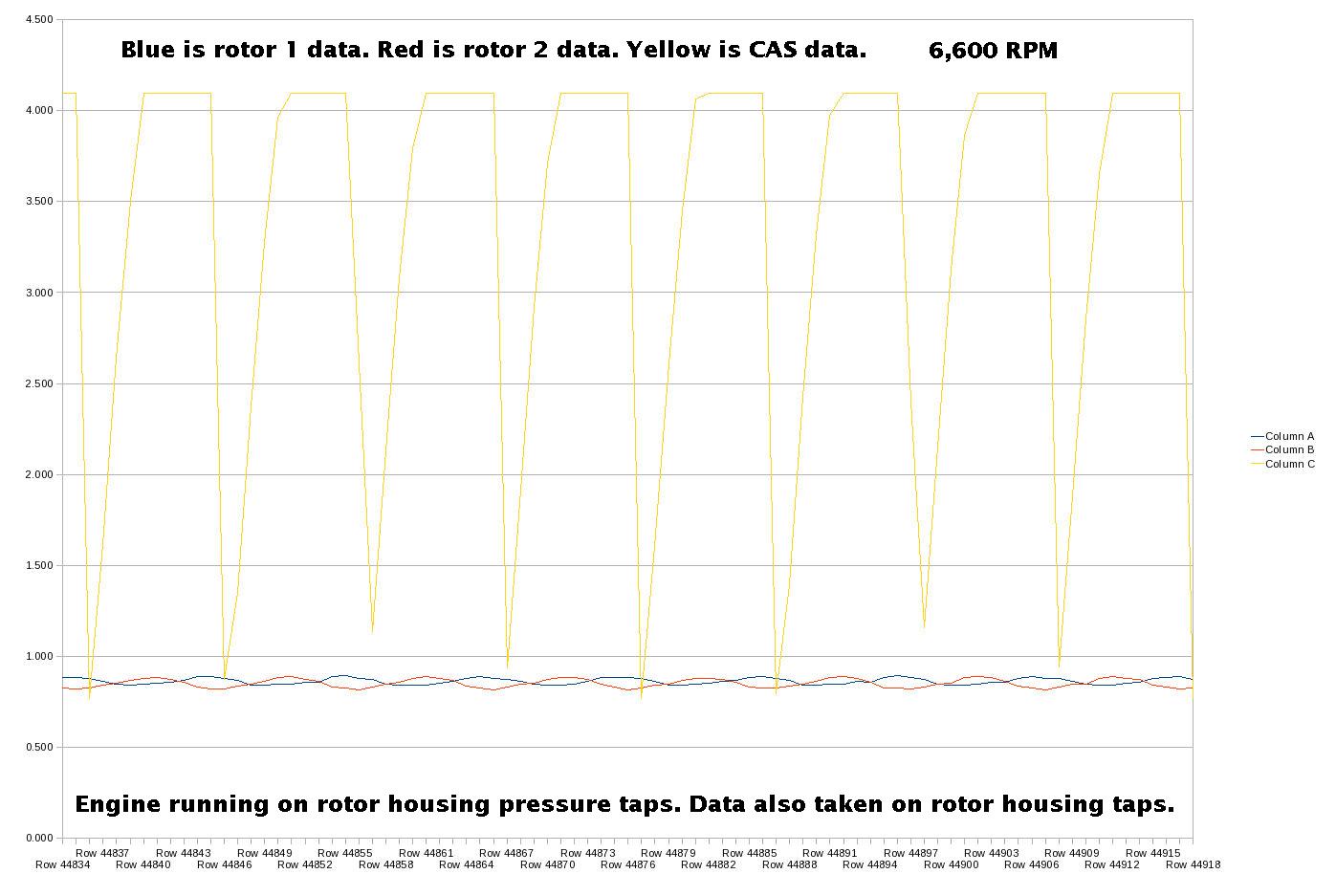
We ran another test with the engine running off the rotor housing taps
while taking data off the same taps. That is called 12a-plot.jpg.
As you can see the data is much smoother causing the P-port engine to run
much much better. Both of these plots were run at 6,600 RPM. About as fast
as we could get the engine to run at 6800 feet altitude and static RPM.
As you can see the small .070 diameter hole in the rotor housing
pressure taps did the trick to smooth the data. Any time you have air
flowing back and fourth through a small hole on a regular basis the hole
will tend to average the pressure. We did not have time
or the lathe to try an even smaller hole but it looks like a smaller
hole may improve the running even more. IMHO a .050 hole is worth a try.
The next step is draw up the rotor housing pressure taps and get some
made for those people that want to run Tracy's EFI system on high power
P-port engines.
The question is why do we need 250 HP? The answer is why not if it
does not add to the weight of the engine, the cost or burn more fuel at
the same HP as a 200 max HP engine. What this does is make the
Mazda rotary engine more attractive to home builders. If you have 250 HP
at sea level you will have 200 HP at 8500 feet so you can go faster
where the aerodynamic drag is lower. If you have only 200 HP at sea level you
will only have 160 HP at 8500 feet.
Paul Lamar
Paul,
Great work. Thanks. Granted the data snapshot is very small but don't
the different pressure wave forms indicate rotor 1 is not getting enough
air flow? Could perhaps the plenum be too small causing the majority
of the flow to go to one rotor 2? Rotor 1's MAP curve is more like a
sine wave while rotor #2 looks close to what has been seen in Mazda's
P- port testing. I take this data was at WOT and 6,000 rpm. Can you
show us data at lower rpms, say 4,000?
Doug in Japan
The difference in the amplitude of the front and rear rotor waves is somewhat of
a mystery at the moment. It could be the way the pressure tap hole was machined
in the runner tube. They were hand drilled. If it is not perpendicular you
could get some strange effects.
----------------------------------------------------------
Here is a plot at 4200 as well Doug.
Paul Lamar
--
The Rotary Engine NewsLetter. Powered by Linux.
ACRE NL web site.
http://www.rotaryeng.net
Youtube key word UTUBPLEASE
Copyright 1998-2008 All world wide rights reserved.