Paul,
Is this engine for real. The video claims it won an award.
http://www.youtube.com/watch?v=_MBYg1NPzMY&feature=related
Doug in Japan
No of course not :)
-------- Original Message --------
Subject: The MYT Engine
Date: Thu, 24 Apr 2008 17:12:15 -0700
From: Rotary Engine <
rotaryeng@earthlink.net
Paul & Group;
What do you think about this Engine?....Is this for real?
Thanks,
Steve
http://www.youtube.com/watch?v=u_pLQQDzStg
That is nothing new. That is called a scissor engine
and it has been around since at least 1925 maybe earlier.
Norbye mentions it in his classic book "The Wankel Engine"
published in 1971. Page 505
Its not a rotary engine. It is scissor, AKA cat and mouse engine,
AKA Tschudi, AKA Kauertz invented years ago. It has a snow balls chance
in hell of succeeding. It meets almost none of these criteria.
There are a zillion of these things on youtube.
The vast majority of the inventors do not have a clue. Felix
spent a lifetime on the Wankel and Mazda and others have spent
billions perfecting it. Mazda has sold two million.
None of these engines have a snow ball's chance in ****
of ever making it into to production.
By Kenichi Yamamoto from his book "Rotary Engine" 1981
1.3 REQUIREMENTS FOR A PRACTICAL ROTARY ENGINE
Although various types of rotary engines have been
developed to date, there are few that do not qualify as internal
combustion engines or do not qualify as a practical engine even
if they satisfy the qualifications of an internal combustion
engine.
The requirements for a rotary engine to be qualified
as a practical internal combustion engine can be summed up in
the following five items. The practicality of various ideas on
rotary engines can be judged by evaluating them by these
criteria:
(1) Every moving part, including the timing mechanism, should
make a rotating motion. A mechanism having a reciprocating
inertia will increase mechanical noise and vibration, and will
work against high speed and high revolution. [In addition
mechanisms that reciprocate generate reversing loads. Reversing
loads lead to reversing stresses. Reversing stresses lead to
metal fatigue and limited life. The Wankel rotary engine has no
reversing stresses therefor the life of the major parts such as the
eccentric shaft and rotor are unlimited unlike, crankshafts, connecting
rods, pistons and poppet valves. Paul Lamar] Accordingly, structures
that require intake and exhaust valves and mechanisms using the rotors
oscillatory motion are not desirable.
(2) Gas seals or the working chamber should be three
dimensionally reliable. The gas seal mechanism of a rotary
engine should be constituted by connecting the individual seals
three dimensionally. Among the many ideas we come across are
those that don't show such three dimensional thoughts.
(3) Appropriate gas exchange of intake and exhaust should
take place. Together with having a mechanism that can correctly
open and close the ports, sufficient time for intake and exhaust
should be provided especially for high speed and high
revolution. Among the ideas on rotary engines, there are some
that ignore this point.
(4) Every component part should have the strength to endure
high speed and high pressure. As the component parts are
exposed to high pressure, high sliding velocity and high heat
load, every part should have sufficient allowance in size and in
shape.
(5) Sufficient cooling and lubrication should be provided.
In order to qualify as an internal combustion engine, although
this is related to above (4), durability against high heat load,
high sliding velocity, etc. are required. Therefore, the
structure should be simple, and the ideas on rotor cooling,
lubrication of seal parts, and oil seal structure should be
those that are given adequate thought.
Also, it is desirable for a practical rotary engine to
have a simple and compact structure. When we evaluate the
various type's of rotary engines devised to date in view of the
above mentioned requirements, the NSU Wankel type rotary engine
is the engine that best satisfies the above mentioned
requirements.
------------------------------------------
Indeed, nothing new under the sun :
http://www.dself.dsl.pipex.com/MUSEUM/POWER/unusualICeng/cat&mouse/cat&mouse.htm
For a large overview see :
http://www.dself.dsl.pipex.com/MUSEUM/POWER/unusualICeng/unusualICeng.htm
Randolph Toom
Managing Director
heat2power
Paul,
Yes the engine is based on an old idea but in fairness to the designer it
is not a scissor as it doesn't oscillate. It is probably closer to a
cat and mouse based design but instead of using wedges the inventor
created a tubular pump chamber where circular curved pistons pucks are
mounted on posts, alternatively on two parallel discs. The discs of
course are surfaced to conform to the tubular combustion chamber and
together, present several sliding faces to have to seal. These sliding
faces are not as difficult to seal as one would imagine at a constant
temperature but if used for an engine the design would have accommodate
thermal expansion. Probably why it has only run on air to date. Perhaps
hot air:)
I can't comment on the snowball chance in hell remark because I can
remember in my youth someone saying the exact same thing about the
Wankel engine. NASA has awarded worse and dropped better ideas.
Doug in Japan
Not a rotary engine
Looks like the Bradshaw Omega engine: 1955.
http://www.dself.dsl.pipex.com/MUSEUM/POWER/unusualICeng/toroidalIC/toroidalIC.htm
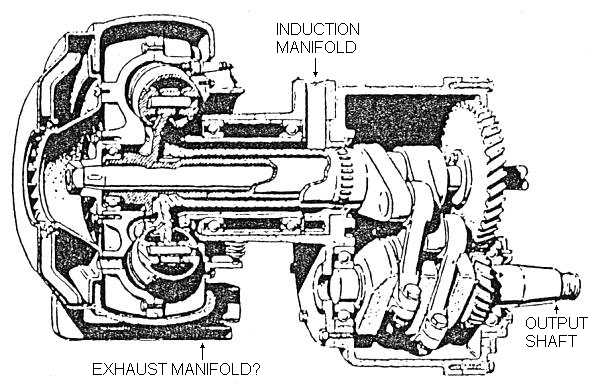
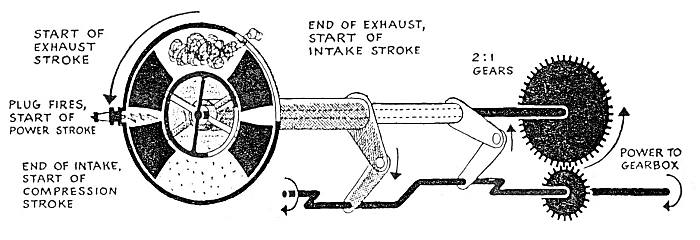
The Bradshaw engine had a single toroidal cylinder, containing
four double-ended curved pistons. The pistons reciprocated in
pairs, while the cylinder rotated around them, carrying around
the spark plug and inlet/exhaust ports.
The cylinder was rotated by the central shaft while
the cranks that reciprocated the pistons were driven
by the output shaft, running at half the cylinder speed.
Paul
Close but no cigar. The current version rotates the pistons past air
ports in the housing.
The inventor is making claims of combustion pressures far exceeding the
diesel engines however. Mechanical stresses incurred with sudden
acceleration and more importantly waste heat issues are issues not
addressed in their presentations.
Felix really did his homework in designing our engine of choice and it is
still evolving.
Doug in Japan
So does the Bradshaw. It is piston ported. See the attached pictures.
The cat and mouse engines use the scissor mechanism to make them chase
each other. In that regard it is no different than a rod and crank.
Read the complete web site.
http://www.dself.dsl.pipex.com/MUSEUM/POWER/unusualICeng/toroidalIC/toroidalIC.htm
Were you able to see the attached photos with your Mac? Robin keeps sending me
photos with the Mac and I have to open them manually. My FireFox browser
is set to open photos automatically and it works with all photos
sent by Linux and Windoze. There is something wrong with the Mac
in this regard IMHO.
Paul Lamar
--
The Rotary Engine NewsLetter. Powered by Linux.
ACRE NL web site.
http://www.rotaryeng.net
Youtube key word UTUBPLEASE
Copyright 1998-2008 All world wide rights reserved.