I have decided to do away with the ABS and crank angle type
magnetic inductive sensors as too expensive and too big. I would have
trouble
clearing the water pumps. Klaus has been using hall effect sensors
for years so I am going to copy him. They are cheap at less than
2 bucks each and we need ten. It will only require one small rotating
magnet to trigger the ten sensors. The sensors can be placed
much closer together so the diameter of the trigger system
can be reduced and fit below the water pump.
Klaus's system fits on the prop shaft so it must be much
larger than necessary compared to our e-shaft pulley.
Here are some graphics on the ABS sensor type and the hall data
sheets.
I have lots of experience using optical sensors. They work well and are
cheap and easy to use but they are way too prone to dust and grease.
----------------------------------------------------------
This is the one I am going to try. I ordered
a couple from Digikey. The price went up to $6 each but
that beats $16 each for ABS sensor since we need ten.
If it works and I buy more than the price will go down.
We don't have a lot of choice in the matter as the trigger
mechanism will be limited in diameter due to the
proximity of the water pump. These things are tiny so
the circuit board will be small and light weight.
If anybody has any experience using hall effects sensors I would like
to hear about it. Klaus has been using them for quite awhile
so I will also talk to him when I get a chance.
I am worried about the end play on the e-shaft but the Lycoming engine
also has end play. I'll check all that out on the bench.
Paul Lamar
Paul,
The Lycomings end play might be a problem, but I doubt that
the Mazda e-shaft end play would be a problem. The O-200
rebuild video I watched had be chuckling because they
said up to .10 inches was "acceptable"! I don't think my
20B has more than .020 inches if that. Too bad motorcycle
parts are so expensive,several Kawasakis use them for
engine timing. They are small too because they have to
fit inside a motorcycle case.
Bill Jepson
Seems like the end play is only critical with one orientation of the
sensor.. On my O-200 with an early LSE ignition, the trigger bolt is
oriented radially and the sensors are mounted outside of that. End
play has essentially no effect because the sensor's response are is
relatively large in this axis. If there were significant run out,
there might be a problem..
Matt-
Sounds like you may have one of Klaus's earlier inductive trigger systems.
Are there any rotating magnets
Can you take a pictures and send it to me
Paul Lamar
No magnets.
Regardless, it seems that the triggering device and the sensor could
be oriented so that a small amount of end play won't cause problems.
Klaus' hall effect sensors are mounted where the magnetos are normally
installed. I believe they require the use of a mag gear to make them
work (on Continental or Lycoming)..
Matt-
The problem is we need a round flat circuit board to locate the sensors.
This board will face the front e-shaft pulley with the magnet
mounted on it. Sort of a face to face arrangement. Therefor the
magnet could change it's distance to the sensor with e-shaft end play
so the flux could change as well. Not a good thing.
I'll see when I set it up on the bench.
Paul Lamar
Paul,
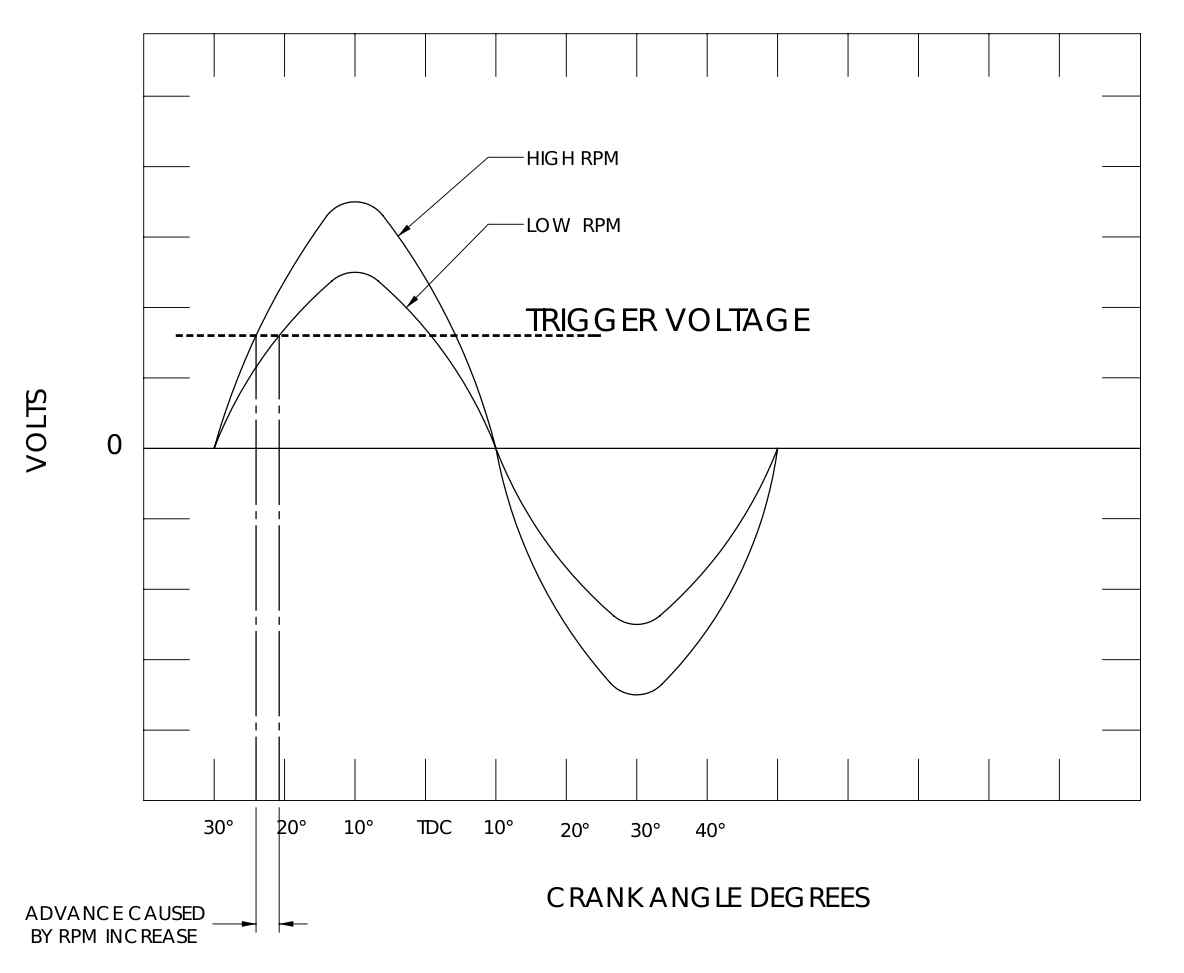
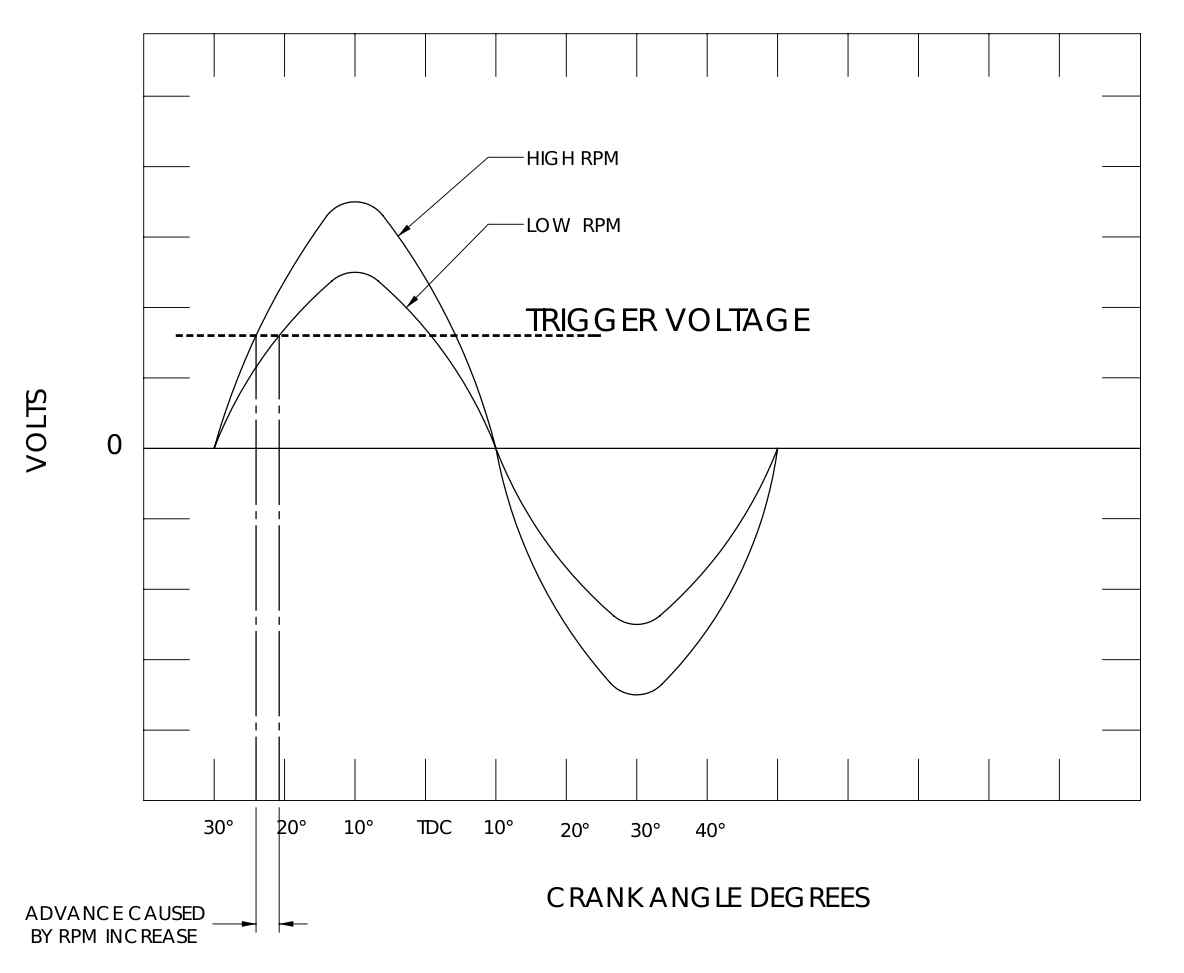
The way most engines get around the end play problem is to set the
Hall effect sensor so the control transistor gets triggered on
the leading edge of the sine wave created by the magnet. The trigger
transistor has to have a trigger voltage well below the maximum
voltage created by the magnet passing the sensor. I believe a
thyristor is used. I am not an EE so this is how the use of the
Hall effect sensor was explained to me. I have made a small graph
to show how the set-up was done relatively speaking. The graph
also shows how you can get advance from the system with no moving parts.
Bill Jepson
That is interesting Bill and it will certainly work.
However I don't think advance is directly tied to RPM
for a prop load. I could be wrong. I would rather control
the advance manually. In other words I don't know what rate of
advance is required if even linear and it would take some
expensive time on a dyno to find out. I am sure the motor cycle
guys had unlimited resources to develop this. I also think the
aircraft engine commonly fixed advance is probably OK as the
power does not have to be optimized over a wide range such
as found in motor cycle or car use.
It is a good idea and thanks for sharing it. I will file
it away for future use if needed.
Paul Lamar
--
The Rotary Engine NewsLetter. Powered by Linux.
ACRE NL web site.
http://www.rotaryeng.net
Youtube key word UTUBPLEASE
Copyright 1998-2009 All world wide rights reserved.