I have decided to do away with the ABS and crank angle type
magnetic inductive sensors as too expensive and too big. I
would have trouble clearing the water pumps. Klaus has been
using hall effect sensors for years so I am going to copy him.
They are cheap at less than 2 bucks each and we need ten. It
will only require one small rotating magnet to trigger the ten
sensors. The sensors can be placed much closer together so the
diameter of the trigger system can be reduced and fit below the
water pump.
Klaus's system fits on the prop shaft so it must be much larger
than necessary compared to our e-shaft pulley.
Here are some graphics on the ABS sensor type and the hall data
sheets.
I have lots of experience using optical sensors. They work
well and are cheap and easy to use but they are way too prone
to dust and grea
----------------------------------------------------------
This is the one I am going to try. I ordered a couple from
Digikey. The price went up to $6 each but that beats $16 each
for ABS sensor since we need ten. If it works and I buy more
than the price will go down. We don't have a lot of choice in
the matter as the trigger mechanism will be limited in diameter
due to the proximity of the water pump. These things are tiny
so the circuit board will be small and light weight.
If anybody has any experience using hall effects sensors I
would like to hear about it. Klaus has been using them for
quite awhile so I will also talk to him when I get a chance.
I am worried about the end play on the e-shaft but the Lycoming
engine also has end play. I'll check all that out on the bench.
Paul Lamar
Paul, I have looked over the data sheet and app notes for the sensor
you have chosen. You picked an excellent candidate, in that it is a
digital output type sensor, so the sine wave graph that was
posted is not applicable to this type of device.
I believe that temperature will be more of an issue with
stability and repetability than end play. Particularly
if you go with a high flux magnet rare earth magnet for
the trigger. The same company that you suggested for pole
pieces has some good candidates.
http://www.kjmagnetics.com/proddetail.aspprod=D11
C. Smith
I wonder if the 'cleaned up' signal is all that accurate with varying
end play. If all they do is run the signal through a comparator, the
output will look good, but the accuracy may not be all that good
depending on RPM and end play..
Matt-
They do more than that.
An amp and a schmidt trigger probably.
We will find out on the bench.
Paul Lamar
How will you check absolute accuracy I guess if you have two sensors
at the same angle, one of them with a fixed clearance and one with a
variable clearance you can compare the signal (delta-t on the o-scope)
to see if varying the clearance changes the timing angle. Not sure
how to check timing vs. RPM..
Matt-
Well as long as it is consistent from rotation to rotation
one can rotate the Hall effect PC board to adjust the exact
timing.
Paul Lamar
Matt you can check timing vs. RPM easily with an old fashioned
timing light. (strobe) BTW Paul, one of the tricks we used on
the old Kawasakis was to set initial timing and get the engine
running and then slowly increase the gap on the Hall effect
sensor until the engine would just run reliably at idle. The
longer gap moved the trigger voltage up towards the top of the
sine curve.You can see that you could get more advance that way
and on the motorcycles better acceleration. There really isn't a
need for that on an aircraft engine though. One thing that
advance usually helps though is running better with a lean
mixture, so we may actually want some advance. The engine would
run fine without it though.
Bill Jepson
If Paul is using the honeywell SS443A digital output sensor, there would
have to be some end play much greater than .020 to cause the sensor to creep.
If you look at the operate and release chart, there is a solid band of
operation between 110 and 155 gauss across it's entire temperature range.
Advance creep begins @ 25c, from 110gauss down to about 65 Gauss @ 150c.
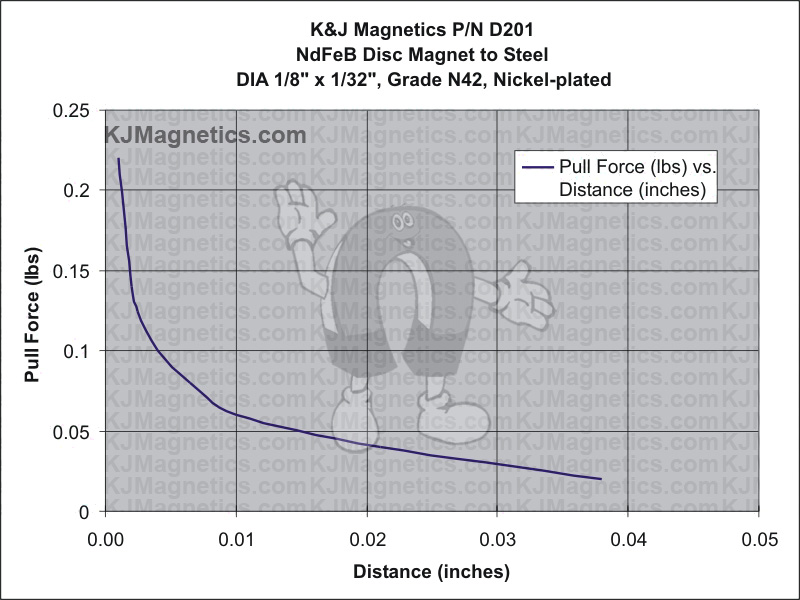
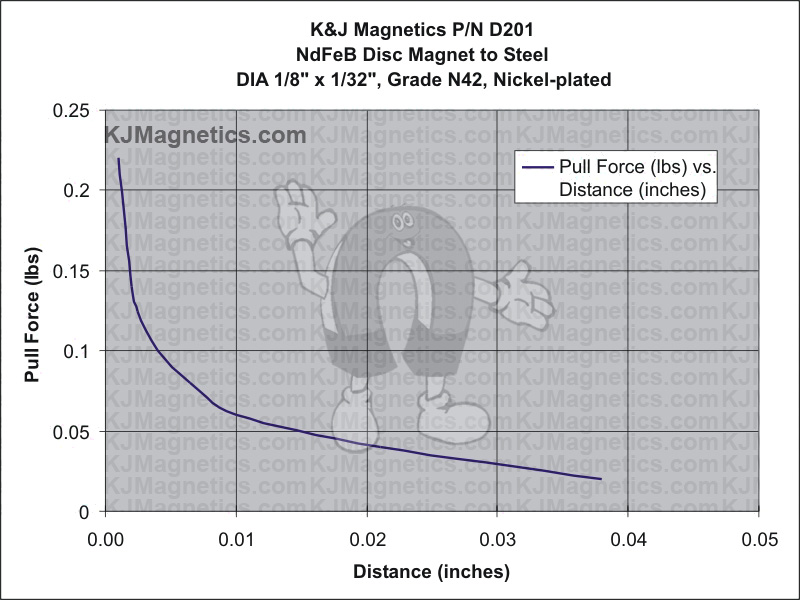
The K&J D101-N50 has a surface field of 1800 Gauss, a gap of .030 still
leaves a field strength of roughly 300 gauss. I would say that would leave
end play variance buried. The force chart is for a slightly larger magnet,
but of lesser flux density. Regardless, the shape of the curve will be the
same.
Temperature is more of an enemy than distance.
C. Smith
The Rotary Engine NewsLetter. Powered by Linux.
ACRE NL web site.
http://www.rotaryeng.net
Youtube key word UTUBPLEASE
Copyright 1998-2009 All world wide rights reserved.