More evidence that more R&D needs to be done on the
rotary engine multi strike ignition system.
I think the need for this has been missed in the past.
Paul Lamar
Ansdale page 112:
---------------------------------------------------------------------------------
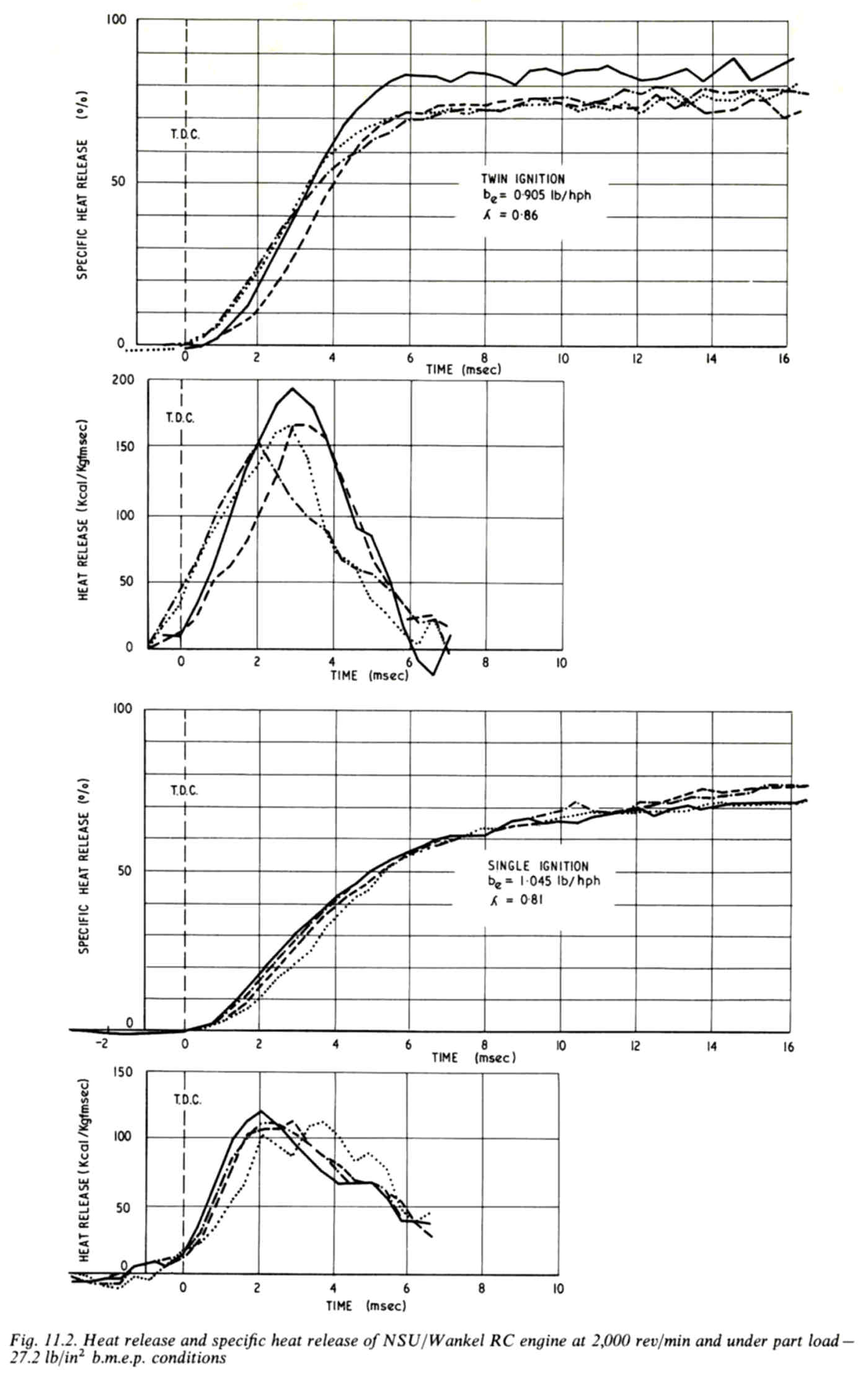
Dual ignition, shown in Figs. 11.1 and 11.2, that is two spark plugs per
cylinder which fire simultaneously, has been applied to certain
reciprocating piston engines to ensure greater reliability and, to a lesser
extent, to raise power output. It is possible to coax a little more power
from a Wankel RC engine with dual ignition because it speeds the whole
combustion process, resulting in a more rapid pressure rise, and thus
providing a longer effective expansion phase. The choice of spark plug
location in conventional piston engines is more or less at the mercy of the
valves, the ports and of the bolts or studs which secure the cylinder head
to the cylinder block. By virtue of the comparatively long trochoidal bore
surface between the respective apex seals when ignition is about to occur,
the Wankel RC engine offers a considerably wider choice in spark plug
position than its conventional counterpart and, in addition, it is eminently
suitable for dual or multi ignition should this commend itself.
When choosing the spark plug position or positions of Wankel RC engines it
seems imperative to create the spark in such a position that the mixture
contained between the depression in each rotor flank and the bore is
directly ignited rather than the mixture in the relatively thin leading or
trailing part of the chamber.
Locating the spark plug b.t.d.c. on engines with symmetrically disposed
depressions on their rotor flanks ensures smoother performance than placing
them in an a.t.d.c.
position, though the latter slightly pushes up the power output. However,
the b.t.d.c.
spark plug position is the most widely used because this ensures more
satisfactory ignition over the range of widely differing fuel/air ratios.
Since it is possible to fit more than one spark plug to every chamber
housing of a Wankel RC engine, and already it is suggested that this type of
engine can derive benefits from dual- or multi-ignition, it is pertinent to
ask whether the plugs should discharge simultaneously or according to some
purposeful predetermined pattern. In support of this contention it should be
pointed out that the Mazda llOS RC engine relies upon a phased dual ignition
system, the two plugs firing in sequence 2° - 7° a.t.d.c. at idling speed.
Unfortunately, multi- or dual-ignition also presents practical problems
because the time lags between the sequential discharges amount necessarily
to only a few diminishing microseconds as engine speed rises. It is, of
course, possible to arrange that dual ignition is operative up to a certain
speed, above which the engine reverts to single ignition.
Indeed this is technically defensible, and is already under development for
conventional reciprocating piston engines. The alternative of a virtually
separate ignition system for each plug, may not be so attractive from an
economic point of view. As indicated above, phased dual ignition systems, as
opposed to the two separate ignition systems, prescribed for reciprocating
piston aircraft engines are already under development. They point towards
improved reciprocating piston and RC engine performance, as well as lower
fuel consumption and more satisfactory exhaust emissions.
--------------------------------------------------------------------------------
--
The Rotary Engine NewsLetter. Powered by Linux.
ACRE NL web site.
http://www.rotaryeng.net
Youtube key word UTUBPLEASE
Copyright 1998-2009 All world wide rights reserved.