I was reading your book, How to Cool Your wankel, and have
a question about Fig. 2 on pg 33. The cited maximums of
length and height are not empirical maximums, but numbers
used to illustrate a relationship of the diffuser,
correct?
C. Smith
Yes. That statement is based on Fig 12-11 on page 30.
It was meant to illustrate the impracticality of a
vertical
mounted, large frontal area, efficient heat exchanger
mounted
under the cowl.
A: You need to cool the engine at take off and climb out.
B: The dynamic pressure forcing air through a heat
exchanger
at 100 MPH is not much. (.18 psi)
C: Therefore you need a thin heat exchanger with large
frontal
area to keep the airflow volume and speed through the core
high.
Since you need a 500 to 600 cubic inch thin heat exchanger
to cool the water it must have a large frontal area.
A 24 inch by 24 inch by 1 inch thick heat exchanger
is 576 cubic inches. Water cooling is 2/3rd total cooling.
It is hard to find that much unobstructed frontal
area under the cowl. You will also need a long duct to feed
it.
According to Fig 12-11 that duct must be 2.5 times
as long as half the core height or 2.5 times twelve inches
or 30 inches long. Not practical in most cowls.
You also need about 12 inches clear space behind the core
or the air flow through the core will be restricted.
Fig. 12-13 through Fig. 12-16.
That is why I recommend the Kays & London
wedge shaped diffuser on page 36 Fig 4. The restriction
on the back side still applies.
BTW I have a limited special on my book. Send $30
plus $5
handling and mailing cost to:
830 East Santa Maria St.
Suite 303
Santa Paula CA
93060
Cash only.
Sorry U.S. and Alaska only.
Paul Lamar
Has a particular model of two pass heat exchanger been
established as the weapon of choice?
C. Smith
Howe is pretty good as it is all brazed and not epoxied.
Unfortunately two pass rads are now hard to find
but it is easy to make one if you can find some one to
tig weld.
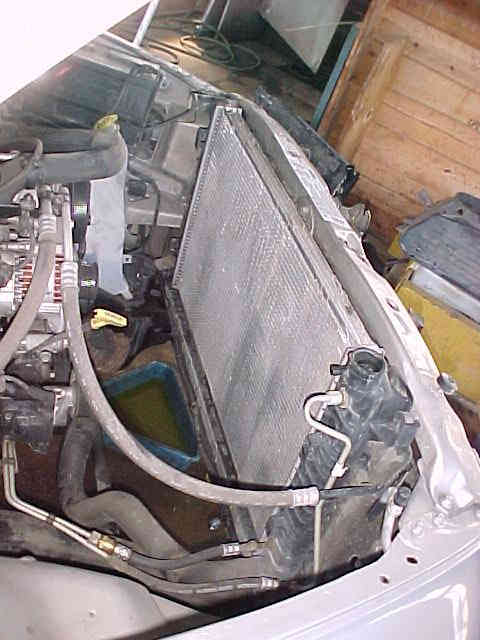
I see Racing Beat now has a modern, thin, large area
core for rotary engines like a late model Dodge pick up trucks.
http://www.racingbeat.com/FRmazda4.htm
You are almost better off going to a rad shop and buying a thin Dodge
truck rad and remove the plastic tanks and weld on your own
with a two pass design.
Find a tig welder in your neighborhood and give him a thin .032" or .049"
aluminum test piece and see how he does. Then give him the rad job.
Paul Lamar
--
The Rotary Engine NewsLetter. Powered by Linux.
ACRE NL web site.
http://www.rotaryeng.net
Youtube key word UTUBPLEASE
Copyright 1998-2009 All world wide rights reserved.