Paul,
I measured the firewall dimensions for my Lancair ES today. It is 46.5"
across and 31.5 high at the firewall, with a 14* aft tilt. The 31.5"
measurement is a verticle measurement, measured straight up from the lower
lip of the firewall.
I also cut some D-shaped cardboard templates to see how the new design
might look. I took some pictures, but left the camera at the
airport. Actually, I like it better than the stock cowl inlets. There's
room down either side for a 19" x 28" x 2" radiator. I feel that I could
modify the existting cowl using foam and glass.
Mark S.
Great Mark I'll adjust the cowl 3D's. Jarret has offered to
machine a 3D foam buck for a new cowl mold. He has a huge NC machine
he built himself. One of these days he is going to send me pictures.
Paul Lamar
--
OK, let me know what he says. What other dims do you need for the cowl
3D?
Mark
I think I have everything I need right at the moment. As a check
on interference a sketch of the cross section of the cowl right where
the fly wheel would go seems to be the area that causes the most
problems. Mock up the side rad in that area.
Paul Lamar
I was out at the airport again today and measured the upper firewall joggle
(trailing edge of the upper cowl) to the prop flange to be 51". I'll have
to take measurements at the flywheel next weekend.
I also built a one tube manometer and measured the cowl pressure at cruise
(160TAS). With the cowl flap closed it registered 5.5", with the cowl flap
open, it was 3.5". Sounds to me like I could use more exit area. What do
you think? BTW, gatorade works great if you don't have any food coloring.
:-)
Mark S.
Good work Mark? What color Gatorade?
More exit area never hurts if you have a cowl flap :)
Paul Lamar
Paul,
When it comes to cowl pressures, is there a target to shoot for, other than
as low as possible? In other words, what is "good" and what is "bad"?
Apparently, 3.5" works for me, or I wouldn't be flying. But what is the
target pressure I'm shooting for? Next, I guess I need to measure
the pressure in front of the radiators in order to calculate the pressure
drop across the cores. Higher pressure drop = better heat transfer, right?
Mark
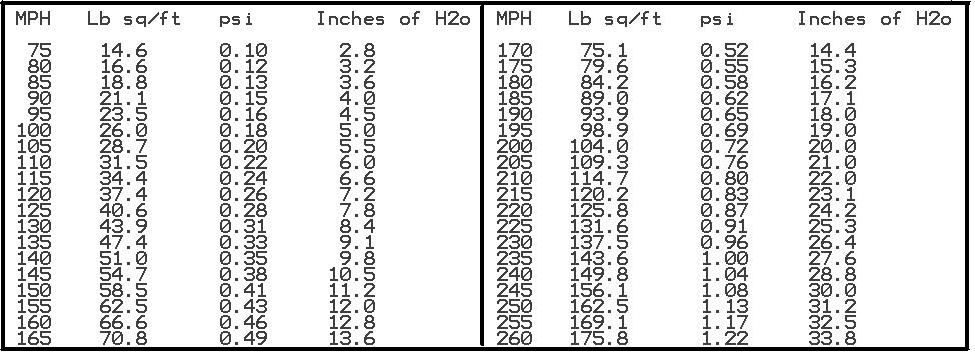
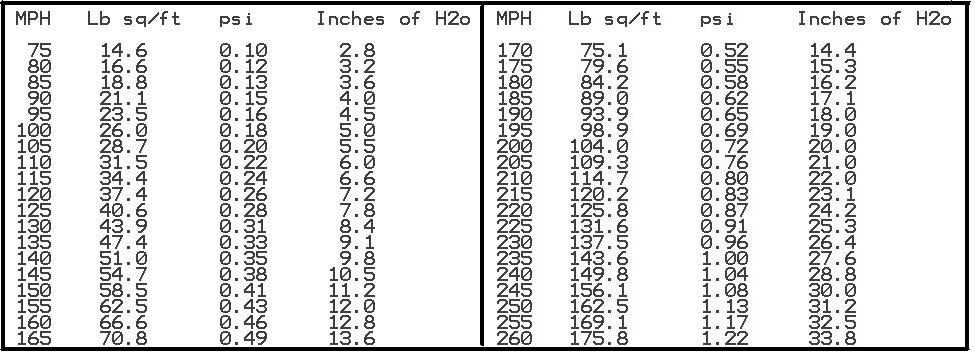
In theory with a scoop pointing forward at 150 MPH and the cowl sealed
you will measure 11 inches of water relative to static pressure.
The same as a pito tube. This is called dynamic pressure or the
pressure on a flate plate one foot square.
If there are any leaks in the cowl the pressure will be much lower.
BTW it is very hard to seal a cowl like that as 11 inches of water is
.41 psi. If the cowl is 48" wide and 40" inches long there
will be a force on the top of the cowl of 48 X 40 X .41 = 787 pounds.
Same as the bottom. The cowl will try to blow up like
a balloon until gaps open up and the pressure is relieved.
If you put a rad in back of a properly designed duct (K&W) and
scoop and the duct is well sealed you may see as much as 6 inches of
water in front of the core and hopefully near zero at the back side
of the core. You need to measure the pressure in four or more
places over the face of the core to be sure the pressure is
evenly distributed.
The thinner the core the lower the pressure on the
front but you will get more air flowing through the core.
I call this characteristic porosity.
In theory with good cowl flaps you could see pressures well
below zero behind the core. In other words pressure well below
static pressure. They will appear negative.
Is this clear? Best I can explain it right at the moment.
Here is a chart of dynamic pressure verses MPH.
Paul Lamar
--
The Rotary Engine NewsLetter. Powered by Linux.
ACRE NL web site.
http://www.rotaryeng.net
Youtube key word UTUBPLEASE
Copyright 1998-2009 All world wide rights reserved.