On the "801"
This is an accident waiting to happen. The motor mount is
incorrectly
designed with un triangulated bays and bent tubes in
tension and compression.
The firewall forward weight is at least 450 pounds aluminum
block or no
aluminum block. No mention is made of beefing up the
fuselage to take the
vastly increased bending loads during landing and high G
turns not to
mention the increased bending loads on the wing spars.
Zenairs are not
over designed to begin with having very thin skins.
"The fuel burn is better then expected though and I am
presently
confirming the JPI 450 for accuracy. Cruise @ 11,000 msl is
producing
5.9 0 -6.3 gallons an hour."
The numbers quoted above shows a lack of understanding
about engine
engineering in general. The fuel burn quoted at 6 gallons
an hour
or 37 pounds an hour means the engine is only generating 83
HP giving
it the benefit of a BSFC number of .45. In the unlikely
event the BSFC
is as low as .40 the HP then would be 93 HP at the absolute
maximum.
Now you have a 450 pound firewall forward weight putting
out 93 HP at cruise.
Something is seriously wrong.
"The numbers I am shooting for are one pound of
engine weight for each
horsepower and a small total engine profile that will fit
in most airframes."
What he is saying here is he things he is going to get 350
to 400 HP
with a 1.43:1 PSRU ratio. With a 2600 RPM prop that is 3700
engine
RPM. No way is that going to happen.
This person is totally clueless.
I am really worried here. Probably one of the most
dangerous airplanes
I have seen in a very long time.
Paul Lamar
-------------------------------------------------------------------------------------------------------------------------------------------
I don't know who this "person" is or what his
qualifications, but..
I am compelled to answer his hatchet job on every topic.
My project is a one of a kind. I had no group, forum or any
other source
to go to during the design, and test flying of my
experimental aircraft,
so all the calculations, fabrications and installations
are a one off
and done to the best of my ability using past life
experiences from
fabricating stuff on race boats, cars and god only knows
whatever I
have modified in earlier years.
I built my plane, 3000 + hours of MY time. I didn't but a
half built
one, or a completed one to use a test bed for my
powerplant. I have
been flying for almost 30 years and owned several other
planes.
My experimental plane has been flying for 5
years and 300 hours.
Been flown in air from 97f to -37f. Has
over 500 landing, been flown
from JAC, 6430 msl to 18,000 feet, full throttle, !! over a
couple of
dozen times to test it for strength. Been flown in all
other power
settings to comfirm and quantify data. Tested to +3.5g's to
- 2.5 g's.
Flown to OSH and back... not trucked there as others seem
to do
to display their creations.
My responses..
1- When is this " accident" going to happen ??
2- The mount is designed by me using triangulation, just go
to my
web site and look at the pics.
3- There are NO bent tubes in my mount. there are
intersecting
angles but that happens on ALL mounts. At those
intersections the
area is beefed up internally. Just because you can't see it
doesn't mean crap.
4- I know EXACTLY what it weighs. I don't guess like he
seems to.
And it is less then his "estimation"
5- Of course I beefed up the airframe as I built it. Just
because I
didn't state that on my website should not give him a pass
at a free shot.
6- Zenith Aircraft seem to be an "issue" to him. Mine has twice
the "suggested" HP and still has not broken in half.
7- The plane has so much power that at cruise I can
throttle back
to ALOT.. A 801 has alot of aerodynamic drag. I can run 90@
6.4 GPH
or 110@ 17 GPH. The plane hits a brick wall so why burn
three times
the fuel to go a little faster. If I wanted to go fast I
would have
built another type plane. You would think a guy like him
could draw
a simple conclusion.
8- I have probably built, raced and tested more engines hen
he can dream about.
9- BSFC of .45 ??? Jeez. I would be
embarrased to tune a motor that rich.
10- Nothing is " seriously wrong"............. I am
seriously throttled back.
11- The motor is capable of 600 + Hp in different trim. ie,
different
redrive ratio, different intake design, etc. The motor will
not gain
any more weight by changing componants, so 350-400 Hp is a
no brainer..
On MY plane I purposely stayed with 1.43-1 because it for
sure doen
not need any more power.
12- Where did he get the 3700 RPM # from ? I
turn the motor alot
higher then that on take off. Yeah, the prop is kinda noisy
but nothing
worse then what noise a seaplane makes with a large
diameter prop.
13- """ Totally Clueless""" Ya wanna bet..
And in closing all I can add is
" I am really worried here. Probably one of the most
dangerous airplanes
I have seen in a very long time. "
Geez... Where was he 5 years and 300 hours ago ??????.
Ben Haas.
Where are the "facts"?
What manifold pressure and RPM do you run?
"Less"? How much less?
"More"? How much more?
"ALOT"?
What is the real BSFC?
What does the engine weigh?
At 17 gallons an hour at .40 BSFC giving you the benefit
of the doubt as far as leaning goes you are seeing
265 HP max not 400 HP. I can believe 265 HP at 17 gallons
an hour.
I don't think you understands what trangulation means.
Here is the pictures from your web site. Where is the
diagonal in the first bay?
How and where did you beef up the fuselage?
What is the empty weight of the aircraft?
Paul Lamar
Spell my name correctly and I might answer your silly questions....
Maybe you can use your nifty cad program to help but chances are you
will get that wrong too, just like designing C. Smiths mount and
calling it FINAL.... And then he emails you back explaining the 640
does NOT have a 5th hard mount point on the top of the fuselage....
You are going to kill another human being one day by your actions ....
Ben Haas N801BH Jackson Hole Wy, JAC
www.haaspowerair.com
I don't care whether you answer my pertinent questions or not. If you can't
discuss the issues attack the messenger or change the subject.
I addressed the fifth mount issue with Mr. Smith but you would not know that
as you are not on this list.
There is nothing wrong with running a V8 with aircraft quality
parts at 100 HP continuously if you don't mind the 200 to 300 pound weight
reduction in the payload. Just don't mention the 400 HP which you will
never see with a normal diameter propeller.
The issue is the power to engine weight ratio and the effect the excess
engine weight and consequent required ballast in the tail has on the
structural integrity of the fuselage.
The real reasons you don't answer my questions is you don't want
that information out there. Perhaps you don't know the answers.
Paul Lamar
You are getting closer on the BSFC number.
Paul asked nicely.
/At 17 gallons an hour at .40 BSFC giving you the benefit
/of the doubt as far as leaning goes you are seeing
/265 HP max not 400 HP. I can believe 265 HP at 17 gallons
/an hour.
I will answer nicely.
Those number have been confirmed several times.
10,000 msl.
average of 43f
wide open throttle. The MP varies with current baro pressure. You can use a chart to find the pressure at 10,000 MSL.
Now, take those number and correct to sea level HP and what do you come up with?
When leaving OSH last month the motor was burning 22.3 GPH on take off. This was the first time this plane has ever been
below 6500 msl in its life, so you can run the BSFC however you want to calculate the HP. Just remember I have this
motor highly detuned for this airframe. The motor is very capable of alot more HP. Your comment about 400 HP is correct
to a point. What you fail to consider is when an application needs that much HP a simple redrive ratio change will cure
the motor powerband / prop RPM issue. The part that really gets me wondering is you should know that and you failed to
suggest it as an option. I am just a serious motorhead/ alternative aircraft engine fanatic and your ideas and mine
clearly don't match. I respect your right to follow any path you seem to think is right,,,,, BUT calling me "clueless"
is as far from the truth as you can get.... I am flying an experimental plane that I built, with 5 years and 300 hours
on it, you are
not.. Simple enough ?
Fire away... I am tough.
Tailwinds.
Ben Haas N801BH Jackson Hole Wy, JAC
www.haaspowerair.com
I got to Hand it to you Ben. You are hanging in there.
I did not fail to consider anything. You are making
claims based on the ratio you have.
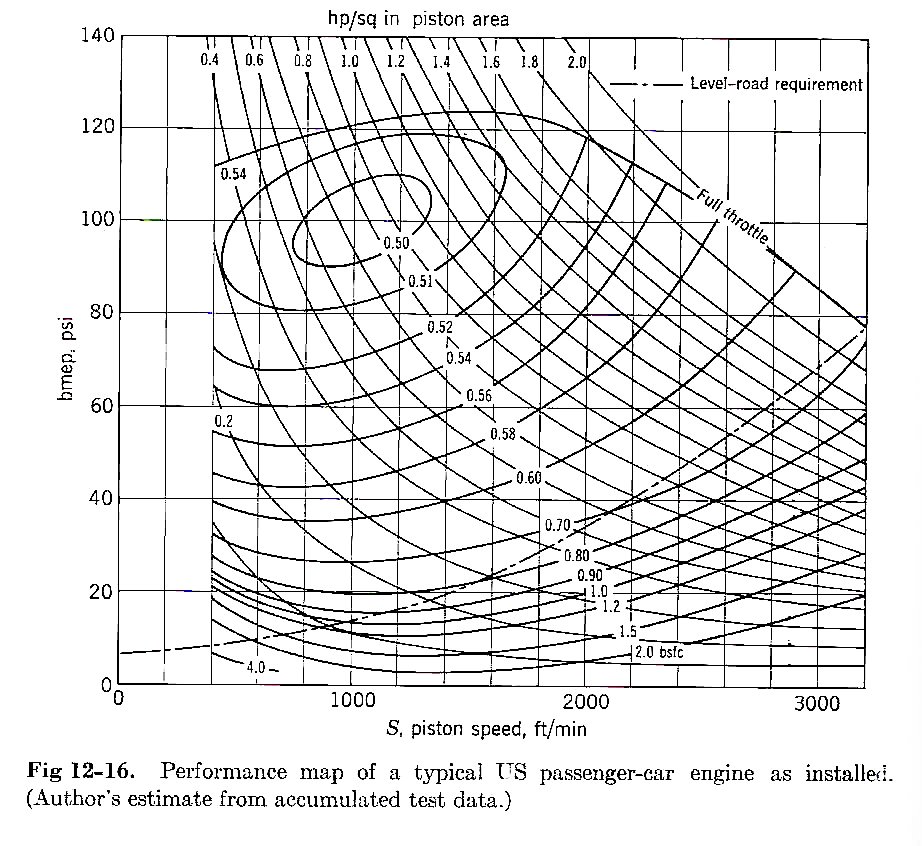
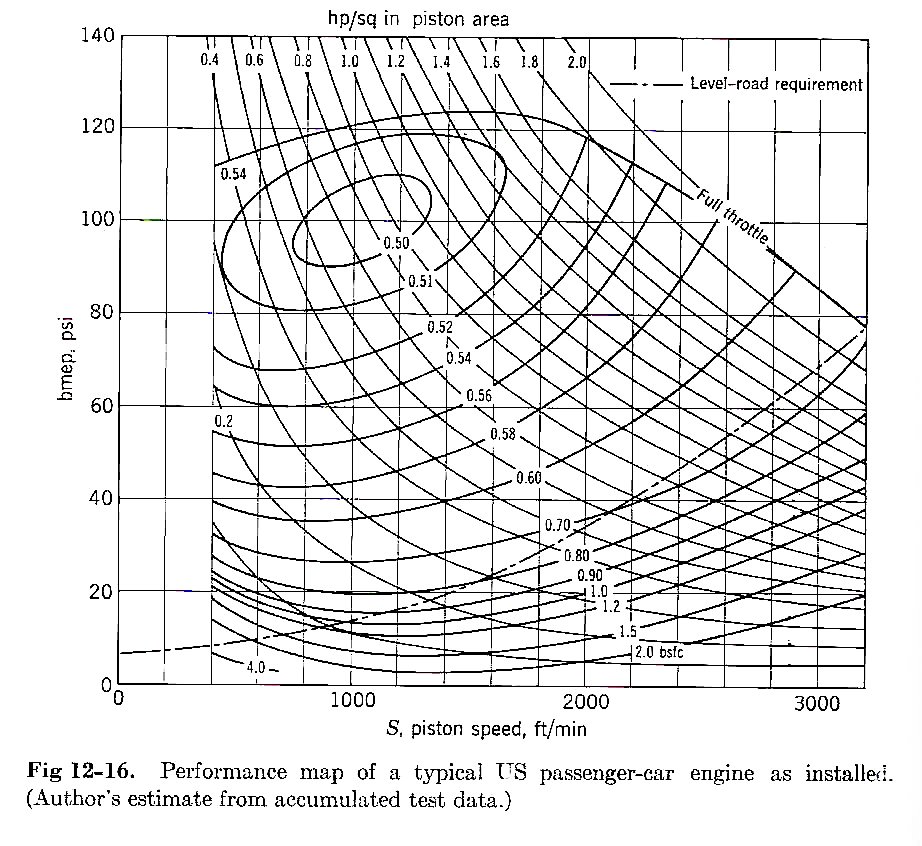
Here is BSFC 101. Brake Specific Fuel Consumption is the amount of HP
generated per pound of fuel burned. Fuel weighs roughly 6.25 pounds
per gallon. BSFC does not vary much with
altitude and lower atmospheric pressure. Surprisingly it is very
similar for a wide range of gasoline engines. The range is .40
to .65 full power 12.5:1 mixture ratio.
The lower the number
the more efficient the engine. There is a range of numbers for each
engine depending the mixture ratio, the load on the engine and the
RPM. There is a best BSFC "island for every engine however it
does not vary much from engine to engine. Generally speaking
the BSFC is lowest when the engine is generating peak torque.
Here is a BSFC chart for a car engine from the bible of engine
design by Taylor. This data is 50 years old so subtract .10
from the numbers for modern EFI high compression engines.
Knowing all this one can predict with rather good accuracy how much
power an engine is producing just by knowing the fuel burn.
In your case there are other givens like the PSRU ratio which
limits the RPM the engine can turn. Typical prop tips run into the sound
barrier around 2700 RPM. Therefor you are turning the engine
around 3700 or so max.
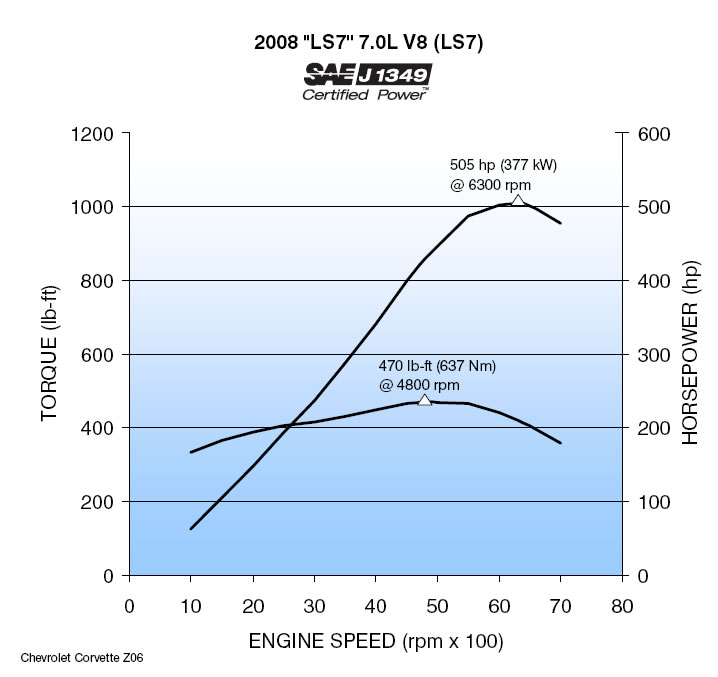
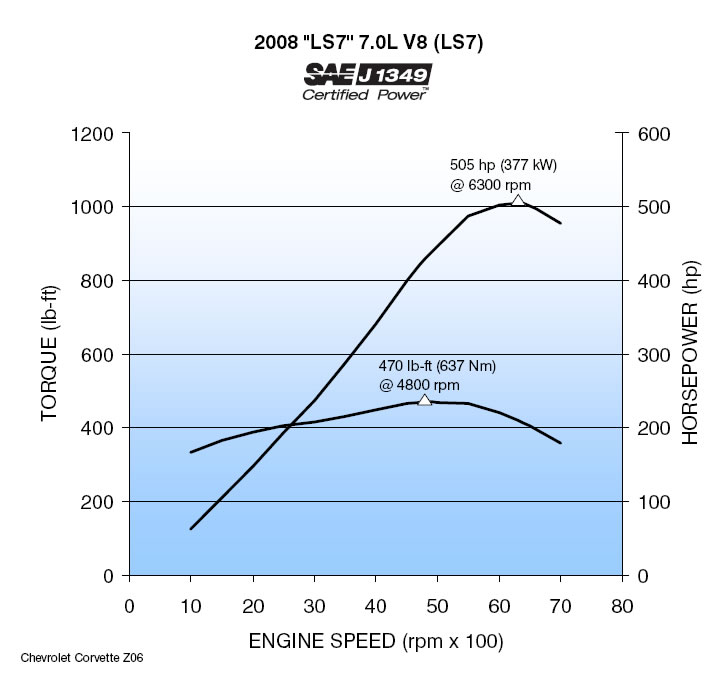
Here is a HP curve on a Chev LS7. Ford and Chev NASCAR engines
are pretty close so at best your engine is making about 300 HP
max at 3700 RPM. I would say more like 200 HP based on
my 45 years of car racing expeirence. Note the torque is at
4800 RPM so you are well below the torque peak.
I am in a motel room using my EeePC so I don't have all my
files available. I'll be back on Monday so this will be continued
then.
In the mean time please answer these question.
What is the weight of the engine?
What is the weight of the PSRU?
What is the empty weight of your airplane?
What is your cruise RPM?
What is the actual manifold pressure at 10,000 feet.
I am not talking about the barometric pressure because
I know what that is. What manifold pressure are you seeing
in your manifold. That will tell be volumes about
your intake system.
n
--
The Rotary Engine NewsLetter. Powered by Linux.
ACRE NL web site.
http://www.rotaryeng.net
Youtube key word UTUBPLEASE
Copyright 1998-2009 All world wide rights reserved.