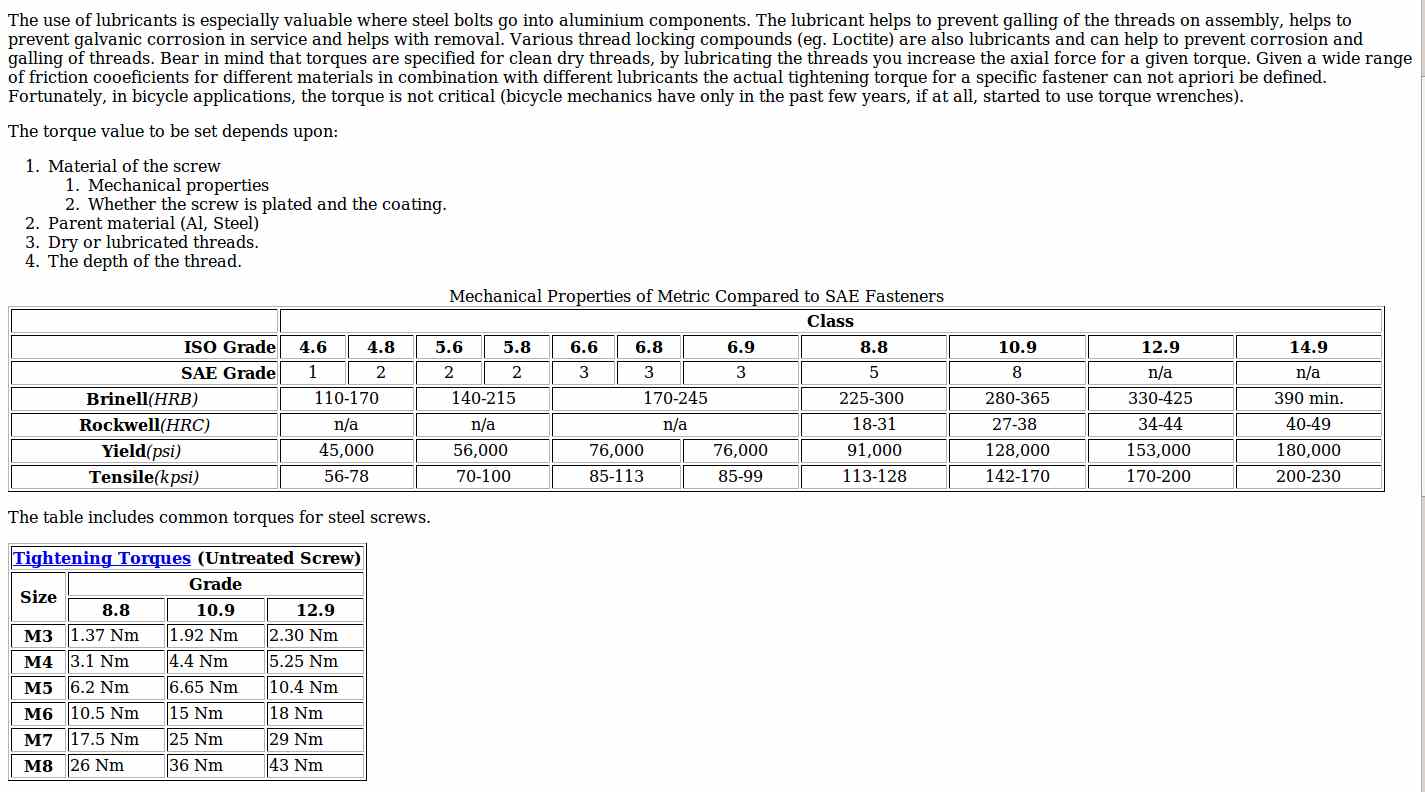
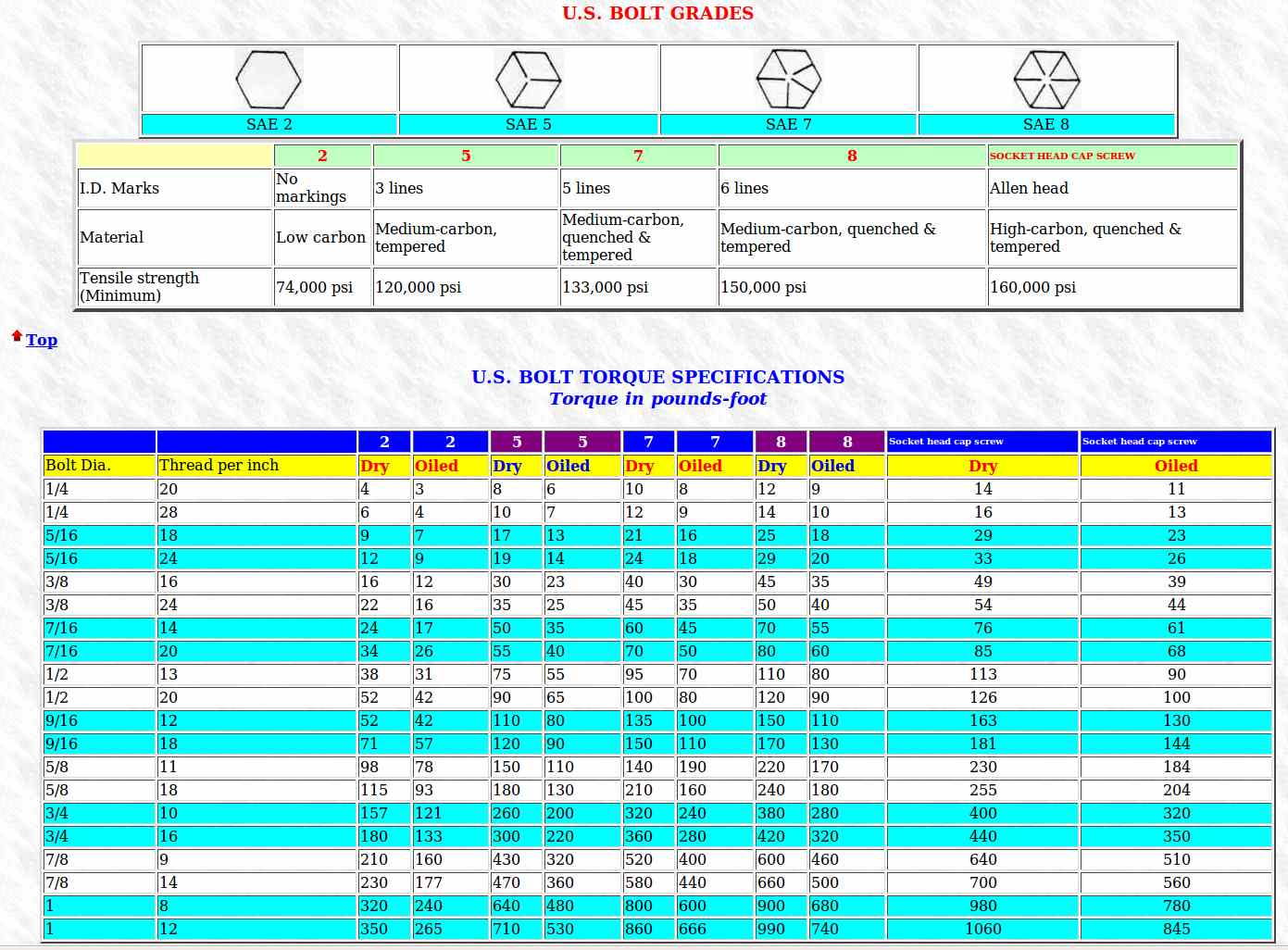
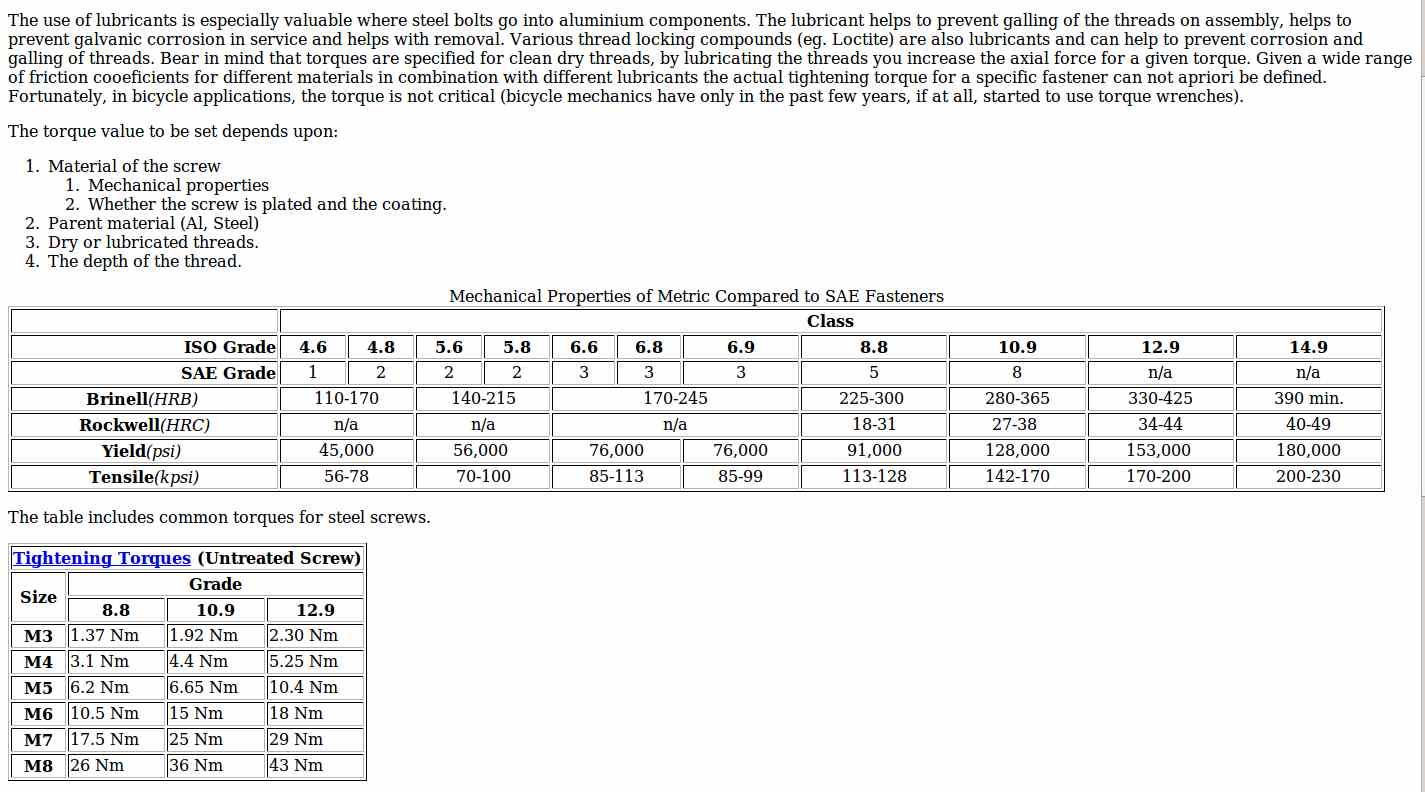
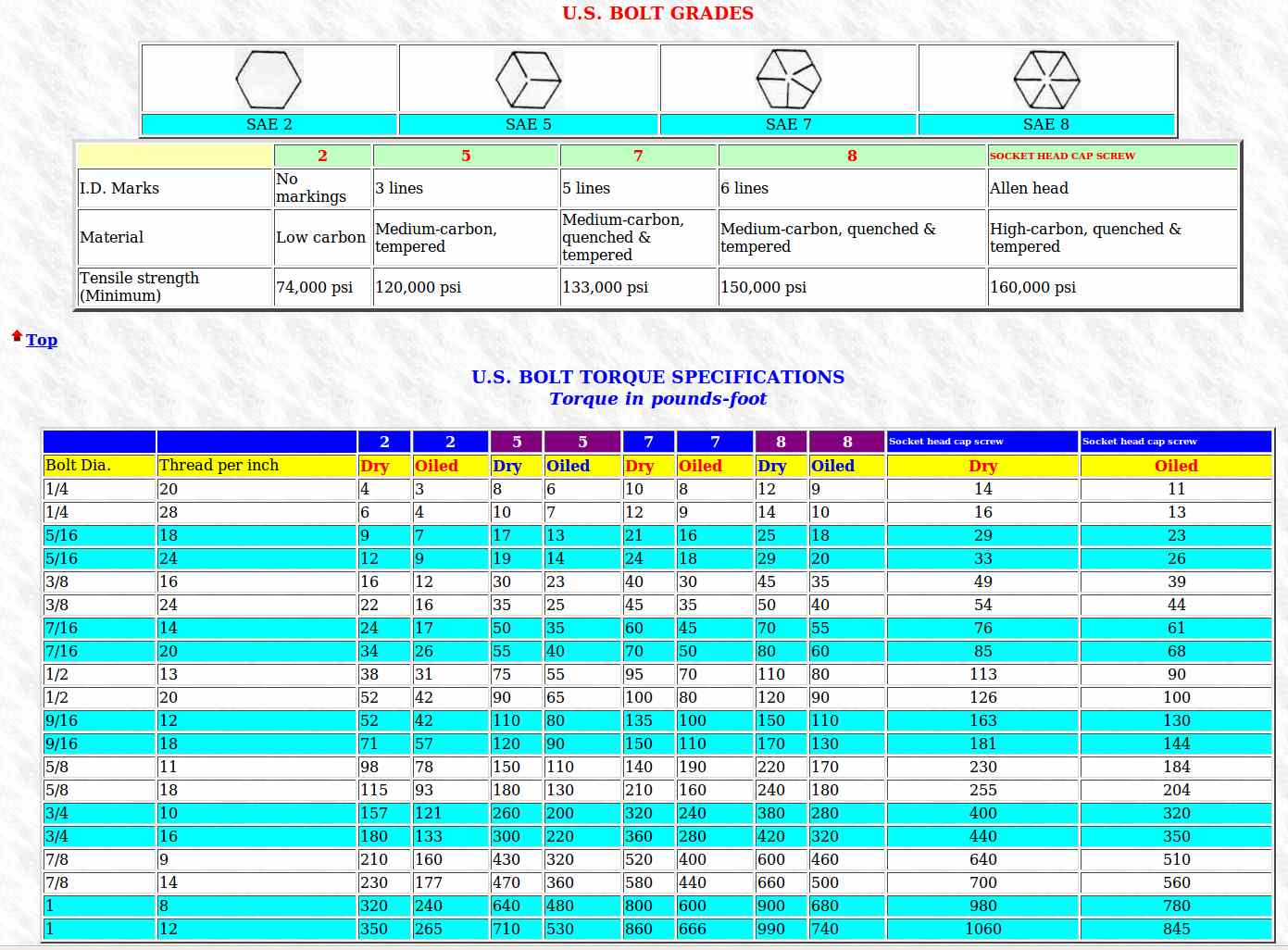
Does anyone know the torque specs for the 5/32? Allen hex head screws in
the AL main gear housing (prop end)?
Thanks
Cary
5/32nd Really? I have heard of 4-40 and 6-32 and 10-32
Paul Lamar
=======================================================================
http://www.madsci.org/posts/archives/2000-08/967051394.Eg.r.html
The other factor is lubrication between the bolt and the threads. If there
is no lubrication, some of the torque force is needed to overcome the
friction between the inner and outer threads. This friction then
dissipates, meaning the net pretensioning is less. By lubricating the
bolt, the torque needed to get the same pretension force is less.
From "Mechanical Engineering Design" Shigley & Mischke.
5th edition, McGraw-Hill Pg. 346).
T = K*Fi*d
Where:
T = Torque
K = Torque Factor
Fi = Preload Force
d = Major bolt diameter (ex. .250" for ¼" bolt)
The bolt diameter is the easy one to find, it is the preload force and
torque factor that are a little more subjective. The torque factor
generally depends on lubrication. Here is a quick table extracted from the
above reference.
Bolt Condition K Factor
Nonplated, black .30
Zinc-plated .20
Lubricated .18
There are other lubrications that can reduce that number even further, but
for general purposes a K value of .20 is used.
What is the max preload force? Again from Shigley and Mischke, who
referenced the following info from Russell, Burdall, & Ward Corp's book
"Helpful Hints for Fastener Design and Application".
"For reused connections, pretensioned load (Fi) should be 75% of the proof
load (Fp) of the bolt." The proof load is obtained from the equation
Fp = At*Sp.
Where:
Fp = Proof load of bolt
At = Tensile Stress Area
Sp= Minimum Proof Strength = psi rating of the steel.
Lets do an example using a ¼-20 grade 5 bolt.
If you can't find a table listing proof strength, it is generally
90% of the yield strength. Proof strength
for a grade 5 bolt of this size is 85 kpsi (1 kpsi = 1,000 psi or
pounds per square inch). Tensile stress area is .0318 in^2.
Therefore, Fp = 85,000 psi * .0318 in^2 = 2703 lbs.
And we wand Fi to be 75% of this, so 0.75*2703 lbs = 2027 lbs.
And from our earlier equation, T = K*Fi*d. We will chose the base K of .20
in this case, and d of ¼ bolt is .250 Then we get…
T = .20*2027 lbs*.25in = 101 in.lbs, or divide by 12 and we get 8.5 ft.lbs.
Which correlates with the attached chart.
--
The Rotary Engine NewsLetter. Powered by Linux.
ACRE NL web site.
http://www.rotaryeng.net
Youtube key word UTUBPLEASE
Copyright 1998-2009 All world wide rights reserved.