http://www.sae.org/mags/AEI/6906
http://www.freescale.com/webapp/sps/site/application.jsp?code=APLSMALLENGCTRL&tid=vansmallengine
http://www.freescale.com/webapp/sps/site/prod_summary.jsp?code=KIT33812ECUEVME
http://www.freescale.com/support
C. Smith
I'll second that. In the true spirit of the 555 one computer per
injector.
If we can get this to work it will be off the shelf ignition and EFI
at very low cost indeed. Modular and redundant for safety.
For a two rotor, four FreeScale demo PC boards would be required as
each one has an injector driver. Two triggers are no problem for us
as each rotor fires once per rev. Just like a one cylinder two cycle
piston engine.
Hopefully there is a one cylinder 2 cycle piston engine FreeScale
software example that we can use to get a fast start.
I downloaded a bunch of stuff and got this version of the code
warrier up and running. Do we have any C programmers on here?
FreeScale makes you jump through a lot of hoops as far as
registering and activation which is a real pain in the ass. I called
them and tried to explain I don't run windows on the Internet for
virus reasons so on-line activation does not work for me.
Thanks Craig for letting me know about this.
Paul Lamar
Robin's Mac OS disk should have X Code on it, provided it's not too
old. You can program C, C++ , and a variety of others with it.
I just loaded mine for a college course in C++.
Chris Cosman
This is a good project for you Chris.
Paul Lamar
It would be a great project for me. However, if you folks were
expecting any timely results, I may let you down...
Let me get through my class first and see what I know...
Chris C.
OK Chris. C is pretty dry and this should add some incentive.
Plus you could ask the instructor questions. Code Warrior comes with
a C compiler.
Paul Lamar
What are the questions I need to be asking the instructor. He wrote
the book we're using and used to design spy satellites, I'm sure he
could walk me through this...
My apologies I haven't been paying too much attention to this thread,
until now.
Chris Cosman
Down load the software and print out some of the C examples.
If there is something you don't understand ask him.
Paul Lamar
Paul, I used to program in fortran, pil, sindue, mad and read up on the C
and later C++ back in 1999. As with other languages the programer writes
his code including things tagged rem (remember what this does) statements.
Function blocks are written in sections and when all are ready they are
"linked" and "compiled" to generate an "executable" file which is what we
get when we buy software. During the compile stage all the rem statements
are dropped and all named variables cas maf ign inj that you used are
converted to generic equivalents. The executable file can be decompiled
for
modification to add mass airflow functions, however not having real
variable
names, and all the blocks would still be linked makes a large confusing
mess
to sort thru. If you have the original source code (open source) a function
of conditional statements to convert the floating point mass air flow value
to an offset of the fuel table would seem to alter mixture. The array of
data for fuel flow time would have the "name" sub x changed to "name" sub(x
+offset)Expanding on this for manual mixture overide would be "name" sub
(x+offset+manual change)
There are several versions of C++ available. Two of the beter ones
are microsoft C as used in windows and borland C++ It is generally thought
that the automatic debugging during linking is much better in borland
C++During your code writing you have a lot of C in where you send
variables into a function block and C out where variable values go out to
other parts of the program. If for instance you send in an integer value
but
declare it floating point as it enters the function block and it is output
with the original variable name with the new value you have a floating
point defined an an integer(no decimal point) and an error. The debugger
looks for these and functions linked to the wrong addresses and changes
them
as necessary. The documentation of borland C++ is more informative allowing
the original intent of the code to be obtained. The new code can then be
run
thru the microsoft compiler to make the executable file if you preffer.
To write source code an understanding of high school algebra is
essential and secondly conditional statements will be neccessary.
Conditional statements aresomething is greater than, less than, or equal
to something else and based on this decision you "go to" some line and do
something. For a beginning "the C++ for dummies" book is usefull and a
full
version of C++ manual might be usefull if you read it twice. All the
sending to and retrieving from a particular storage address type of
initialization is done in the compiler. Personally I found it usefull to
write out a line in plane english then converting to code. For instance, if
the mass air flow voltag e is more than this but less than that and the air
temperature is more than
this and less than that then enter a fuel flow time of something in an
array
named whatever on a line number some variable plus 1 then go back and
repeat
with the mass airflow a step higher until the mass air flow is more than
some number, then start over with the air temperature one step higher until
some value is exceeded then exit this function. This would generate an
array
(look up table) for fuel versus air. A more extensive set of inputs
including throttle position and crank angle sensor position and rpm for a
single master table would generate a larger table. By using rpm as the
input
the table would sort thru the list to choose fuel flow time and injection
and ignition timing. Using multiple tables or branched tables would reduce
sort time, and using a polar array as a matrix could be a nice trick to
cross refference many tables in a single sort. We did this to sort lumber
by
length, width, thickness, grade, species, trimmed, untrimmed, current bin
location etcetera for lumber sorting/packaging systems.
About using a pre built board without mass air flow or some kind of
air density input I don't understand how to input data on a board with no
input treminal to connect to. Using a second board with a sata or serial
connection would add more circuit boards and this is then starting to look
like an industrial rack system. Is it possible to match up a mass air flow
sensor output to replace one of the existing inputs to the board, possibly
the throttle position sensor if a manual throtttle cable is used for power
control. I was thinking the ford maf sensor could be in series with a pot
to
modify the voltage and add manual mxture override.
george grimes
The Code Warrior comes with a C compiler debugger and emulator. All free.
The boards have .025 square headers on the opposite side for data input.
We think there is already a provision for a mass air flow sensor input. It
would help if you downloaded the free code samples and see if there is a
sample C program source we can use already written. Just about any one
cylinder program will work.
Paul Lamar
The MC9S12P128 has a 10ch 12bit a/d, so a great many possiblities exist for
input. Download
http://www.freescale.com/files/analog/doc/user_guide/KT33812ECUUG.pdf?fpsp=1
I don't know as of yet if the sample application has provision for MAF, but
there is some pre cut smples for demonstration and application validation. I
would think it may be as simple as substituting one input for another, some
scaling math?, and maybe creation of look-up tables.
C. Smith
Paul, pages 31 and 42 user guide show the locaton of the manifold absolue pressure
inputs which could be retained or switched to maf. The look up tables are
user defined so the nonlinearity of maf or air temp sensors would be done
on the included spreadsheet of the kit software. Has anybody got the kit
price and price for additional boards. I haven't used my oscilliscope for
decades, but it could be a fun winter
project.
george grimes
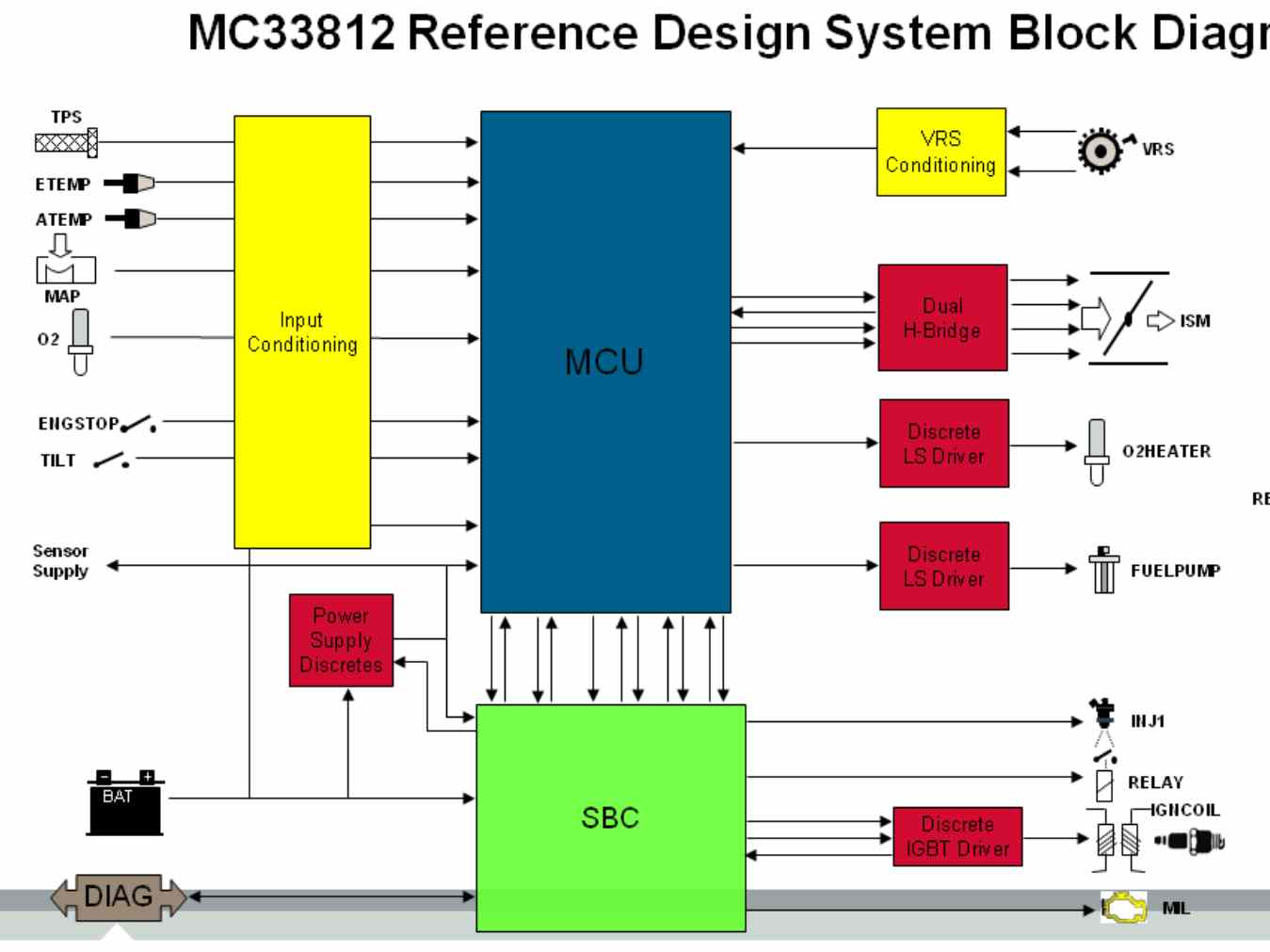
I see what you are saying. A MAP sensor is a lot cheaper than a mass airflow sensor.
Cheap enough to use one for each rotor. Like $10. There is also a throttle position
sensor which would help the throttle response.
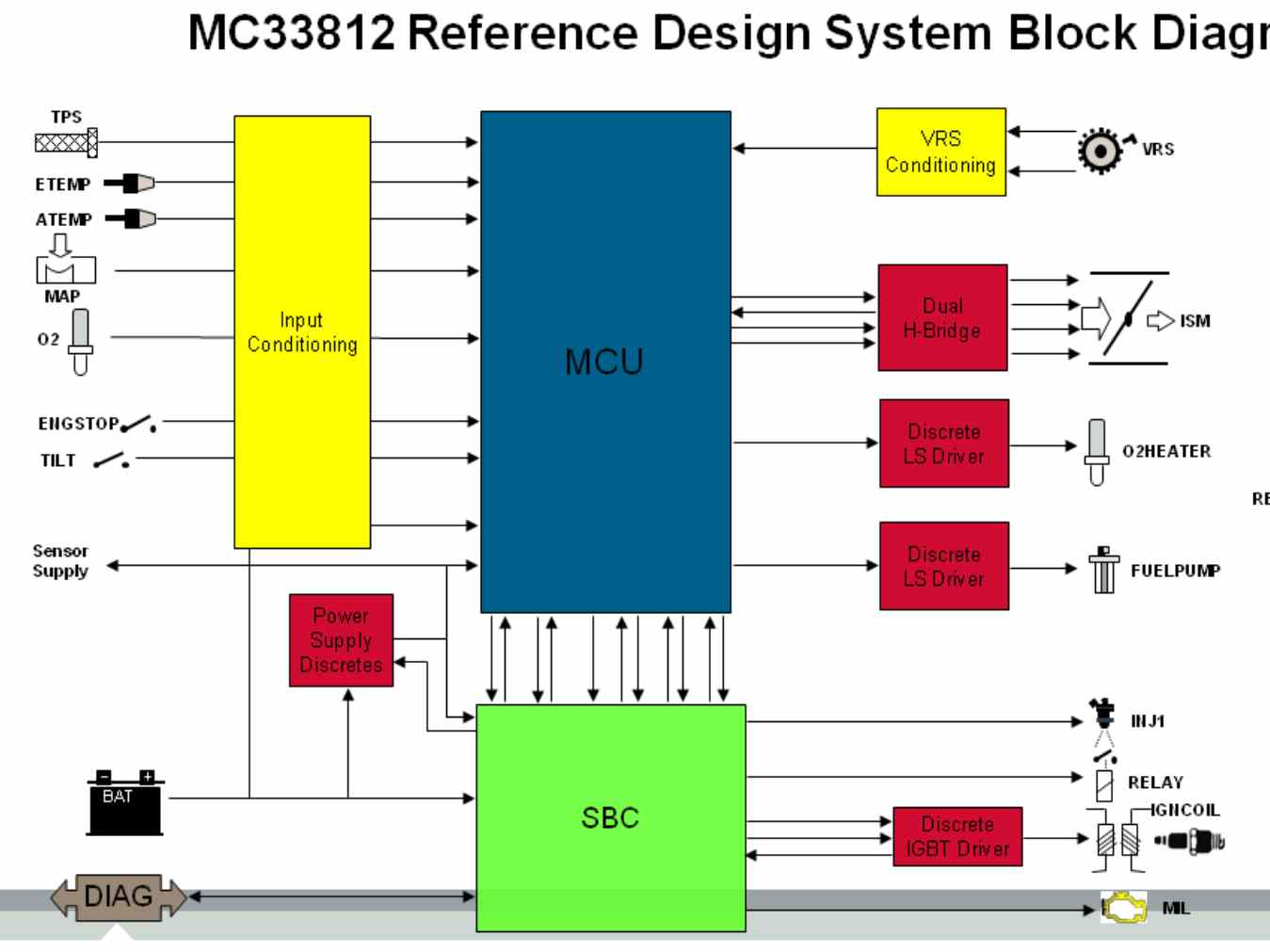
Here is the diagram from page 31. It also looks like it has a missing tooth detector
from the crank angle sensor.
Paul Lamar
--
The Rotary Engine NewsLetter. Powered by Linux.
ACRE NL web site.
http://www.rotaryeng.net
Youtube key word UTUBPLEASE
Copyright 1998-2009 All world wide rights reserved.