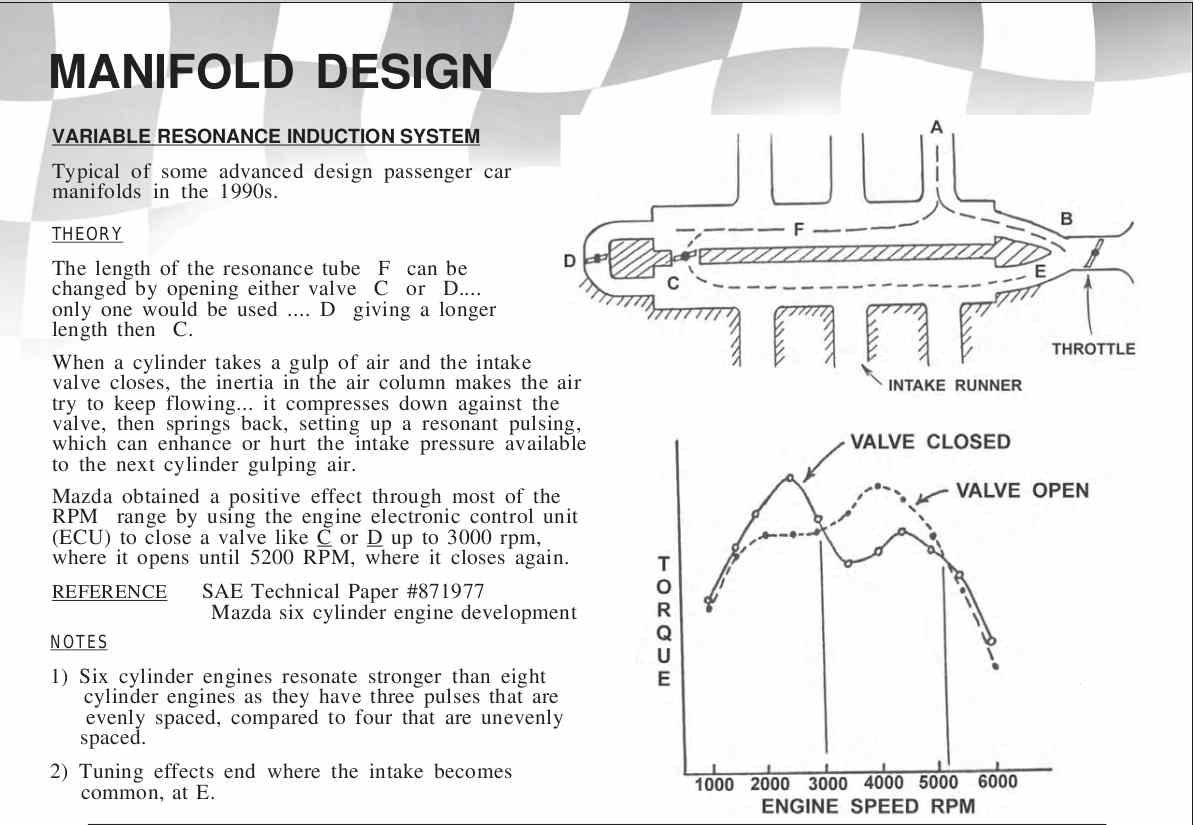
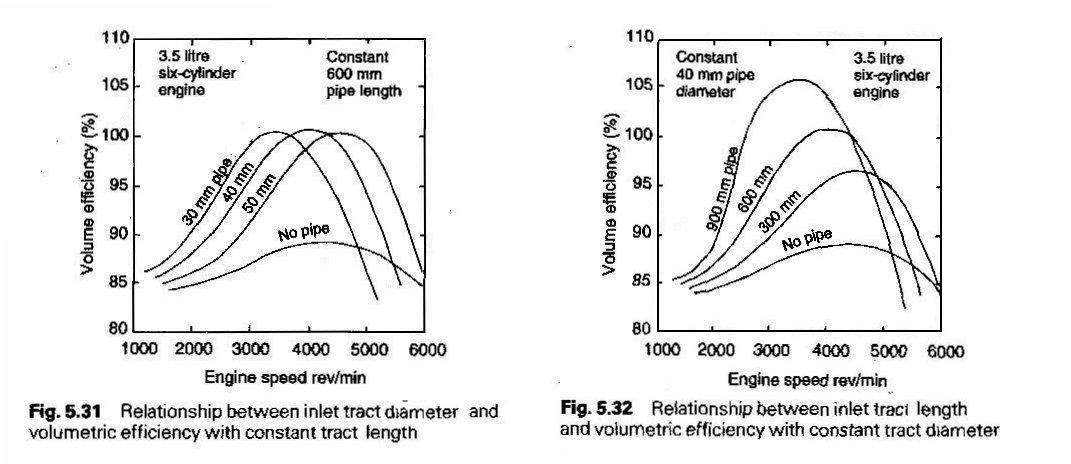
All you need to know about everything!
Print it large poster size and frame it.
This is from the Kinsler Catalog.
http://www.kinsler.com/page--HandbookCatalog--2.html
Paul Lamar
------------------------------------------------------------------------
Another pearl of wisdom from Kinsler.
Ironically it is from Mazda.
Here is something I did not know. If you have a tuned runner of a given diameter
and a known torque peak RPM and you want to keep the torque peak at the same RPM
but go down on the runner diameter, for some strange reason, you must keep the
ratio of runner length over runner diameter the same. Currently we are using a
1.875 inside diameter runner 22 inches long. The ratio is 22 / 1.875 = 11.73.
Lets say we wanted to go down to a 1.5 inch ID runner for some strange reason.
New L / 1.5 must = 11.73 there for the new runner length would be 17.6 inches.
I guarantee you will generate less HP as the velocity of the intake air going
through the runner will increase and the skin friction drag inside the runner is
proportional to the air velocity squared! The velocity of the air at a given
volume flow is proportional to the cross sectional area of the runner. This
would be a good problem for a QB program.
BTW the HP peak RPM will lower as well due to less torque.
Read this news letter for ten years and you get an automatic phd in engines :)
Paul Lamar
--
The Rotary Engine NewsLetter. Powered by Linux.
ACRE NL web site.
http://www.rotaryeng.net
Youtube key word UTUBPLEASE
Copyright 1998-2009 All world wide rights reserved.