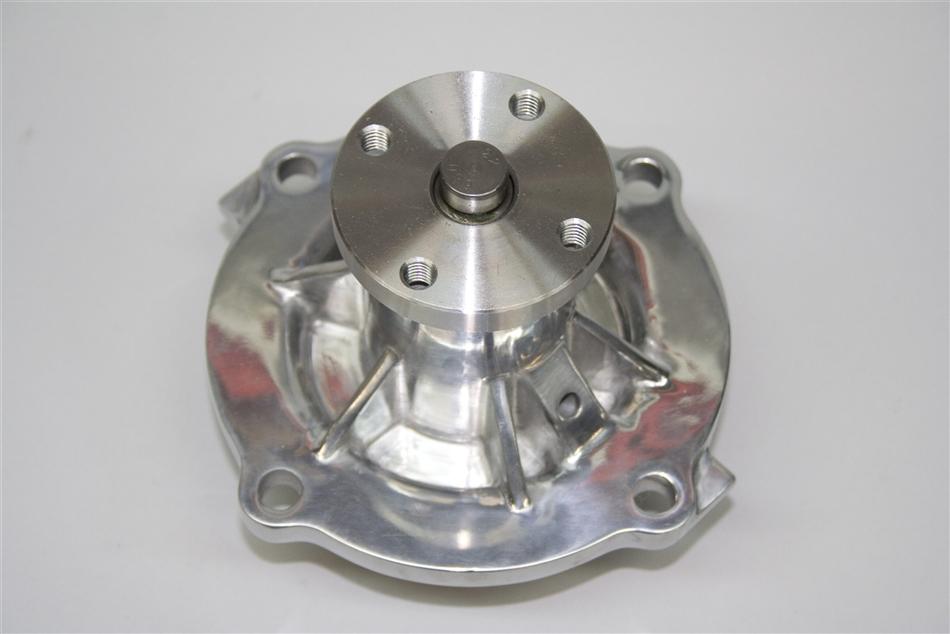
Paul
I just sent out 2 more units. so far there have been 5 sent out.....I
have 6 units machined and ready to ship now..
If there is anyone out there I missed please let me know.............
Water pump
http://www.car-stuff.com/exclusives/bmw/328i-water_pump.html
I found a Graf pump on a BMW that may work here, check it out...
thanks
jeff
-----------------------------------------------------------
Think about wiggins couplings on all in and out.
That is pretty inexpensive for a BMW. Looks like it will work.
Paul Lamar
Paul and Jeff, The pressure of centrifugal pumps is dependent on the
difference between the inlet diameter and the outside diameter of the
impeller and the pictured pump while inexpensive doesn't look to be
designed
for much pressure. The rotational speed from the relatively small drive
sheeve if connected to the stock e-shaft sheeve could exceed 15,000
rpm at
an engine speed of 6,000RPM, not good for long term durability.Also the
sheat metal impeller looks a little thin with straight blades also not
the
best design. And finally any brand of pump not used on an engine designed
for more than the 250 HP of a p-port would seem undersized leading me to
think some type of 1970's detroit big block V8 might be a good start. For
instance the smallest HP used in the oldsmobile toronado was 375 HP
and many
were 425HP. The ford engines as I remember used a 32 PSI radiator cap
much
higher than the GM systems.
Increasing cooling system pressure would raise
the boiling point of the coolant which would be particularly
beneficial in a
series cooled rotary. Personally I went with the 426 chrysler pump which
will be backpressured by the restriction imposed by the rotarys smaller
cooling passages and hopefully provide higher flow velocitys and
turbulance
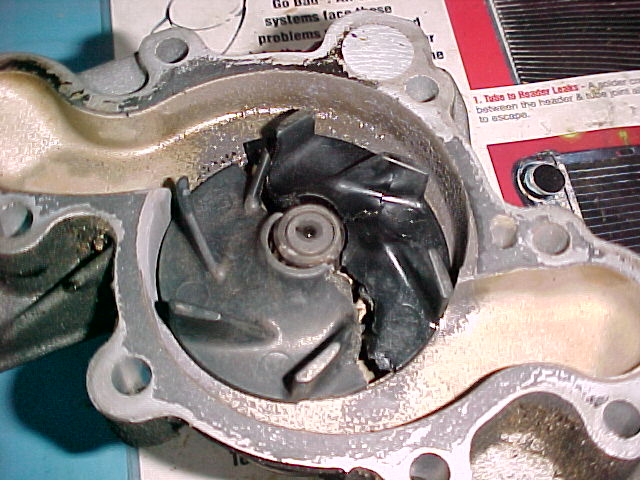
through the block. As far as I know none of these engines used a
closed face
impeller as used on the higher pressure industrial pumps, however
minimizing
the running clearences between the impeller face and pump housing is a
close
approximation.
Possibly someone who worked in a autoparts store in the 1970's
might recall what engines used cartridge style pumps. One other one is
the
331, 354, 392, 398 desoto, chrysler, imperial waterpump.
On the wish list for a new front cover, how about a provision
for
some gerotor type dry sump pumps and a boss for a backup magneto for the
redundant ignition.
george.grimes7@gmail.com
goerge
You bring up great points........I have searched all over for the right
unit with the properties mentioned. The impeller styles I have seen off
the shelf are either too heavy, too plastic, sloppy fit, weak shafts, on
and on....I was interested in the drive and bearing hosing..
I may get slammed here but is it out of the realm of possibility to use
an inlet impeller of a turbo charger...? That type of design is what I
have been looking for with no luck...
jeff
I have a gut feeling they will not be tough enough. The only thing that seems to
hold up is cast iron or sheet steel.
The problem I have with the BMW is the way the water comes in. It is not good to
have a right angle where the water comes in. The Ford and Chrysler are better in
that regard. If the Chrysler rotates in the right direction I would use that
over the Ford.
Paul Lamar
--
The Rotary Engine NewsLetter. Powered by Linux.
ACRE NL web site.
http://www.rotaryeng.net
Youtube key word UTUBPLEASE
Copyright 1998-2009 All world wide rights reserved.