Hello Paul,
Yesterday I met Christian Hugues, developer of Minix winglets.
Those winglets have shown reduction of induced drag of 18% on wing and
thus about 6% on total plane drag.
See video of principle on
http://www.minix.fr/video_minix_swf.htm
Prototype on a plane is currently being installed in the UK.
French site is complete :
www.minix.fr
English site not complete yet :
http://www.minix.fr/english/index.php
I think you might be excited to see this. Any interest of using those?
Best regards,
Randolph in Paris
That is very interesting. Reducing induced drag has been the holy grail aero
engineers for decades.
Paul Lamar
Paul,
This is very interesting. I have been searching for an alternative
wingtip for my SeaWind since I extended the wing and copied a friend's
fold-up sponson design.
Would there be any advantage to having them up the T- tail stabilizer as
well.
Doug in Japan
They only pay off when the lift coefficient is very high and the airplane is not
climbing. They pay off at high altitude when the aircraft is near stall in the
so called coffin corner. During climb induced drag is a factor but compared to
lifting the weight of the aircraft it is a much smaller factor.
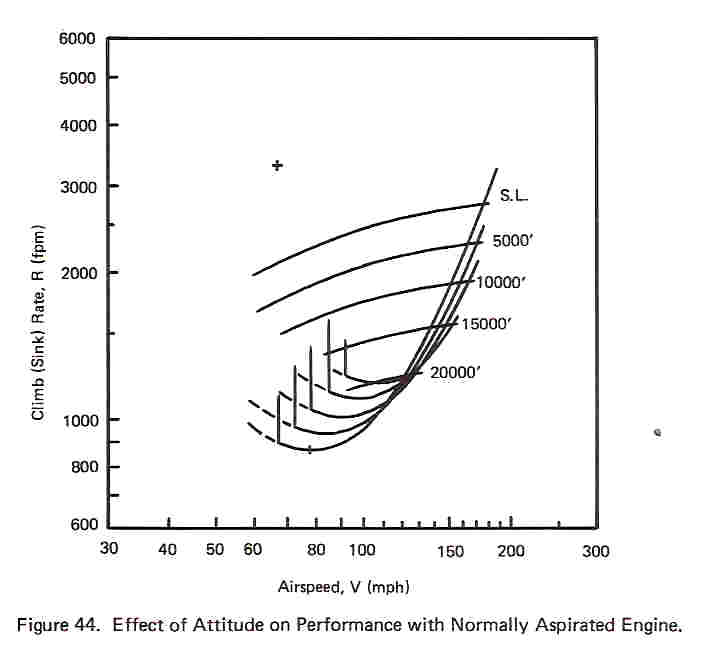
If you are climbing at 1200 FPM and your aircraft weighs 3000 pounds that is 20
feet per second straight up or 20 x 3000 or 60,000 pound foot per second divided
by 550 or 109 HP just to climb. 128 HP from the engine assuming an 85% eff.
prop. The aero drag is near nothing at 100 MPH climb speed. If you get the flat
plate equivalent down to 4 than you have 100 pounds of drag, not counting
induced drag due to lift, going at 150 feet per second or 32 prop HP. Now the
induced drag coef. is C sub L squared over pi times the aspect ratio. Here is
where the special wing tips come into play. In effect they improve the aspect
ratio somewhat.
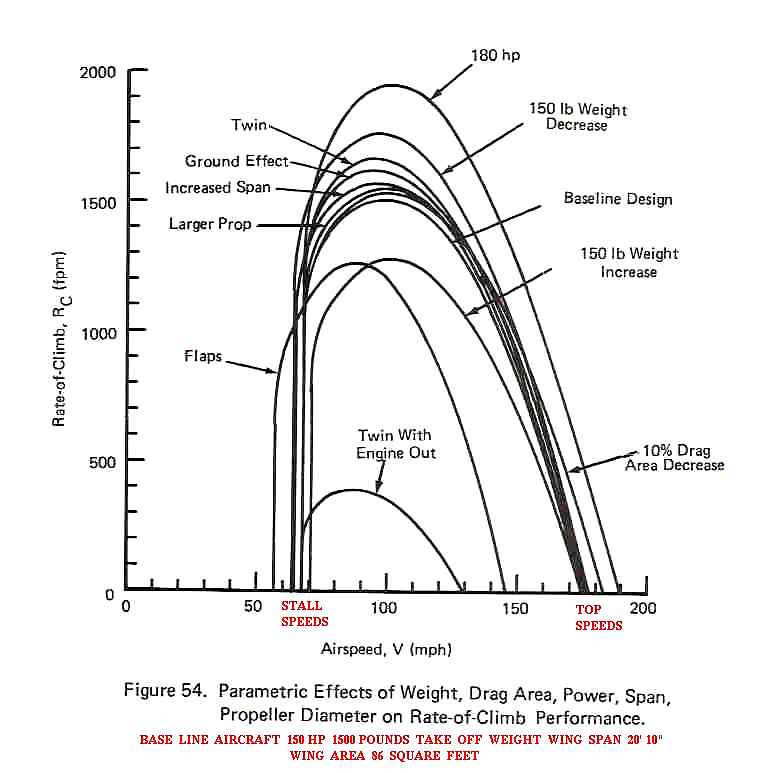
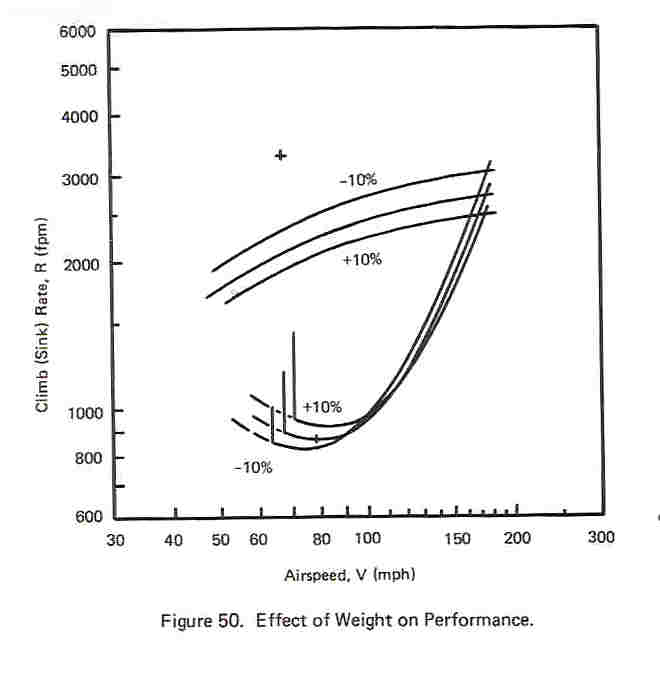
Here are some charts from one of my favorite books.
Practical Guide to Airplane Performance and Design by Donald H. Crawford 1981
ISBN 0-9603934-0-4
Paul Lamar
Dear Paul and Group
I remember when I attended a Forum at Oshkosh in 1980 given by the great
R.T.Jones on the aerodynamic configuration of a novel 3 winged lightplane
design with a pusher prop which he was touting.It resembled a Taylor Aircar
with a mini foreplane,a main wing and a Y-tail stabilizer/rudder, of which
he brought a model he held and demonstrated its performance advantages ("the
foreplane and the tailplane 'talk' to each other") he said.
The Forum was packed,being a rare opportunity to see and hear the Master
Aerodynami- cist.At the time I was obsessed with a wingtip device consisting
of a cylindrical body with an array of small winglets along its length which
was touted as an ideal configuration to reduce/eliminate the negative
effects of the induced drag at the wingtip, caused by the wingtip
vortex,especially when applied to transport aircraft.. ,
At the end of his presentation,he opened the floor to a Q&A,and I asked him
if this device was possible to "eliminate" the retarding effects of the
wingtip vortex.I was sitting near to him and he looked my way and
said.."son,there is NO WAY that any wingtip device can "eliminate"a wingtip
vortex,its a physical impossibility.He said."think of the wingtip vortices
as two reins on a horse,they extend to infinity,holding back the
aircraft.Now if you could cut them off,the aircraft would accelerate like a
rocket"."You can't defeat nature" and he chuckled.The rest of the attendees
also thought it was funny.So,sobered I have always been keenly following all
the technologies used to eliminate the strength,and drag of wingtip
vortices,such as winglets etc.(see how they've been retrofitted to the older
Boeing transports for a measured decrease in fuel consumption,with the
accompanying benefit in range increase).
Now with the INGENIOUS Minix vwingtip vortex reducer/eliminator,I think as
you've stated Aviation design has finally found the "Holy Grail" in a
simple,elegant and very revolutiona- ry device which when applied to the
light aircraft designs powered by rotary engines,will help to reduce the
fuel consumption specifics inherent in the rotary engine,increase the speed
and the range of our lightplanes and more importantly be a 'snap' to install
to any existing aircraft we fly.Not to mention the ease of fabricating one
especially out of compo- sites.Can you imagine trying to find the proper
sized cardboard tube in the garbage can to make a mold,covering it with mold
release ,curing it cutting a couple of diagonal slots in the finished
tube,ataching in to your aircraft's wingtip,and seeing a 10 to 15 knot
increse in cruise speed? Mad Cool,I say!....
We must have to congratulate the Professor.He really has advanced the
Science of flight vehicle design by taking out the "Black Art" component
that has dogged it all these years. INDUCED DRAG!...BRAVO!
Regards to All,
Dave Young.
I think that is an exaggeration of the potential of this device. Under most
flight regimes the advantage would be hard to measure. Reread what I said above.
In medium altitude cruise the drag may be higher.
Paul Lamar
--
The Rotary Engine NewsLetter. Powered by Linux.
ACRE NL web site.
http://www.rotaryeng.net
Youtube key word UTUBPLEASE
Copyright 1998-2009 All world wide rights reserved.