I downloaded the stewart water pump catalog. The inline pump is a
brushless computer controlled pump rated at 55 GPM and is used as a booser
pump. For situations like mine with the mustang type radiator location 7'
behind the engine being able to push the water to the engine water pump
would be really advantageous.
george grimes
How much current does it draw?
Paul Lamar
Paul, The catlog doesn't list the current draw of the stewart inline
pump.The current draw is related to both flow volume and pressure rise
across the pump. In a cooling system the system is pressirized from a low
of13PSI to a high of 40PSI due to the heating of the water and expansion
of the air in the expansion tank. This inline pump as with the automotive
pumps are really circulation pumps and only have to provide enough pressure
differential to move the water through the system. Having a booster pump
delays the point where cavitation in the automotive pump starts and reduces
the HP draw on the engine mounted pump.
It will still take similar HP but
just devides the load. A single v belt transmits at best 5HP so the pump is
less than that, still a lot of electric draw. The common zoller basement
sump pump pushes 12 feet of head and flows 80GPM running on a wire size of
#14 which is 15 amps max, at 9 times our voltage or roughly 125 amps at 14
volts if the sump pump actually drew 15 amps which it doesn't ( actually 9
amps?) for about 81 amps at 80 GPM, less at 50 GPM the engine needs. It
seems like an 8 pound compound turbine impeller pump would boost cooling on
the gound and heat soak temp rise after shutdown and provide some flow if
the v belt breaks in flight.If the engine driven pump is providing flow
through the booster pump at 50GPM+ and the booster pump is spec'd at 55 GPM
the current draw (it is computer controlled) would be minimal and if over
55GPM goes through it might be possible to generate some electricity at
crusie RPM by running the leads through a bridge rectifier.
george grimes
110 volts AC is apples and oranges with 12 volts DC.
15 amps at 12 volts DC is 180 watts or .24 HP. Point two four HP.
a fraction of one HP. 746 watts is one HP.
15 amps at 110 volts DC is 2.2 HP!!! Something slightly different at 110
volts
AC but not far off.
The GPM flow is an inverse function of the resistance of the cooling system.
It is insufficient to quote the flow when the resistance of the cooling
system
is not specified.
It says on the web site that it is not designed as a stand alone pump. It is
designed to supplement the water flow at idle. Which may or may not be a
problem
on the rotary. One must instrument the rotor housing with a thermal couple
to
find out. I suspect 90% of the problem mainly is the lack of air flow
through
the rad core and not inadequate water flow. I could be wrong as higher water
transfers the heat to the rad core more rapidly perhaps lowering the
temperature
of the water.
We have no evidence what so ever of cavitation in a rotary engine pump.
If you have cavitation in a pump you will not only hear it but the pump will
be
damaged as well. I have seen several damaged water pumps that look perhaps
like
cavitation damage. One was subject to low water levels and another due to
pump
bearing failure.
This subject comes up over and over again. Hope springs eternal. It appears
it
is approaching the status of a religion. The original development of the HP
concept was related to how fast a gallon of water could be raised from a
mine
shaft. There have been no magic developments in water turbines in the last
200
years.
Paul Lamar
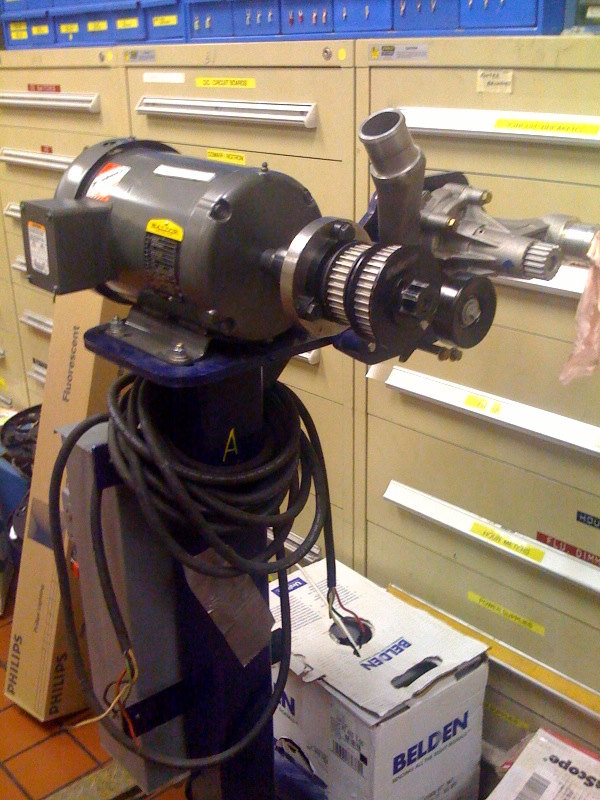
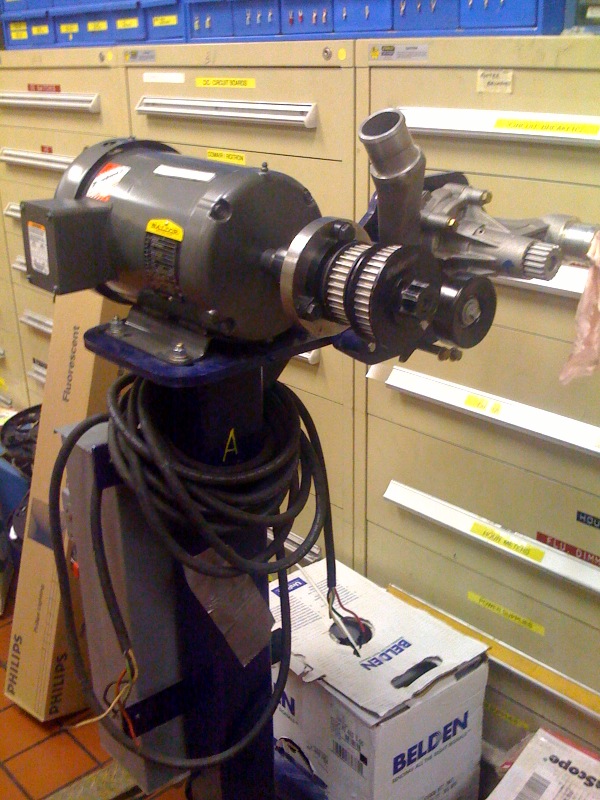
I was working overtime in our Dyno building (probably over 100 separate
engine test cells in this building) today, and spotted this in our
electricians crib. (TOP SECRET, TELL NO-ONE). We build up anything the
engineers need for tests if we have the stuff in-house. I took the pictures
with my iPhone at great risk to my continued employment.
I think this should put to bed the notion of an electric motor powering the
cooling pump on its own.
This set-up is based on the engineers requirements. We have been building
cars for over 100 years, and by this time, we pretty much understand what is
going to be needed for a given application. These guys know how much HP is
required for any given engine function. We test every subsystem, and have
intimate knowledge of how much HP every component consumes. So let's say, we
needed to perform a particular test regime on a particular engine design,
but did not want to be driving a cooling pump. Or had another reason for an
independent engine cooling pump, or the particular test cells cooling system
was down for repairs, but the testing schedule could not be delayed.
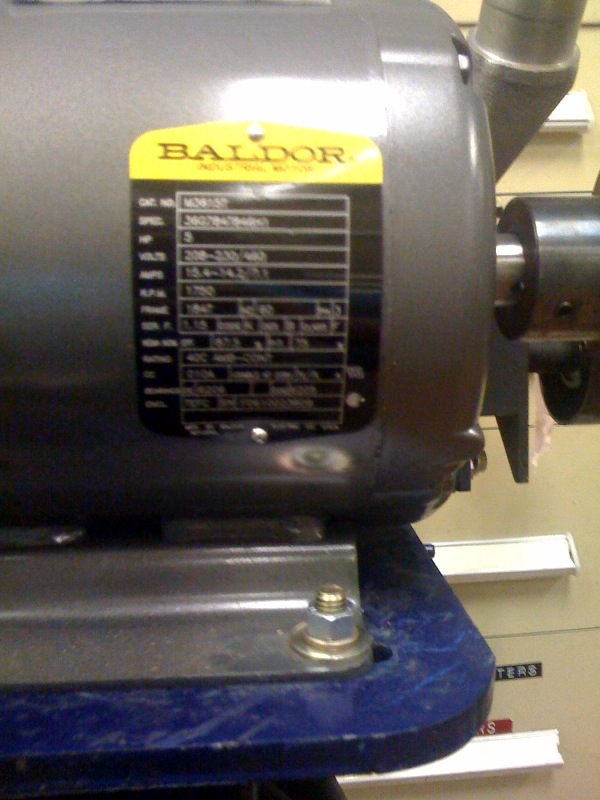
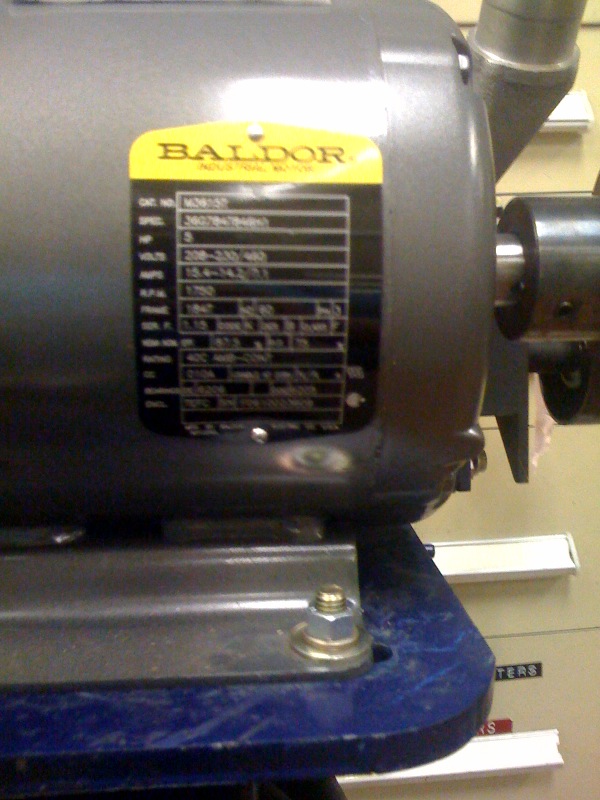
This is what we make. Notice the size of the motor. It is a 5HP 230/460VAC
motor. It will draw 7/14 amperes @ full load. This is what the engineers
have determined is required for adequate and reliable cooling for test
purposes. It must not fail. The motor itself probably weighs 22 lbs or
thereabouts.
A DC motor may be a bit more efficient, weigh a bit less, but cost much,
much more and will draw much more current, in DC amps @ 12VDC.
Do you have room for this in your aircraft?
C. Smith
--
The Rotary Engine NewsLetter. Powered by Linux.
ACRE NL web site.
http://www.rotaryeng.net
Youtube key word UTUBPLEASE
Copyright 1998-2009 All world wide rights reserved.