Hi Paul and everybody
Merry Christmas
I finally dusted of the old VCR tapes and downloaded them onto my computer to make DVD's
and have up loaded some parts to YouTube
First Starts and First Flights ect.
http://www.youtube.com/watch?v=I4Zm7zRU3vs
http://www.youtube.com/watch?v=loEZcospzi8&feature=related
http://www.youtube.com/watch?v=YpXFRisteek&feature=channel
http://www.youtube.com/watch?v=cbxxTLtJZGM&feature=channel
Mark Kirkpatrick
MSK6 20B
Great work Mark. OK everybody give him five stars.
I am curious. How fast was the 13B? How fast was the 20B?
Any cooling problems? The muffler seems to be working well.
Paul Lamar
I never got the speed or ROC out of the plane with the 13B I had hoped for, but I also
never got around to cleaning up the airframe, nose wheel pant and intersection fairings or
a paint job. I'm also not sure just how efficient the Ivo prop is because of the way the
blade is twisted. With the 13B the cruise was 160 mph. I haven't gotten a good comparison
with the 20B. The first time I fire walled it was 5 hours into the test flight period and
that was when the re-drive broke, but the airspeed was flying passed the 160 mph mark.
That was three years ago about the same time the shop I worked at for 28 years shut down.
A lack of funds has slowed progress on getting the plane back in the air. I was quite
happy with the cooling on the 20B. All the test flying was done is August with and air
temp of 100 deg. plus, the worst I saw on the oil temp was 210 in a long climb and water
temps around the same. In cruse they would run 180's. The plane is still uncomfortably
loud. You have to fly with noise canceling headsets. The exhaust system consists of 3
1-3/4 headers tube 21 long into a collector and then a 2 ¼ tube running to a Flowmaster
muffler mounted under the co-pilots feet. I was thinking of trying a fish mouth exit on
the back of the muffler to see if that helped.
Mark Kirkpatrick
MSK6 20B
The 13B dynamic chamber was overrated for aircraft use. I tried to tell them but they did
not understand it :)
What broke on the Ross PSRU?
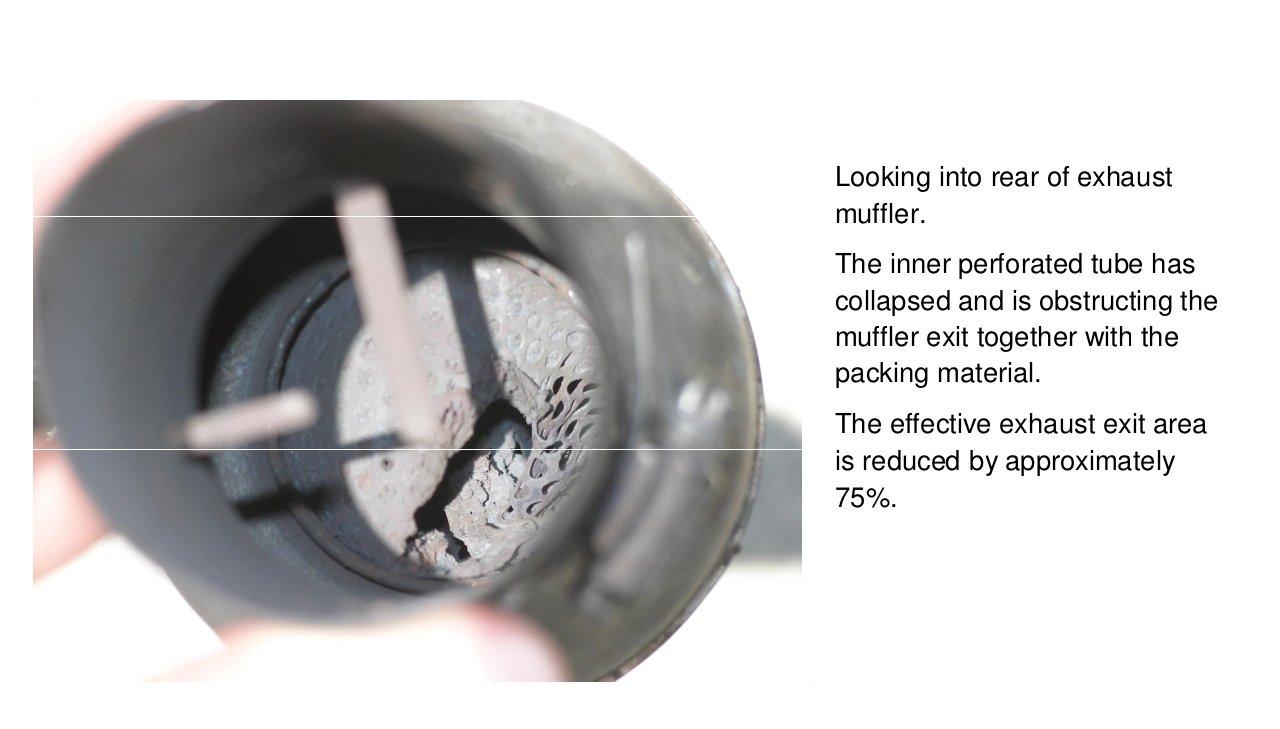
The fish mouth will help but beef it up. Keep a close eye on the inside of the muffler
with a Harbor Freight bore scope as something could melt in there and plug up the exit.
It has happened. Best to use mufflers with nothing inside them. One of the tricks is to
use a fairly large can with a air blast tube down the center to keep it cool.
Paul Lamar
Paul, the conclusion I came to on the broken drive was I had put a bearing on the bell
housing side of the drive just in front of the seal to center the shaft, but the hole that
held the seal that I used to index the bearing on was about .030" off center. So I believe
it was only driving one or two of the plant gears. See pic.
I like the idea of getting the muffler out from under the cowl. If you were going to build
one that mounted in the same place, and were looking for noise reduction more then
performance (I think I have plenty of power) what would you build? Also when I built the
headers I was trying to tune the exhaust, how important is that on the three rotor? Would
it make any difference in the noise level if done differently?
Mark Kirkpatrick
MSK6 20B
The best idea I can come up with for something under the airplane is a
coaxial type muffler. I'll do a quick 3D here. The outer shell is open
on both ends. The prop blast and the forward motion of the aircraft
will cause cooling air to flow through the muffler.
There is just enough sheet steel spacers to keep the outer shell
in alignment with the inner tube. Something like a 2.5 inch OD inner tube
with a 5 inch OD outer tube. 304 SS .035 thick outer tube and 304 SS .049
thick inner tube. Lots of 1/2 inch holes in the inner tube. The end
of the inner tube can be blocked or not blocked. Try it both ways.
Make it about 3 feet long.
I don't think tuning the exhaust will make much difference as far
as noise is concerned. The optimum length is around 32 inches
or more depending on your gear box ratio.
Paul Lamar
--
Paul,
I don't think I've ever seen a muffler design like that--it looks like it would offer less
drag than most other under-the-airplane designs. Should be plenty durable and cause very
little back pressure, though it would be heavier than a tangential muffler. Are you aware
of anyone using this design with a Wankel who could tell us about noise reduction
effectiveness?
Mark,
Have you got a web page or additional info on your plane design, specs and how you went
about designing and building this airplane? I'd be very interested in how you did it.
Mark Waldron
I am just guessing. I don't really know how well it would work but keeping
down the aerodynamic drag crossed my mind. The outer steel would weigh about
six pounds .035" thick. The inner steel 4.8 pounds .049" thick.
Paul Lamar
Thanks Paul, My main goal is to quiet down the engine would that design work with a fish
mouth end on ether the inner or outer tubes?
Mark, I don't have a web site at the present time. I did have one up for several years but
I was using space from the hobby shop I managed. We shut it down a few years ago.
Basically I started building model airplane with my dad a age five and had always wanted
to build a full size airplane for as long as I can remember. My models just kept getting
bigger until I finally got in one. I named the plane the Phoenix after the movie. Another
model airplane builder who didn't know you can't do that. I did take A&P classes at night
school while I was still in high school and Martin Hollman who did most of the engineering
of the Lanceair aircraft use to come into the shop a lot. He has a series of books on
aircraft design that I used. It took 12 years from the drawing board to first flight with
a lot of 'Life' getting in the way.
Mark Kirkpatrick
MSK6 20B
It might make a difference but the pressure in the inner pipe may be
so far down by that point due to all the holes I suspect the difference
might be hard to measure. Fly out to SZP some day and I'll buy you lunch.
I have a radio shack sound meter and we can make a few measurements.
With and with out a cap and with and with out fish mouth. I have plenty
of tools and creepers to work on the bottom of the plane.
Not needed on the outer pipe and would reduce the cooling air flow. I also
Have a Harbor Freight bore scope that we can use to inspect the inside
of the muffler you have up to any walls in there. If you have a long
1/2 inch drill it might be a good idea to stick it in the muffler
and drill a 1/2 inch hole all the way through as a safety measure.
Maybe a bunch of 1/4 inch holes near the front of the muffler
on the bottom. If it plugs up it can ruin your whole day.
I forgot what brand of muffler this was. See the attached pictures.
Here is a source for SS tube in 5 inch OD with .025" .028" and .032"
wall.
http://www.twmetals.com/contact/default.aspx
Paul Lamar
The Rotary Engine NewsLetter. Powered by Linux.
ACRE NL web site.
http://www.rotaryeng.net
Youtube key word UTUBPLEASE
Copyright 1998-2009 All world wide rights reserved.