Kindly asking for help in drawing renesis 13b and 16x engines in 3D
modeler software
(Catia and SolidWorks). Need dimensions, locations of attaching points,
intake and exhaust
ports, and all data, which can improve quality of engines drawings. Even
(planar)
photographs can help. Accepting most of known graphic formats. Thank you
very much.
B.r.
Viktor
Slovenia
Yes I read the paper professor :)
That is obsolete thinking. K&W and K&L came up with something better
after the war. That stuff is 70 years out of date. Where have you been? :)
I have some 3D's of the Mazda rotary engines in igs zip file format that
can be loaded into solid works. Can you receive zip files?
Paul Lamar
Hello,
Paul if it's possible please send me some 3D's of the Mazda rotary engines
in igs zip file format that
can be loaded into solid works, maybe do You have some mazda engine parts
3D's?
Best Regards
Damian Jurczak
OK here is the basic block.
Paul Lamar
Hi!
Thanks for Iges file. Is this 13B ? Location of main axis ?
We are trying to estimate how much place we need for two wankels in the front of airplane.
From your experiences what is the estimated maximum 2min shaft power without notable wear
of 13B and 16x supoported by turbo compressor? From graphs (
http://www.rotaryeng.net/) it
is between 350 and 400HP?
Regarding cooling system just wanted to help without changing configuration to much. Of
course there are newer and better solutions.
Just for remark regarding turbulators: About five years ago Mr. Joseph F. Sutter, a chief
constructor of legendary Boeing 747 had a lecture in our faculty (his parents emigrates
from Slovenia/Austrian-Hungarian empire to USA in the beginning of 20th century). As a
young lecturer (66 generation) I asked him "wrong question": If he used turbulators for
improving of wing performances. Everybody in auditorium was surprised with Sutters sudden
sharp denial answer. Something was behind. On Boeing 747 wings there are no turbulators,
but on newer Boeing models they are. Even on the highest level of USA aircraft technology
level there are still "warm" debates for and against turbulator usage.
B.r.
Viktor
Slovenia
That is the same more or less for the 13B and the RX8 engine.
The rotor housings are symmetrical so the center is the center.
350 to 450 HP is about right for take off. The 16x does not
exist yet if ever.
Maybe you can come up with some shorter ducts and show us
some actual data using turbulators to improve the flow
through a given heat exchanger if you have access to a wind
tunnel or a vehicle on the road at 160 Km/Hr. Take off speed.
I would start with a duct 280 mm long and a typical oil heat
exchanger 50 mm thick and 280 mm square. Record the number of
fins and tubes per cm for the test heat exchanger.
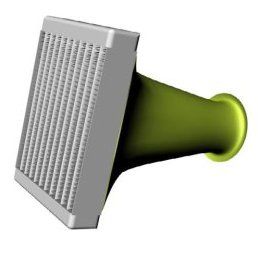
That is a common problem we have. Use the K&W coordinates for
the duct shape as a base line. Use a 125 mm dia. round opening.
Survey the pressure distribution over the face of the heat exchanger
relative to dynamic pressure with and without turbulators.
This would be a good subject for a professional society
paper and a good project for some of your students.
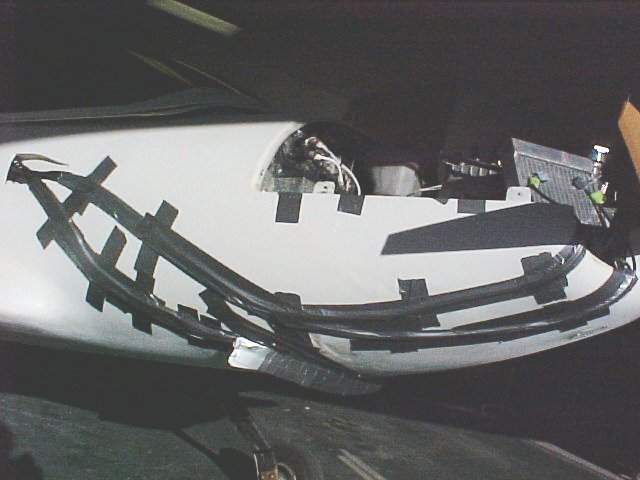
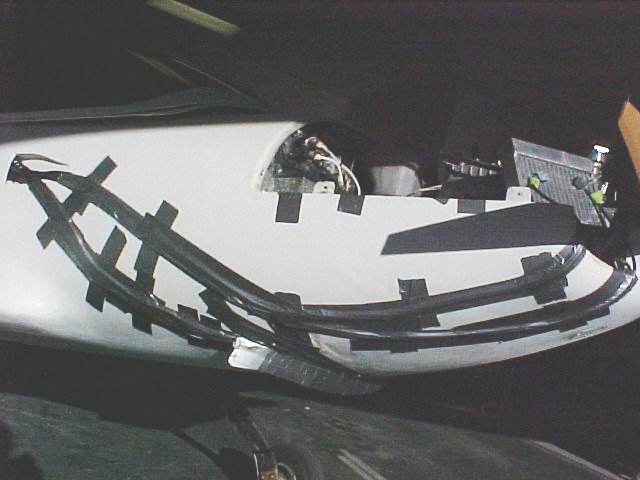
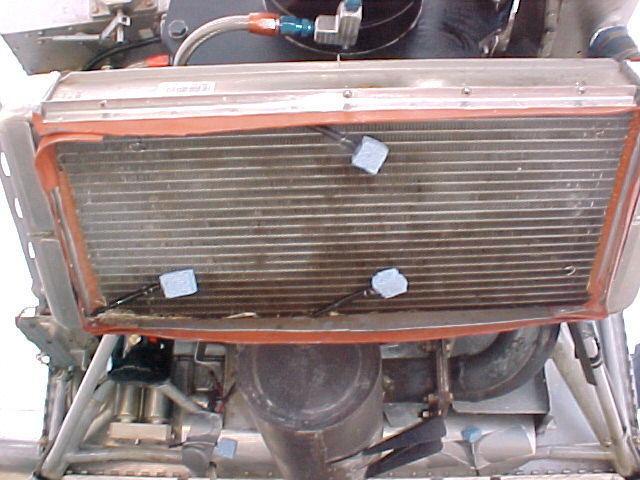
Here is some work I did along these lines.
Paul Lamar
--
The Rotary Engine NewsLetter. Powered by Linux.
ACRE NL web site.
http://www.rotaryeng.net
Youtube key word UTUBPLEASE
Copyright 1998-2009 All world wide rights reserved.