Hi Paul,
I haven't updated the group on my progress in quite a while, so today is a
good time to do that. As you know, I've been building a p-port 20B using
your design of slide throttle. The engine is together and in the
airframe.
In fact, I've actually flown it with the old intake (p-ports blocked off).
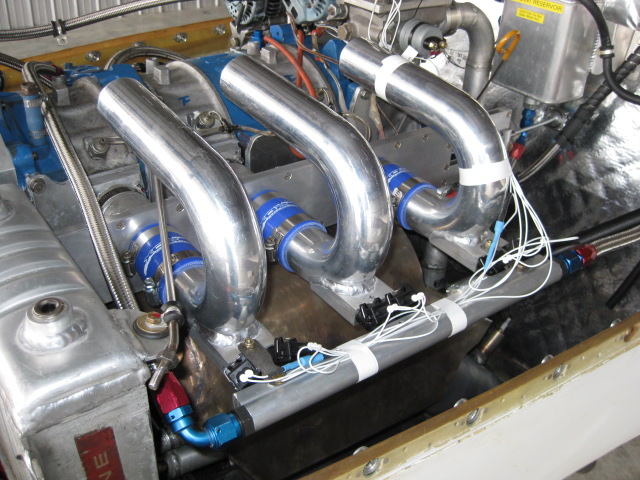
The slide throttle is also technically complete and installed in place of
the old intake. Today I ran the engine with the slide throttle, with
mixed
results. The slide throttle was very smooth open-to-close, until the
engine
started. With three rotors sucking against the slide, it immediately got
very difficult to actuate. On top of that, after the engine warmed up, it
became extremely difficult to slide. I figure that I can cure the temp
related problem by milling the teflon slide down .010 or so. However, I
was
hoping you would have some ideas on how to reduce the slide forces during
low/mid throttle settings.
Mark
Too bad I did not think of this earlier. Your engine is one third larger
than the two rotor so the force on your slide during the over run
at 15 psi is 124 pounds as opposed to only 82 pounds on the 2 rotor.
The coefficient of friction of Teflon is reported at .06
so in theory the load on the throttle cable, worse case scenario,
is 7.44 pounds. For a two rotor it is .666 of that or about 5 pounds.
From your description it sounds like three or four times that
number or .18 to .24. Mark Supinski says throttle force is no
problem on his two rotor p-port.
The brand or exact type of Teflon makes a difference. The friction
coefficient can be as high as .2 for some brands and types.
My suggestion is uses a fish scale and a sample chunk of the Teflon
you have and place a brick on the Teflon and try to slide
it along on aluminum sheet pulling it with the fish scale.
Weigh the brick and tell us what the brick weighs and the
fish scale reads. I'll do the same tomorrow with the
Teflon sheet I have.
Try to record the manifold pressure down stream of the slide
(on the engine side). 30 inches of Hg is 15 psi.
Teflon has a coefficient of thermal expansion .000075 inches per inch per
degree
F. So a temp rise of 130 F would be .00997 inches per inch. In 3 inches it
would grow about .030 so that is the total clearance you will need at top
and bottom. Thickness wise it would be only .004. The gasket in there
should cover that. It is more likely the height of the Teflon is
the high temp sticking problem.
The required slide travel is 2 inches so a throttle lever that moved four
inches
would reduce the force on the slide to half of what it is now. I think as
much as six inches of throttle movement would be acceptable. That would
give
you a 3:1 advantage.
The other thing to minimize is bends in the throttle cable.
The friction laws apply to that too. If you put a lever in there
you might design a pure push/pull rod system.
Paul Lamar
--
I'm surprised to hear how difficult the slide throttle is to move on
the 20b. As Paul said above, on our 13b the slide is silky smooth --
in fact it feels "just right", neither too difficult nor too easy to
move. A bit more friction on ours would not be a problem; it is a
long way from being difficult to move.
Having said that, we did at one point have a very balky slide throttle
-- we found the problem to be misalignment / binding of the throttle
cable where it entered slide body. The binding was variably bad --
which ended up being related to engine vibration either making the
binding better or worse. I would suggest checking for similar
friction in your installation.
Our solution was simple -- we enlarged the hole where the throttle
cable enters, and then beefed up the cable mounting structure to
minimize it's ability to allow the cable assembly to impart a sideways
force against the hole.
Mark Supinski
** Btw - we have test pilot now. We're making some final mods to the
muffler & then we'll be buttoning up the airplane & seeing if she
stays aloft.
Paul,
Thanks for the suggestions. It just dawned on me that some of the
heat-related binding may be at the top and bottom edges of the teflon. I
initially was only considering the two large sides, although there may be
some there too. I'll look for signs of binding when I disassemble it.
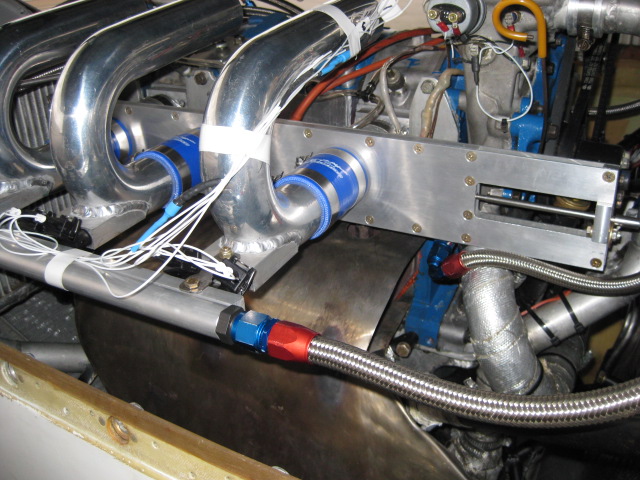
I replaced the throttle cable for exactly the reason Mark stated above. Now
it is only 36" long and a straight shot through the firewall into the slide
throttle as can be seen in the second picture. I may end up adding a lever
for a mechanical advantage as there is only 2" of throttle travel with the
current arrangement.
I will do the drag test and let you know the results.
Mark S.
Austin
You did a nice job on that 3 rotor slide throttle Mark.
Don will be in the market for one soon :)
Do you need bell mouths? I have them for $5 each :)
--------------------------------------------
I just noticed you are appearing to be using the apex
seal oil metering pump. Perhaps the 2 cycle oil in
Mark Supinski's fuel is making the slide move easier.
Paul Lamar
--
The Rotary Engine NewsLetter. Powered by Linux.
ACRE NL web site.
http://www.rotaryeng.net
Youtube key word PaulLamar2
Copyright 1998-2009 All world wide rights reserved.