Paul,
I have enjoyed reading your email list over the past few
months, and I have learned a lot about rotary engines. There
is no question in my mind that this is the engine I will use
when I start to build my plane. However, I have a few questions
that I am trying to answer.
The first thing I am curious about is whether P-Porting an
engine dramatically affects the life span of the engine. I
ran into a website that claimed that P-Porting causes "excessive
noise, extensive intake mods, very poor drivability and fuel
consumption, relatively short engine life, is very expensive,
and results in a narrow power band". The website can be found
here:
http://www.mazdarotary.net/porting.htm
Obviously they are focused on automobiles, not planes, so
some of these comments may not be relevant to airplanes.
They mention other kinds of porting on this site, including
mild porting, extended porting, bridge porting, and J porting.
What are your thoughts on this issue? Will P-Porting have a
negative effect on engine life? If so, how much (ball park)?
Would it be better to use another less aggressive form of
porting to get some increase HP if we wanted longer engine life?
I am inclined to use P-Porting, but I want to make sure I can
get 2000 hours out of the engine if I go this route. After all,
it is a lot of effort and expense to go through this each time.
Next, I was curious if it would be better to start with a
13B from an RX-7, or to go to an RX-8 (assuming money is not
the issue)? How about the 16B, is that engine available yet?
Is there a difference in HP between the NA 13B and the NA RX-8
engine? In your opinion, if you were an inexperienced newbie
looking for a two rotor engine in the 225 HP range, what option
would you select, and how would you acquire an engine?
Finally, I am baffled by the fact that Mazda does not sell
"crate engines". However, it seems there are plenty of new
parts for these engines on the market. Is it possible to
simply purchase all the engine parts new from Mazda and assemble
your own new engine, or is that prohibitively expensive? Are
there companies out there that do exactly this?
I apologize in advance for all the questions, but these
things just run around in my head all the time, and you are
clearly the most knowledgeable person to ask. Thanks again
for your excellent email list.
Dave Stoddard
Future Cozy MKIV Builder
No need to apologies. All questions are welcome.
The guy is in the biz of porting engines. What else can I say
other than it is a lot on nonsense. The 13B exhaust p-port
is ten times harder on the apex seals than any intake p-port
ever could be. The intake p-port actually cools the apex seals
which normally run about 500 F near the center. The fuel
consumption is actually lower in a p-port as less HP
is used to suck in air. The guy is a grinder and not
an engineer :)
IMHO the 16B will be vapor ware into the near future.
The over all cost of the p-port winds up cheaper as there are
no suitable manifolds out there for all the variations
of side ports. Just to name a few, there is an old four port RX4,
six port 13B, four port 13B turbo, Cosmo four port, RX8 four port and
RX8 six port. What intake manifolds there are... are too short
and mostly for carbs. People wind up kludging intake manifolds
and wind up with disappointing amounts of HP.
I think a P-port RX8 engine is the best of all worlds.
It runs as well as a stock 13b in our RPM range and
is quieter with a cooler exhaust. The intake manifold
is cheaper and lighter. The slide throttle cost
the same as a throttle body.
Mazdatrix will sell you all of the parts. Same goes for
Mears Motors in Lubbock Texas.
http://www.mazdatrix.com/
http://www.mearsmotors.com/
Read the whole web site as there are other links and lots
more info on there.
Paul Lamar
Paul,
I'm sure its been covered before but humor me. Why do you advocate PP intake
ports on an engine that presumably is then going to be breathing limited
with side ports on the exhaust side (RX8 engine)? Seems to me that in the
interest of HP the best choice would be an older 13B with PP on both intake
and exhaust? Show me where I'm wrong (purely from an HP perspective). As you
know I'm well aware of the noise issues with the 13B PP exhaust ports (mine
are turbo housings without splitters).
Mike Wills
It is quite simple when one looks at the pressure differences involved.
On the intake side one has only a few psi difference to suck air into
the engine. The amount of HP generated is directly proportional to how
much air one can get in the engine.
On the exhaust side one start's with well over 100 psi and one is pumping
that out of the engine to only 15 psi at sea level. 85 psi difference.
It is far more important to streamline the intake and tune it using
organ pipe theory to archive a 120% volumetric efficiency which is what
you get with a tuned P-port.
I was pleasantly surprised to get about the same HP on the P-port
RX8 as we got on the p-port 13B. We tested both on the Mazdatrix dyno
with a similar muffler system. The RX8 had a slightly higher compression
ratio. Both had the same Weber 51 mm carb. If anything the exhaust manifold
on the RX8 was worse than the tuned header we had on the 13B.
Paul Lamar
This is precisely why conventional reciprocating engines
_all_ (as far
as I know) have more intake valve area than exhaust valve area.
Ford's 3 valve engines have two intake valves and one exhaust.
Audi/VW 5 valve engines have 3 intake and 2 exhaust valves. I guess
one other factor for these poppet valve engines is that a smaller
exhaust valve might be easier to cool.
Mazda has had the port size relationship backwards until the Renesis.
Matt-
Strictly on the basis of port area I don't think so Matt.
The 13B P-port exhaust is smaller than it looks. In a six port 13B
you have to add the area of 3 side intake ports for each rotor.
The RX8 side exhaust ports are 17% more area than the 13B p-port exhaust.
That could be another reason we are not losing more power in the
RX8 intake P-port engine.
Port area of course is not the whole story as the air can be going through
there up to 400 MPH. A straight shot is therefor better than a bunch of
right angle turns.
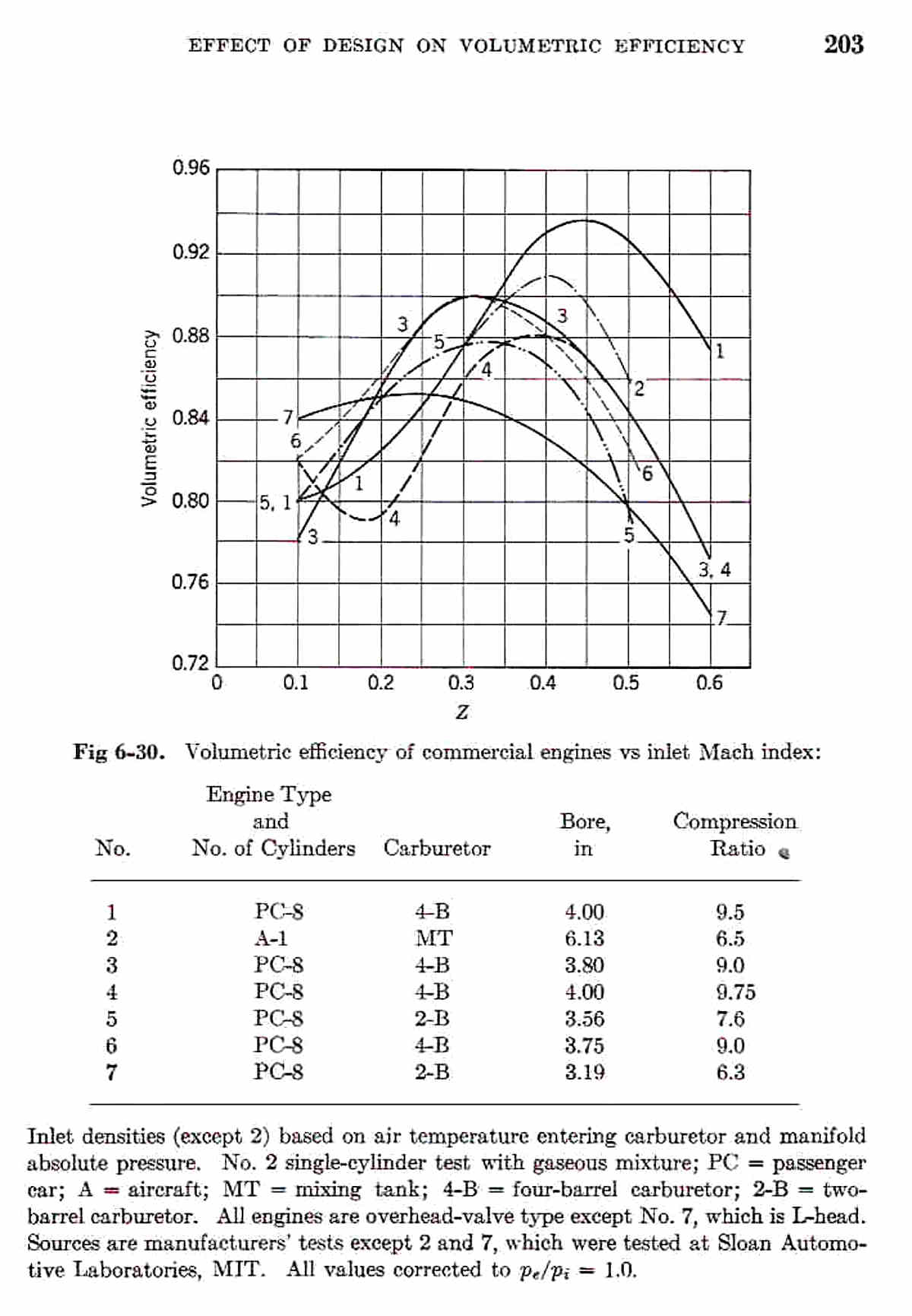
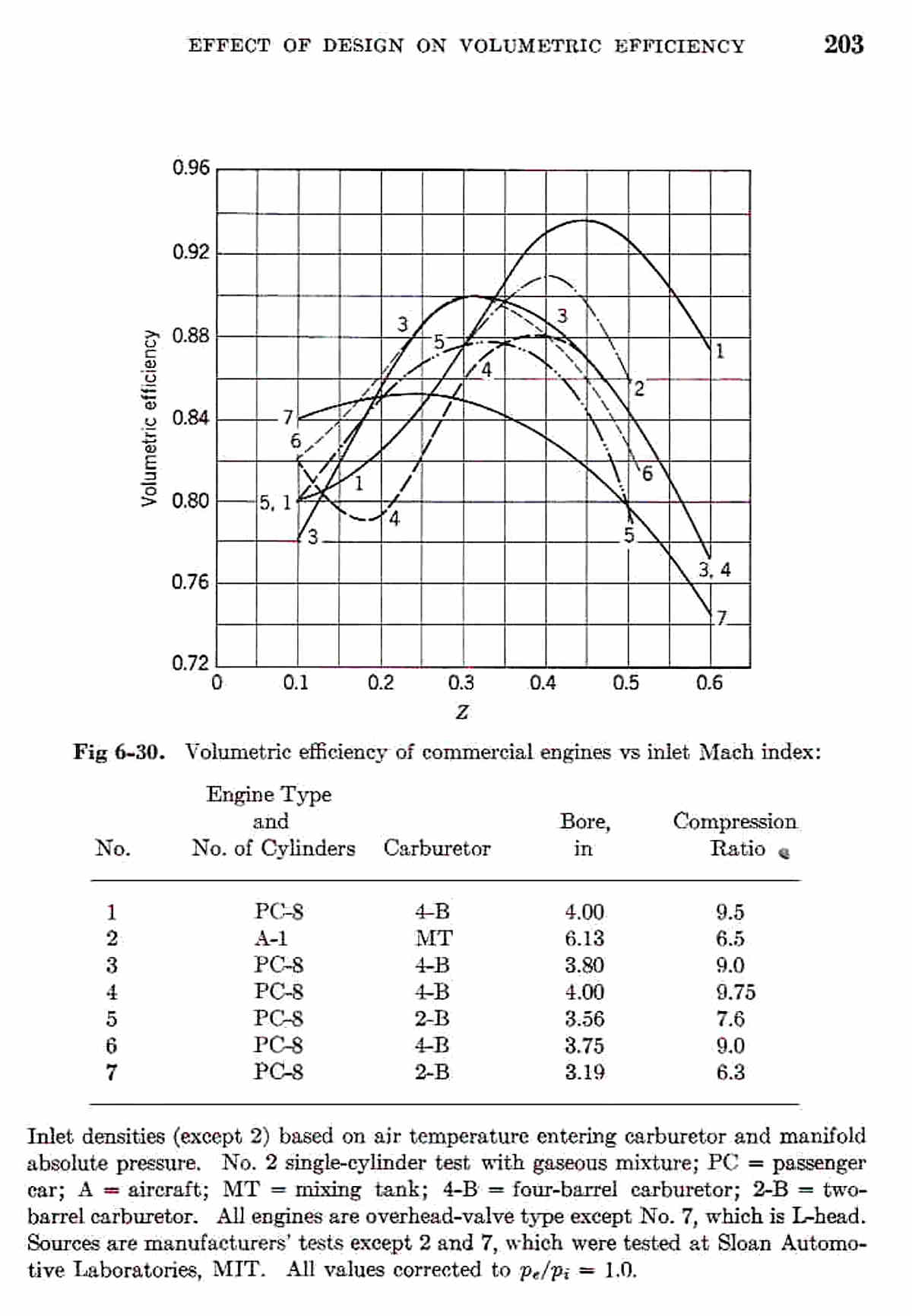
Charles Taylor at MIT did some work on this subject years ago.
Note curve 2 which is the VE of an aircraft engine that did
rather well. Modern engines with multiple intake valves can do
better but not as good as a rotary p-port at 120% VE.
Paul Lamar
--
The Rotary Engine NewsLetter. Powered by Linux.
ACRE NL web site.
http://www.rotaryeng.net
Youtube key word PaulLamar2
Copyright 1998-2009 All world wide rights reserved.