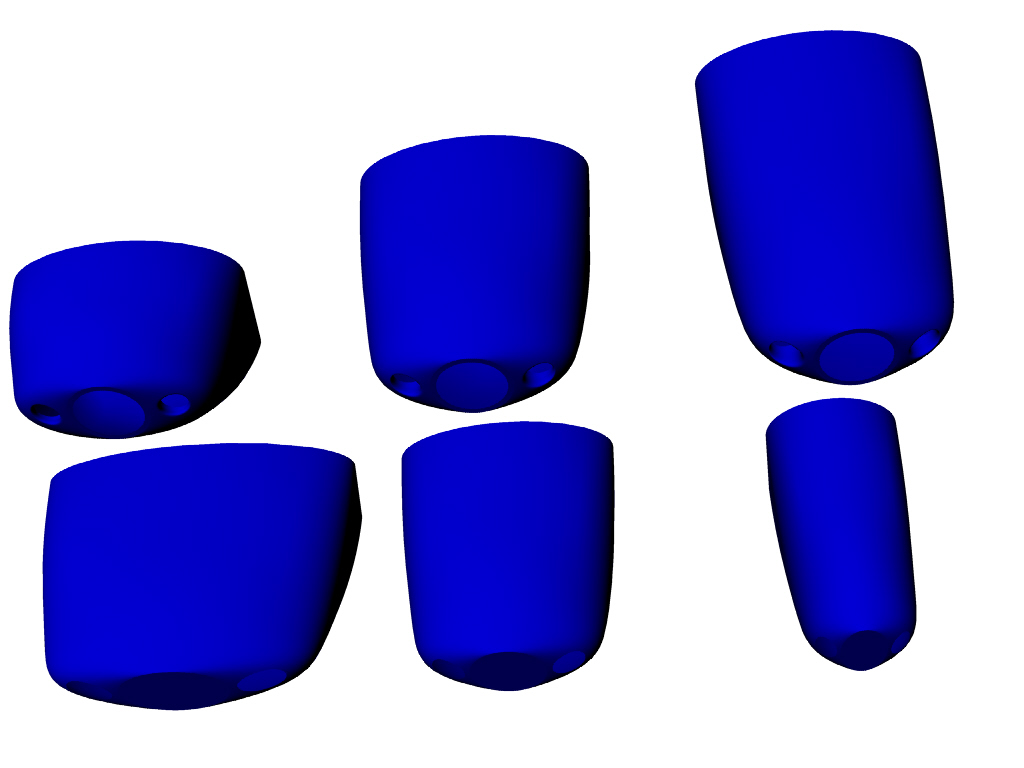
In order of when received.
Please vote on your favorite.
The first 3 were done with Solid Works.
Jeff, Jarrett and Larry.
The next one was done by George with Rhino.
George did a remarkable job based on only
three weeks of learning.
I took George's design and used Rhino
to make a few improvements like radius the
cooling openings for the last entry.
IMHO the point is that the $4000 cost of Solid Works
is hardly justified compared to the $1000 cost
of Rhino. They both do simple things like
mechanical parts with about the some quality.
Solid works has a slight advantage for mechanical
parts.
IMHO Rhino is clearly a better tool for cowlings.
Paul Lamar
--
All of these look great, I'd be happy to have any of them on the front
of my plane (if I had one:( )
- Part of the choice boils down to what a user wants--something that
looks "conventional" even though we don't have a horizontally opposed
engine under there, or something that looks good and also fits the
actual cooling requirements of our installation.
I vote for Larry's design, with Jeff's as a close second.
If I had any talent and any skill with Rhino, I'd draw a wide, thin
profile design like Larry's, but with no intakes at the front, and put
a wide scoop underneath to feed a low-mounted horizontal radiator.
Again, all are great. Thanks to all for contributing.
Mark W.
Paul
You attached the same file twice, there was a file called "RV10 cowling
stock"..
SW is a very powerful program but Surfacing is not it's strongest
feature. Try fairing surfaces in a wing root and you will see what I
mean...There are people that can do that but very advanced users..If you
need to make a living doing designing, SW is the best value out there
with great support.........
I built over 5 different versions of this cowl (others not sent) by just
changing numbers on sketch's in minutes once the main body was
created.....parametrically it's awesome....
jeff
Sorry, Can you send it again as a iges or step?
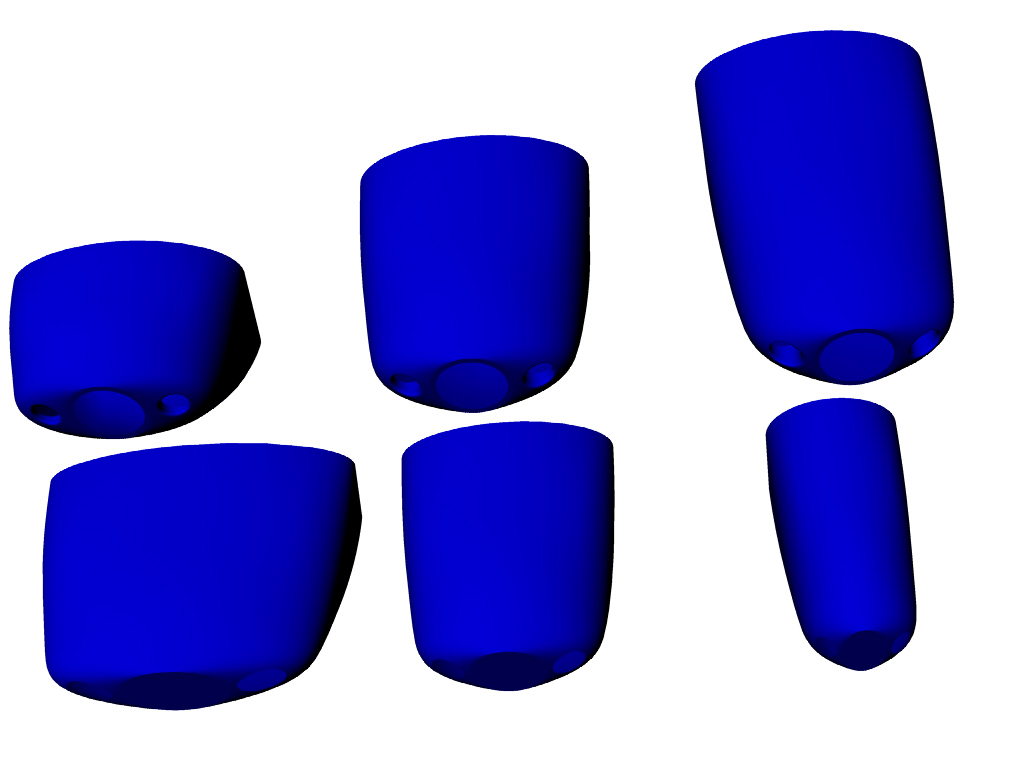
What I did on all of them was render them twice. Once to show
the mold lines and the other without mold lines. In Rhino they
are called "curves" and "iso curves". One can learn a lot about
the process by looking at the mold lines.
The same thing is done in Rhino by turning on "control points"
and dragging them.
--------------------------------------------------
All six of these cowls are the same Rhino dwg.
They are just scaled 1D, 2D or 3D. One step process.
Paul Lamar
--
The Rotary Engine NewsLetter. Powered by Linux.
ACRE NL web site.
http://www.rotaryeng.net
Youtube key word PaulLamar2
Copyright 1998-2009 All world wide rights reserved.