This weekend the Aus Formula 1 GP is on the
Speed Channel sponsored by Mazda.
Still using that high fuel consumption rear wing
and 300 pounds (weight) 48 gallons of fuel.
Paul Lamar
Good day,
KERS system out the door this season also.
Offsets fuel load somewhat. So much for being "Green".
Al Koivisto
Vettel got the pole, Webber was second both in Redbull Renault
and Alonso 3rd in a Ferrari.
This year most of the guys were complaining about not enough grip on
the front tires. Roughly two years ago I had a friendly disagreement
with somebody about the FIA intention to reduce front tire width. He
was for it and I was against it.
Here is my main rational.
http://www.rotaryeng.net/AIAA-Paper.pdf
You want all the grip you can get. You can always
balance the car with roll stiffness distribution, down force
distribution and fore and aft weight distribution.
Paul Lamar
Hi Paul,
You are absolutely right on the FT Tires situation, but the reason the F1
guys requested that change was because with the KERS installed, the spec
Engine and spec Gears, it was virtually impossible to achieve the desired
weight distribution. They also got to rise the weight limit to 620Kg to
allow for the KERS (Then decided not to run it!!!). That last change was not
necessary, any F1 car worth its while had around 80 kg of ballast, with the
KERS (~30Kg) still left 40/50 kg to play with and added the narrow FT tires,
no need to increase the mass, hence the inertia in case of accidents,
another oxymoron of the rule book!!
Best Regards,
SR
I suspect the reason KERS was not more successful was the six second per lap
use rule. Formula 1 cars spend a large percentage of the lap time braking
and therefore accumulating energy. If that had been increased to say 10
seconds then I think KERS would have been a clear advantage on most tracks.
I still hope the FIA implements turbo compound as unlike KERS it works on
the autobahn at steady speeds. Formula 1 would be doing the world a great
service if that happened.
My opinion on the wake turbulence is this. Anytime
any method of generating down force is used it is also going to generate
turbulence due to an overall pressure difference between the bottom
of the car and the top of the car. This pressure difference causes twin
vortex's behind the car. Air flows from the high pressure area on
top to the low pressure area on the bottom behind the car.
The same is true of wings. It is related to induced drag. The simple
formula for the induced drag factor is Cl squared over Pi times the
aspect ratio. The aspect ratio in this case is the width of the car
divided by its length. In the case of the rear wing it is the span
divided by the cord. You now have two vortexes from the wing and two
from the car all mixed together.
Sailplanes reduce the induced drag by increasing
the span. Another way of looking at it is called span loading.
Basically that is the lift or down force per foot of span or car
width.
I suspect the best way for the FIA to reduce over all span loading
and the resulting turbulence is disable the rear diffuser by specifying
the angle and allowing a full width rear wing. Down force on the rear
wing could then be limited by a simple span and cord specification with
no slots allowed.
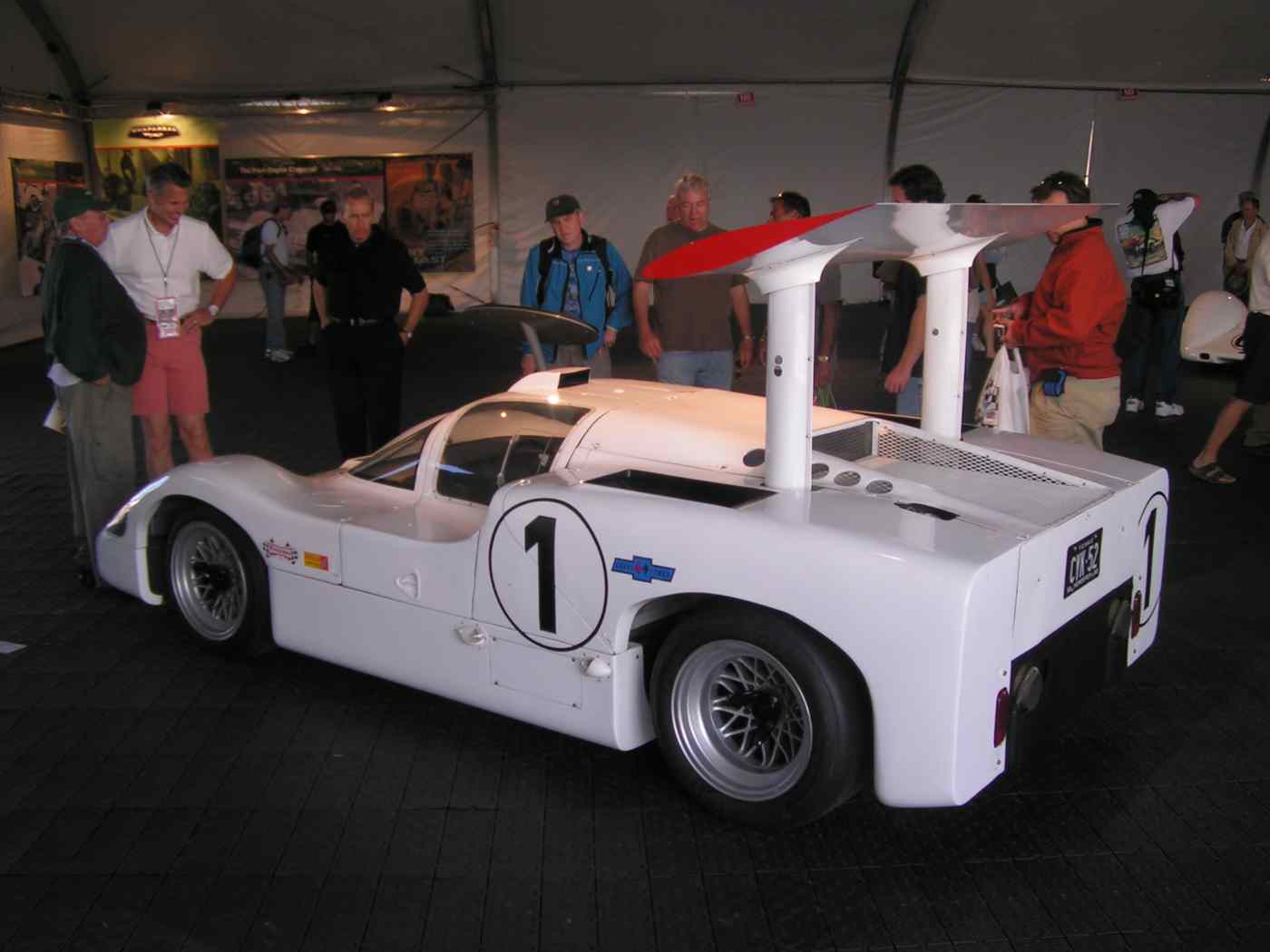
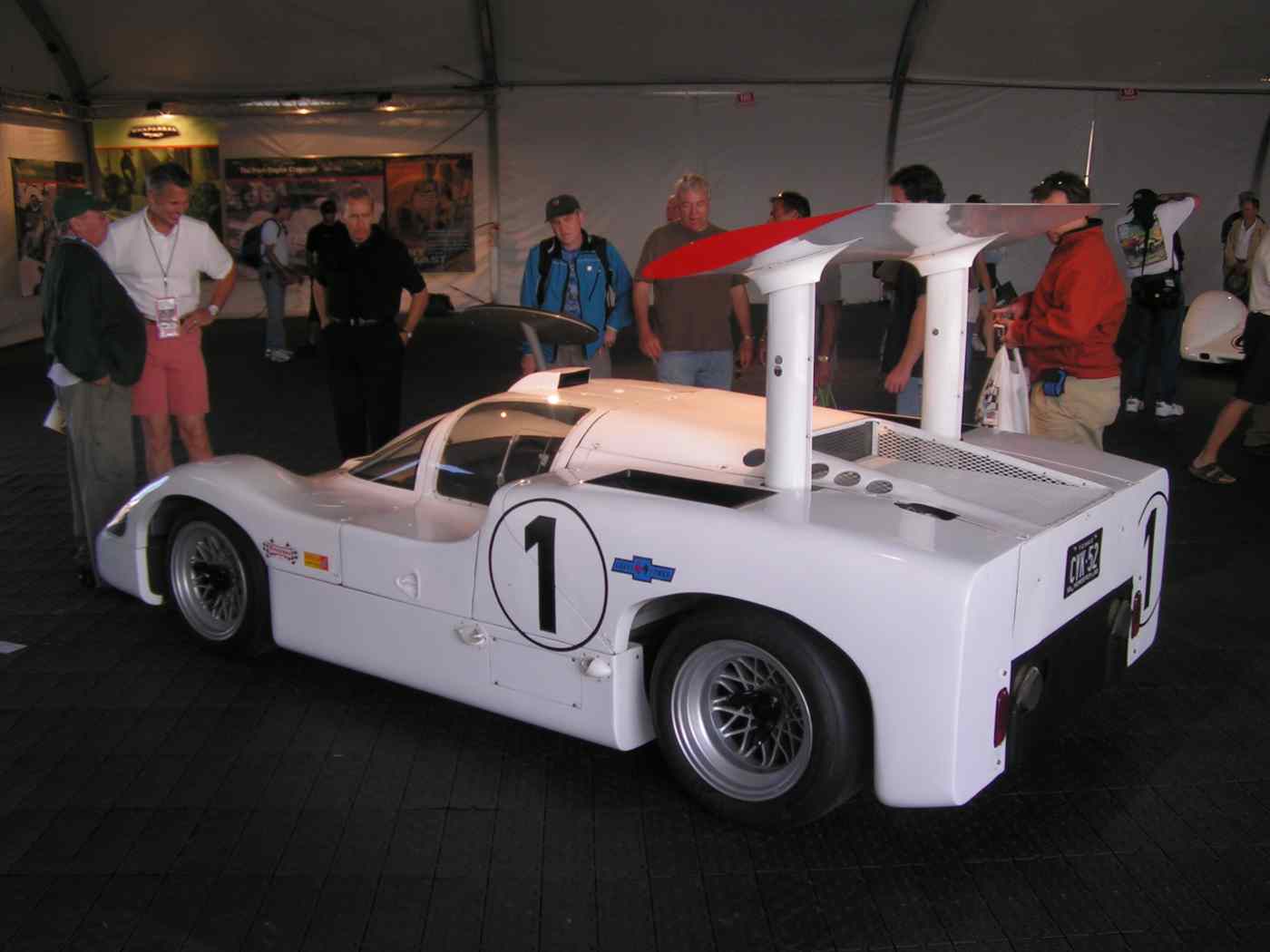
BTW my first experience with diffusers was on the Chaparral
in 1966.
We designed a belly pan to go under the aft portion of
the 2F. It promptly failed on the first track test. I looked at
the failure mode and concluded there was a high amount
of down force on the belly pan. We beefed it up and used it.
The diffuser angle we used can be deduced from this picture.
The wing airfoil is symmetrical because we were allowed to
flatten the wing on the straights eliminating the wing vortex's.
Nobody complained about not being able to pass.
Paul Lamar
--
The Rotary Engine NewsLetter. Powered by Linux.
ACRE NL web site.
http://www.rotaryeng.net
Youtube key word PaulLamar2
Copyright 1998-2009 All world wide rights reserved.