Why yes; yes it does...
While investigating our poor oil cooling performance, I disassembled
the stock RX-7 oil cooler to confirm the bypass port was properly
closed. Imagine my surprise when I looked into the oil intake port
and saw what appeared to be a large amount of foreign metal coiled up
in the port. I reached in with a pair of needle nose pliers and
proceeded to remove eight 1/2"x18" metal strips in varying degrees of
jumble inside the intake port. (photos below)
After inspecting them, it became clear to me what these were.
Apparently, these were inserted into the oil tubes and served to
turbulate the oil as it flowed down each tube. No doubt to increase
heat transfer & prevent laminar flow/boundary layers from forming. In
our installation, we had oil flowing into the outlet, and out of the
inlet. This apparently dislodged these turbulators, and allowed them
to fold up within the port area at the end of the cooler. Not only
was no turbulation happening, but no doubt flow was restricted by all
the tightly jumbled metal.
I spent 15 minutes or so carefully removing all the turbulators (there
being no way to reinsert them).
My question to the group: Is this oil cooler now officially shot?
Does the lack of these turbulators render the cooler useless? Our
intent is to go ahead and reassemble it and give it a try -- the
resulting cooling can't be any worse than we've been seeing after all.
Mark and Terry (Rocky Mtn High)
New one on me. What weight oil are you running? Did you start it up
on a cold day?
I think it is shot.
Paul Lamar
Sorry for the improper format in my previous reply.
Forgot to mention, it is necessary to cut off the end tanks to get the mesh
out. Yours may have an oil thermostat on one end.
Ed Carver
Mark, what is the status of the oil cooler. Are you going to replace it
with another RX7 cooler? I cannot for the life of me figure out what
happened. Either the cooler was not brazed properly or near solid
cold oil forced the turbulators out of the tubes under the influence from
the oil pump. Highly unlikely. For those brazed joints to fail it took a
lot of force. First time in eleven years I have heard that happen.
Perhaps the lack of the oil thermostat had something to do with it.
When the oil was cold it was more or less solid. What weight
oil are you using? 5 W 30 or some such should be used.
Paul Lamar
We flew again today to test the changes we'd made. Changes included
the removal of the turbulators and reshaping the KL wedge to more
perfectly match the ideal shape.
Net result: no apparent improvement in cooling; perhaps slightly worse
cooling. Not remarkably worse cooling, and temps today were about 20F
warmer than previous flights, so might not actually be worse at all.
We're running Mobil 1 10W/30. Given our temps here, chances are 100%
we ran the engine any number of times after overnight temps in the
teens or twenties.
Going to make a few more changes using the existing cooler to see if
we can get temps more reasonable. If not, we will almost certainly go
with a different after market cooler(s) vs getting another rx7 core.
Mark & Terry
Take the cooler out of there and pore oil through it to be sure
there are no left over obstructions in the tubes.
When I get back I will do a similar test on an RX7 cooler I have.
In theory those turbulators are very important. Also try a fixed
fixed (for now) cowl flap. Is the max fuel burn still 17 GPH.
Paul Lamar
Oil flowed through, although somewhat sluggishly. I hooked the cooler
to a water spigot and the water flowed through just fine at 40psi.
I'll pull a vacuum on it tomorrow to dry it out before I install it in
the new location.
Max fuel flow during the last flight was 14.4 gph. Terry put the
airplane into a 150mph dive and still did not get a rpm above 6600. I
don't know if he was at WOT during the dive, but I'm guessing he was.
Mark
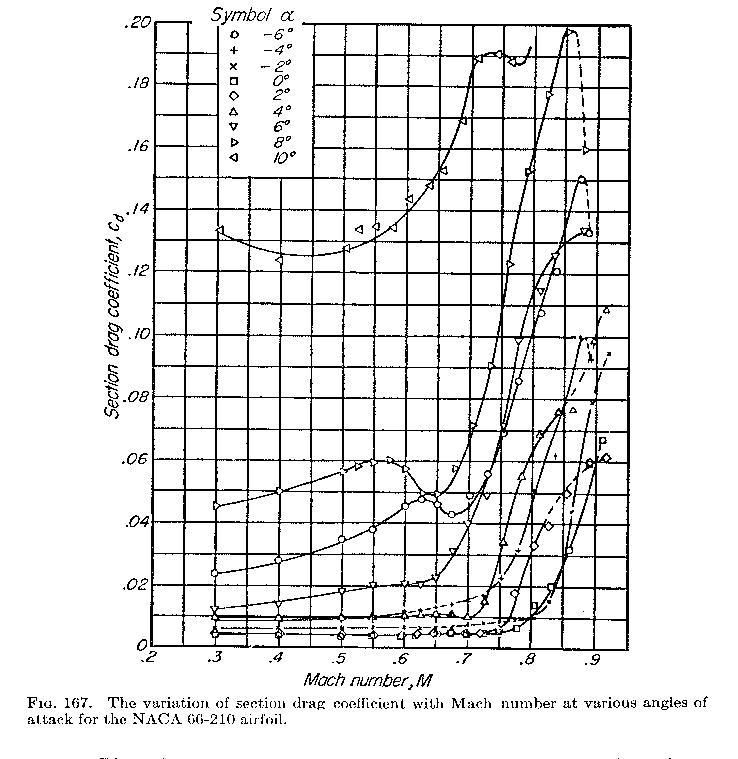
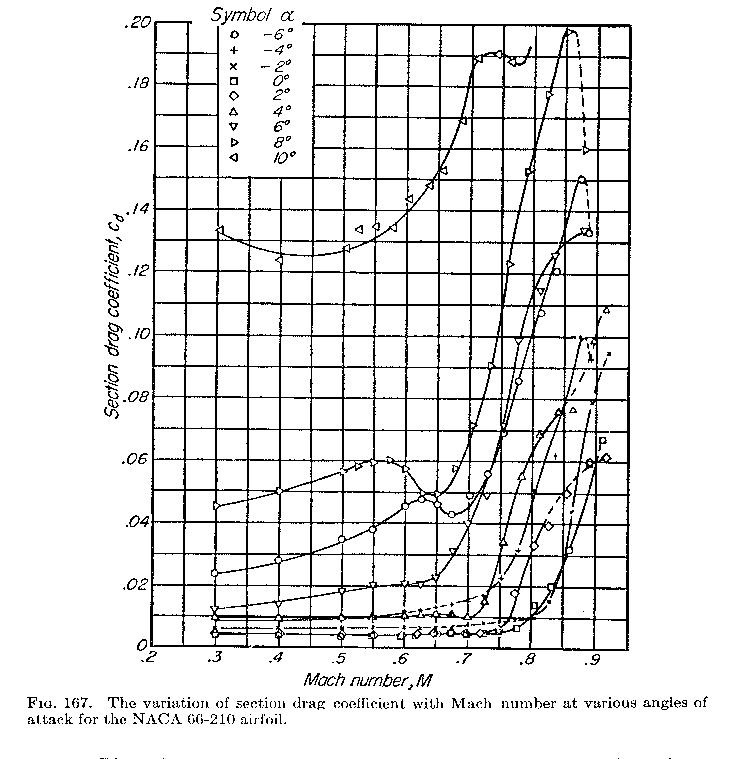
That shows all signs of tip speed limited. Even though it is
only Mach .7 if there is a finite angle of attack the C sub d
shoots up. See the attached chart from Von Doenoff.
Yes a Lycoming will turn that 2300 prop RPM at sea level
but not static sitting on the ramp. I can barely get 1900
out of my Cont. 230 HP O-470 at fine pitch sitting in the run-up
area near sea level as I recall.
What are other people seeing on here ?
Ideally you want a super thin airfoil at the tip with
zero angle of attack at max speed. The zero angle of attack is at
the vector sum of the forward speed of the aircraft and the
circumferential velocity of the tip. I suspect you don't have
enough pitch. Tracy and Ed Anderson are both running a 73 inch
dia. 88 pitch with a 5.25 inch wide blade. As I recall you
mentioned a 77 inch pitch.
One must also add the HP consumed by the trust.
If you are on the back side of the HP curve due to too lean
that will also show those symptoms. My guess on the p-port HP
at 9000 feet is 200 so if the fuel mixture is set to 12.5:1 for
max power and the BSFC is .65 as Lynn mentioned than the engine should
be sucking down around 130 pounds an hour or 21 gallons an
hour WOT. Are there any lower airports around there?
Paul Lamar
--
The Rotary Engine NewsLetter. Powered by Linux.
ACRE NL web site.
http://www.rotaryeng.net
Youtube key word PaulLamar2
Copyright 1998-2009 All world wide rights reserved.