Hi Ed,
I remember your fuel trim map from Sun n Fun.
Where is your manifold pressure tap located if you don't mind?
Paul
Not at all, Paul
I have two MAP taps - I use the stock ones in the lower N/A cast aluminum
manifold that I adapted for my two secondary injectors. I just run a tube
off of each and then I "H" the two tubes together before a tube on each
outside leg of the "H" takes the pressure to the MAP sensor barbs in the
EC2.
The idea was in the unlikely event one MAP tap became plugged, both MAP
sensors would get pressure from either tap. Also I figured it might dampen
the pulses a bit. I've never had any problem taking it from those locations
- they appear far enough away not to be perturbed noticeably by the opening
and closing of the intake ports.
Many advocate taking the tap just behind the throttle plate - probably OK,
but I figured there is likely to be a bit of turbulence in the wake of a
partially opened throttle plate - so I would put them at least 3-4 inches
behind the throttle plate - just an opinion, no data to support it.
Ed
Ed Anderson
That is what we found by sampling the MAP at 1000 samples per second.
Is there anyway you can take a picture of your EC2 interface
fuel trim map?
Paul Lamar
Hi Paul,
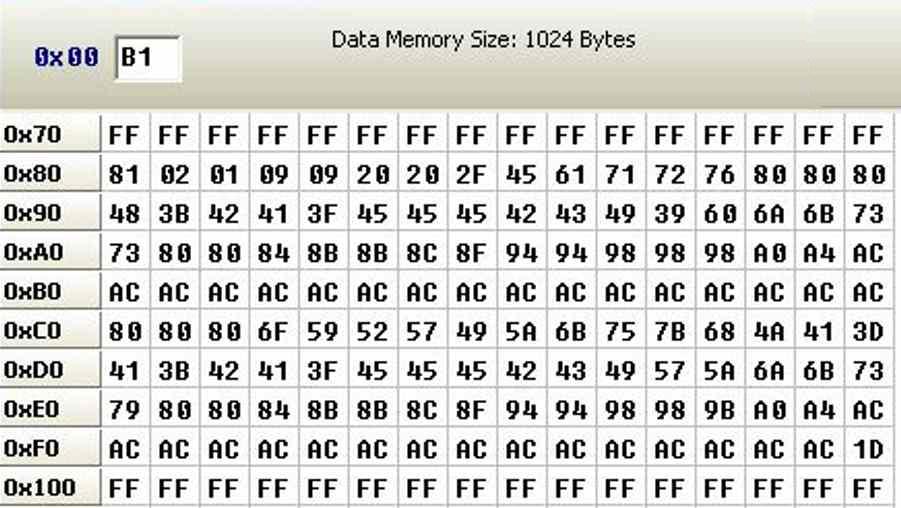
Here is a print screen of my fuel map values in Hex(of course). If you
start at EEPROM location $80 (value 81) and take that as fuel bin pointer
location 0, then as you step from $80 location through the 8 rows of data to
position 128, the value at each location corresponds to my fuel trim. These
are actually values I fly with.
Now since my engine stages, the maps from location 18-67 are seldom (if
ever) functional, because when it stages it jumps from the high teen pointer
location to the mid 60s pointer location. So since my engine seldom
operates in those in between areas, the fuel map may not be as refined as it
could be. The map values can range from zero to 255, but in my case there
was no power increase once the value reached 172 and the green air/fuel
indicator indicated full rich, so that is as high as you see on my map. The
white bar in the photo indicates the selected position with its values
displayed in white below the map, red map value to the left, blue map value
to the right of the selected (white) position - for ease of extrapolation.
This map can be expanded into two display screens for old eyeballs, but this
shows the total map.
Looking at the photo of my fuel map, my operating point jumps from the
yellow region to the blue region in normal operation as the EC2 stages. The
low value area after the blue idle peak is where I am normally operating in
crease (leaned out), the high 172 value region after the cruise is my power
setting area for take off, climb out or (very occasionally WOT dash to clean
out the cob webs).
I undoubtedly am operating in the red region during descent, but since I
have the power pulled back, the settings you see appear to be adequate (i.e.
engine keeps running).
The high peaks at the beginning of the yellow and blue regions are idle
settings which, as you know, require a richer mixture ratio due to the
higher percentage load the auxillary subsystems (alternator, oil pump, water
pump, friction, etc) are of the small power being produced at idle.
This is using 4 x 460 ccm/in injectors (stock Mazda N/A injectors) and a 65
mm [2.55 inch] dia TB.
Needless to say, this map may have little bearing the map for an engine with
different port timing or port positions. Hope it provides some useful
information.
Ed
Ed Anderson
Rv-6A N494BW Rotary Powered
Matthews, NC
eanderson@carolina.rr.com
http://www.andersonee.com
Thanks Ed.
That looks extremely helpful. It appears to have a PC interface
to read out the map to a PC. Is that correct?
As I recall you have a 72 dia. 88 pitch Performance wood prop
and a 2.85 PSRU on your RV6.
What is the top speed at what engine RPM?
Gross weight of your airplane?
Max climb rate in FPM?
Cruise RPM and fuel burn?
Paul Lamar
--
The Rotary Engine NewsLetter. Powered by Linux.
ACRE NL web site.
http://www.rotaryeng.net
Youtube key word PaulLamar2
Copyright 1998-2009 All world wide rights reserved.