This subject keeps showing up like a bad penny.
Don't forget we use a 2.85:1 gear box so
prop torque is 2.85 times engine torque.
The p-port is about 200 foot pounds
and the side port is about 160 foot pounds
if both are tuned correctly.
That means the prop torque on a P-port is 570 foot pounds
and 456 foot pounds prop torque on a side port.
Paul Lamar
TORQUE "LET'S TORQUE ABOUT HORSEPOWER"
It seems that wherever you go, people seem overly obsessed by torque. "Yeah
that engine may have a lot of horsepower, but it really takes torque to turn
that prop", just as if we were talking about two unrelated characteristics
of the engine. Yes! It does take torque to turn that prop, but torque alone
is almost meaningless in describing power. Torque is only a measure of
force, specifically operating on a lever arm. The most common English unit
of measure being foot-pounds. This perhaps best represented by the Torque
wrench in your toolbox for tightening critical threaded joints. When the
book says tighten to 40 foot-pounds, you could do this by applying 40 pounds
force at the end of a one-foot long wrench, or 20 pounds on a two-foot
wrench. The torque is the product, force times lever length. Just to make
things more complicated, the English unit for "work" is also the product of
pounds force times feet (distance rather than arm). Many references try to
sort this out by using pounds-feet for one and foot-pounds for the other,
but if you are easily confused like me, just make sure you identify the
units you are using as either torque or work.
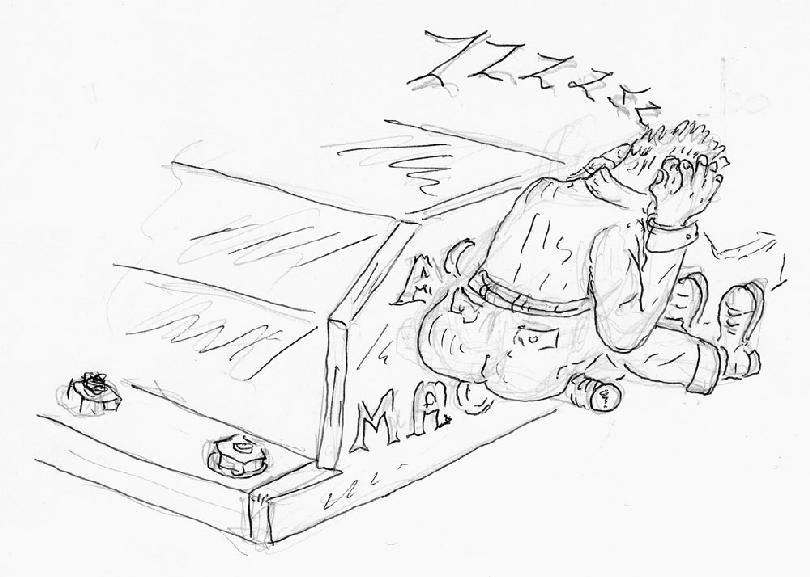
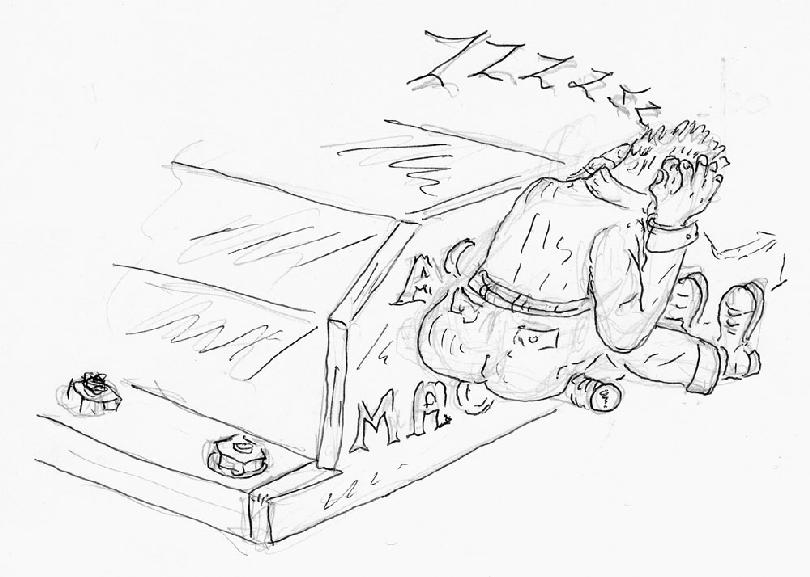
A simple-minded cartoon might help - we have two employees at Acme Machine
Company. Our first employee is resting (possibly sleeping) on the machine
handle. He is providing torque - if it is a two foot handle, and he is
resting 100 pounds of his weight on this handle, the torque is 200 foot
pounds. Even though he is being paid by the hour, he is not doing "work", a
totally inert 100-pound weight would accomplish just as much.
See jpg #1
However, our foreman's "pet" George is busily cranking away on his machine,
applying a force and rotating the handle at a useful rate. He is doing work,
and not just because he is getting tired and sweating. Rotary work is torque
times the distance around for each turn completed. Power is the rate of
doing work, or in this case torque, times 2PI (6.28) times the number of
turns per time unit, a typical answer being in foot-pounds per minute, or
per second.
See jpg #2
HORSEPOWER - THE PONY TO PUT YOUR MONEY ON
As we stated above, power is the rate of doing work. Early in the days of
steam engine development, one of the first uses was for pumping water out of
mines. Horses were used for this job, rotating mindlessly around a turnstile
to drive the pumps. In order to sell a steam system to a mine owner, you
would need to tell him how powerful it was. An enterprising young man named
James Watt observed and measured work being done by horses, and decided that
it was about 550 foot-pounds per second (either he was watching union
horses, or was foretelling current advertising techniques of the auto
industry, for any self respecting horse can easily exceed that work rate).
Thus, a one horsepower work rate is equivalent to lifting 550 pounds one
foot per second, or any other equivalent product such as 100 pounds 5.5 feet
per second. For rotary work using torque, the distance is around the circle;
horsepower is torque times 2Pi times turns per second, divided by our 550
number (for rpm the divisor is 33,000). If you have some horsepower, in a
manner of speaking you might say, "Torque is cheap" (groan), just gear her
down". That is the secret of bulldozers and tractors, which usually have
surprisingly modest horsepower. As we see from the computations, rpm alone
is also not an automatic indication of power.
SOME TORQUE MYTHS
"Long stroke makes more torque". This one probably came from the old method
of sizing engines for tax purposes. This barbaric custom was common in
England and Europe, the British RAC and French CV being good examples. Total
piston area was the criteria, using old state of the art values for piston
speed and BMEP (brake mean effective pressure) (1000 ft/min and 67.2 psi,
specifically). The figure below is a good indication of the state of the art
when these rules were laid down.
See jpg #3
>From a first edition Mark's Handbook of 1916, this was a six cylinder Alco
engine with 4.75 bore, and a 5.2 in, stroke for 553 cubic inches. The famous
old Austin Seven was named for the seven RAC horsepower under those rules.
The Citroen 2CV and the Renault 4CV are other examples. It did not take car
builders very long to realize that they could offer more performance (for
their tax dollar) at the same RAC tax horsepower, by lengthening the stroke.
More torque?, of course - well DAH!, it is a bigger motor. Obviously you
could also increase torque an equivalent amount by increasing the bore, but
the tax man was at the door waiting. This is the reason that all those early
postwar engines had ridiculously long stroke.
"Them Diesels make more torque than gas engines". This is a true mistake of
perception, brought on by comparing big truck Diesels with car engines. This
myth has been at least Partially discredited by General Motors unfortunate
350 inch "Olds" Diesel. The truth is, that for the same displacement and
manifold pressure, the Diesel will provide significantly less torque (and
horsepower) than the equivalent gasoline engine. The reason for this is the
fact that direct injection has problems providing a uniform mixture ratio
distribution, such that at full throttle you run into the "smoke limit".
This is typically at a much leaner mixture than the near stochiometric
operation at full throttle in a gasoline engine. If you can't usefully burn
the fuel, you cannot make the power.
PERCIEVED TORQUE
"I know torque when I see it, and them rotaries don't have it". Most people
do not have a real feel for what torque is and what it does. What they have
experienced is typically with a manual transmission, a lack of acceleration
from a cruise to a passing situation. This is best described as a "peaky"
engine with a reduced area under the power curve. In today's overdrive
world, we are cruising 5000rpm engines at about 2000rpm at highway speeds.
If we do not have a "fat" power curve, there is not much extra power
available in going to full throttle. Modern automatic transmissions have
made those "torque holes" almost invisible, and an aggressive driver has
already downshifted.
SOME TRICKS WITH TORQUE
It is often desired to have a power curve for an engine, and the data is
difficult to obtain. Most specifications do list peak power at the given
rpm, and peak torque at that given rpm. Of course it is good to remember
that for advertised data, that the sales department gets two votes, while
the engineering department gets only one vote. By using the simple equations
you can convert that data to two torque points and/or two horsepower points.
Now, you high school teacher wisely told you that you should not try to draw
a curve with only two point. However, we also know that these points are
tangents on the curve, falling of on the low end from valve overlap, and the
other end from breathing limits. It probably works best to first draw the
torque curve, and recomputed, using these points to make the horsepower
curve. Some engines put lumps in the torque curve from intake tuning, and
other tricks. But the approximation works pretty well most of the time (This
will not work for classic airplane engines, because they do not give you
peak power, but power curves are generally available for them)
TORQUE AND POWER RELATIONSHIP IN ENGINE MODIFICATIONS
In modifying an engine, the various "tools" work on different parts of the
power picture. Increasing compression ratio can increase the torque (as long
as you can get away with it). But usually has little impact on rpm
characteristics. "Porting" will usually have little impact on torque in the
lower speed range, but will move, and possibly increase the "peak" point Cam
modifications generally increase lift, for more area, and overlap and
duration, with the usual loss in lower speed torque, but moving the torque
peak, and possibly increasing it. Manifold resonance ("Ram charging")
primarily increases the cylinder filling over a fairly narrow rpm range for
increased torque in that range, but generally decreasing power in the off
resonance rpm ranges. Super charging, and high energy fuel and oxidizer
additions increase power all over the range, with real potential for total
"meltdown".
CONCLUSION
It pretty much boils down to the fact that that it is not enough to "torque
the torque" you have to work the work!
Vance Jaqua
--
The Rotary Engine NewsLetter. Powered by Linux.
ACRE NL web site.
http://www.rotaryeng.net
Youtube key word PaulLamar2
Copyright 1998-2010 All world wide rights reserved.