I also had two small leaks
from around the screw heads that didn't show up until after I ran the
engine. I counter-sunk the holes and used small o-rings and
button-head
screws on the two that were leaking. No leaks since.
Mark S.
Paul,
I tried applying the 422 CC material per instructions and still have
the
leak.
I will pull the side plates and try it from the inside. I did the
other
housing that way but have yet to test it. if I can't get a seal I am
tempted to JB weld the cavity.
Joe Berki
Limo EZ
Doing it from the inside was what I had in mind.
Before you do that try Mark's technique.
Use a counter sink on the out side of the bolt
holes and a small O ring. Max CS diameter .352 inch.
Practice on scrap and use a stop.
I'll ask Jeff to machine them all that way.
You can buy the screws from McMaster with the right size O-ring.
Paul Lamar
In my case the air is going around the threads and seeping out between
the
RTV that is placed over the JB weld and the sealplate. It has to be
stopped
in the threads of the screw.
From the photo I have the slide throttle mount plate fastened using
the
same
screws through (4) 4130 spacers. I would have to machine recess in
the
sealplate and capture the O ring between the spacer and the seal
plate,
doable? Using 10-32 sockethead SS capscrews.
Joe Berki
Limo EZ
OK Joe I see what is going on. I forgot you are using
a slide throttle from Doc. We did not consider that possibility.
I had no idea he sold any at all. Not an easy thing to adapt.
Did you put an O-ring in Doc's flange to seal the intake
air?
"I would have to machine a recess in the
seal plate and capture the O ring between the spacer and the seal
plate."
Yes it appears that is the case.
Try sealing the threads from inside first using the conformal coating.
I am not sure what you mean by:
"Using 10-32 sockethead SS capscrews"
The hold down screws for the seal plate are supposed to be 1/4-20.
Are you using 10-32 instead?
Paul Lamar
Paul,
When I was fitting this all up i noticed that Doc's plate was tight
against
the SS tube that I had to open the hole to get it to push on to the
tube.
Would red RTV around the joint work? I see a similar problem when the
plate
gets bolted up to the side plates of the slide throttle itself.
Definitly
need red RTV there.
Joe Berki
Limo EZ
Avoid using RTV with gasoline or oil.
Do you have a gasket in there between the side plates and
the spacer? McMaster has some 1/64" thick gasket material that
is resistant to fuel and oil.
Same goes for O-rings use TES or Viton.
Paul Lamar
Paul,
If you are talking about the side plates and the Al spacer on Doc's
slide
throttle there are none. If a gasket is in between the spacer and the
sideplates wouldn't there be more room that would permit the teflon
plate
to leak from one port to the other? If you are refering to the side
plate
in the pic that bolts to the slide throttle side plate there is
nothing
there either. I can see using that material there along with a O ring
between the SS tube and the sideplate. I will have to come up with
somthing
to compress the O ring like a plate and shortten the 4130 spacers.
As for the threads leaking I could machine a recess in the bolt
holes of the
sealplate at the surface that in in contact with the housing via JB
weld and
red RTV for an O ring that when expanded would seal the screw.
Joe Berki
Limo EZ
1/64th is .015" or 15 thousands. At 250 HP 400 cubic feet of
air is going in the engine per minute at up to 400 MPH. That level of
leakage would hardly be noticed. To put things into perspective you
need
to know the numbers :)
A turbo jet operates on wide open passages between the compressor,
the combustion chamber and on to the turbine. The inertia
of the air is all you need. No seals between chambers. The rotary
is rumored to run at high RPM with out apex seals.
You don't want raw fuel leaking out of the slide throttle onto
the exhaust manifold. One of the first things we found out when
we first tested the slide throttle on the dyno.
Paul Lamar
Since we are talking about leaking, may I throw out these questions
even though I am a little off topic: If the trochoid is lined or
sintered with
steel, but the rest of the housing is made out of aluminum, why
isn't that a problem when thermal expansion is considered?
[I understand why an iron ROTOR is NOT a problem inside aluminum...]
Similarly, when folks use 'aftermarket' aluminum heads...or generally
use parts that are not of the exact same alloy formulation, why isn't
there a much bigger problem with incompatible thermal expansion?
[The thermal expansion of aluminum is twice that of cast iron...]
OK, the reason I throw this out is because I was fantasizing about
modifying some old truck diesel with some components of lighter
alloys substituted for the original cast iron parts...
Gene Kahn
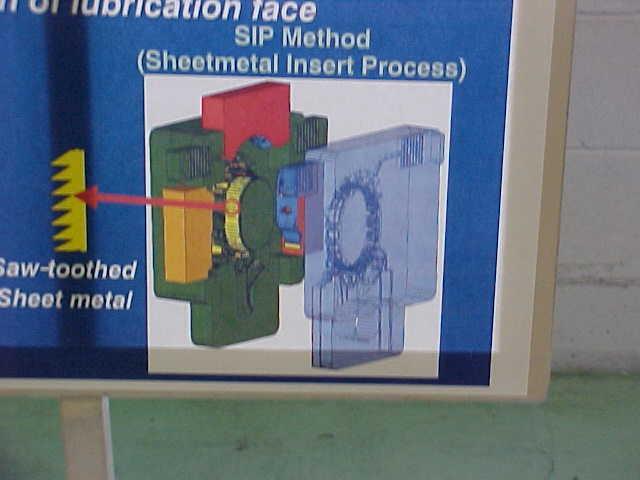
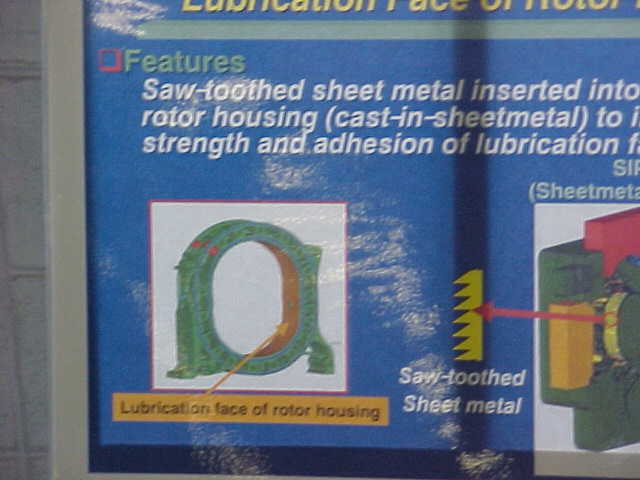
Never a problem with the rotary.
The hardened steel liner is mechanically locked in the die cast
rotor housing.
Paul Lamar
--
The Rotary Engine NewsLetter. Powered by Linux.
ACRE NL web site.
http://www.rotaryeng.net
Youtube key word PaulLamar2
Copyright 1998-2010 All world wide rights reserved.