I suggest if you are interested in this system you make
a folder and drag over all the many future messages on this
subject otherwise delete it.
There are at least two ways to build an EFI program.
The first and the simplest is to assume power is a direct
function or RPM and manifold pressure. That is how a 555 system
works. The injector is triggered once per revolution
and the pules width is controlled the manifold pressure.
The higher the pressure the wider the pulse... more fuel.
See
http://www.rotaryeng.net/simple-cheap-555.html
To do that using a computer programed in BASIC is trivial.
Almost a waste of the computer's power. I could write
the program in about five minutes. Maybe a day at the most.
The vast majority of EFI systems and that includes Tracy's system
use a look up table to adjust the injector pulse width for
a given RPM and manifold pressure. That gives a 2 dimensional
table of several hundred entries. One could have a one dimensional
table for say 75 different RPMs and modify the table values
by the manifold reading. That would be say every 100 RPM
for the rotary. I am not sure which system Tracy's
uses. One can do a bit of math and interpolate between
fixed readings. The same thing could be based on manifold
pressure alone and adjusted by intake air temperature.
The table is stored in EEPROM so it is always there even if
the power is turned off. In ZBasic speak that is called
persistent memory and there are 4000 bytes available.
Fortunately ZBasic has 2 Routines that are highly
useful in this sort of EFI system.
PersistentPoke(value, address) and PersistentPeek(address)
See page 182 of the ZBasic System Library Reference Manual.
The address is just the line number of a one dimensional
table. The value at that address is a Byte data type
being 0 to 255. See page 7 ZBasic Language Reference Manual.
Poke can load the table from a file in your PC computer
you generated with an editor. If you used two ZX computers
such as Tracy does you could fly on one while adjusting
the other using a NetBook and switch in the air. It helps
if you have an autopilot or some one else to fly the plane
and look out for traffic.
Peek of course can read the file for a given RPM
and use that number adjusted by the MAP to control
the injector width.
Peek can also be used to read out the file to your
PC just to check up on what is in there in case you
forgot.
Paul Lamar
Paul,
Sounds interesting. What would it take to read an output voltage from the
O2 sensor, compare it to a voltage from a potentiometer circuit (knob on
the
panel controlled by the pilot), and PersistentPoke the appropriate byte as
determined by current rpm? That would be "auto-tune".
Mark
Now I having you thinking Mark :) Not much in terms of software.
We have at least eight analog to digital converter pins to work
with.
IMHO it would be better to use a wide band O2 sensor. Of course that
would die if you were forced to burn 100LL. If it were a sub routine,
called up only once, when you first fired up the engine on the
first flight using auto fuel, stored the MAP table in persistent
memory and then never used again.... that would work.
Perhaps using EGT would be better. Max EGT at all power levels
which is almost peak power. See the attached charts. The leaning knob
would then take care of cruise or richen it a bit for cold
starting and peak power. War emergency mixture :)
BTW As a compact user interface on the instrument panel I am thinking
of using a rotating switch with 16 positions that will call
up to 16 different programs. Autotune could be one of them.
Interfacing with the NetBook another. Position 1 to 8 could be
computer 1 and 9 to 16 could be computer 2.
You then push a button on the switch to run the program
and or switch computers. The program name would be NC milled into
the bezel. IMHO that is an intuitive way for people to control a
small computer.
What do you think?
Paul Lamar
Paul,
I have a wide-band O2 and run 100LL. Burning 100LL may cause it to be a
bit
slower in response time, but it works just fine for my purposes. The
problem I've always had with EGT is that I can never know which side of
peak
I'm on. With a wide-band there is never any question. So, how does the
computer know which way to go (rich or lean)? Also, I've had a couple of
EGT probe failures. Maybe that's because of the higher EGT's of the rotary
engine.
BTW, I ordered a ZBasic book from Amazon yesterday. Hopefully, it will
take
a more logical approach than the ZBasic.net manual, which is more like a
dictionary than a manual. There was only one to choose from. Is ZBasic a
big secret or something? What gives?
Mark
Easy. Richen the mixture. If the EGT goes up you are on the lean side.
If the EGT goes down you are on the rich side. Computers are good
at that sort of thing.
Wow! I am surprised there is a book. Amazing. ZBasic is not exactly
a house hold word. I know Don is doing well as I met him in Oregon.
I am working on a stand alone index for the lib ref manual. Or rather QB
is doing it. The Linux version of the pdf viewer allows one to cut
and paste text out of a pdf. I'll upload it when it is done.
Paul Lamar
Paul,
Right now I need a "Dick and Jane" type book. Once I practice and see how
things are supposed to be done, then I can start getting creative on my own.
Hopefully, this book will be a good starting point. It was only $12
(used), so I don't have a lot at stake. If that doesn't do it, then maybe
there is a "QBasic for dummies" book that I can get to cut my teeth on.
Mark
I hope it is better written for non computer gurus than the pdf docs.
I have trouble understanding ZBasic because it was obviously written by
some person going though computer science courses or a C programmer.
I know Don wrote it in C ++.
I am self taught as there were no computer classes back in 1975. C did not
become popular until the mid 80's. I think it was first written
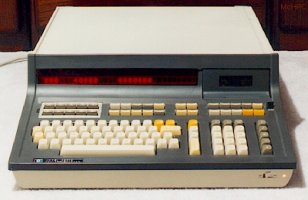
in the early 70's for UNIX. I had a BASIC programmable calculator loaned
to me for a few years in the early 70's. It was made by Friden, Wang or
HP as I recall. It kind of looked like this HP except it was bigger.
The size of a kitchen stove.
BASIC was heavily criticized by computer professors. Ostensible because
of it's lack of "structure" and its slowness. I suspect it made
them redundant as it was too easy to learn :) The truth is a BASIC
compiler can generate machine code that is just as fast and just
as small as any other computer language with the possible exception
of assembly language. QB is anarchy while ZBasic like C is closer to
Communism or Nazism :)
Paul Lamar
--
The Rotary Engine NewsLetter. Powered by Linux.
ACRE NL web site.
http://www.rotaryeng.net
Youtube key word PaulLamar2
Copyright 1998-2010 All world wide rights reserved.