Paul,
I just got through reading through John Slades website about
his turbo troubles with different stock and Aussie modified
Mitsubishi turbochargers.
He as well as several other people recommend a Turbonetic
TO4E -50 with the big shaft. I know the unit comes with
an Inconel turbine, and P trim is recommended. Since I want
to turbo normalize the P-ported 13B at high altitude I have
been advised that an A/R around 1.15. is best. This way
the turbine only makes a few inches on sea level take-offs
but really pumps the air at low flight levels. Do you know
a purchasing source in California? I am want to make sure
I can order one with high nickel content and ceramic ball
bearings as well.
Doug in Japan
Performance Turbochargers LLC
8482 Cherry Ave.
Fontana, CA 92335
909-429-7200
909-429-7204
Garyhetrick@dieselusa.com
www.dieselusa.com
Limit Engineering
885 Kiowa Ave.
Lake Havasu City, AZ 86403
928-453-7321
928-453-0789 (fax)
craig@redrivernet.com
www.limitengineering.com
Advanced Tuning Products
28988 Hopkins St.
Hayward, CA 94545
510-445-1682
510-445-1692 (fax)
info@atpturbo.com
www.atpturbo.com
Retail Distributors
Jim Wolf Technology
212 Millar Avenue
El Cajon, CA 92020
619-442-0680
619-579-8160(fax)
www.jimwolftechnology.com
You may have trouble buying a new TO4 as it is now obsolete.
The A over R is a measure of how far the inlet diameter is
restricted by the nozzle. An A over R over one means
the inlet gas velocity is actually reduced before it is
applied to the turbine.
The high turbine A/R means it will not generate a lot of turbine HP but
it will be less likely to over rev at high altitude. It will
also have less back pressure on the engine.
There are two A/R's numbers. One for the turbine and one for the
compressor.
http://www.turbobygarrett.com/turbobygarrett/tech_center/gt_basics.html
"GT Basics / Nomenclature
Please note that we have made
a subtle modification to the GT nomenclature.
In our product catalog, all offerings are grouped according to
their turbine wheel frame size. The frame size of a turbo or CHRA
is dictated by its turbine wheel inducer diameter . The larger
the turbine inducer, the bigger the frame size-- so any turbo
in the GT42 family has a larger turbine wheel inducer than
those in the GT35 family, and so on.
In the model name of each turbo or CHRA, you'll also notice two
digits after the frame size. These two digits refer to the
compressor exducer diameter, as measured in millimeters.
Let's use the GT4294 as an example. This unit has a GT42 frame
size turbine coupled to a 94mm (exducer diameter) compressor wheel.
If there's an "R" on the end of a model name, this means the
unit is ball bearing. So, a GT4294 is not ball bearing; whereas
a GT4294R is ball bearing.
The biggest change related to the nomenclature is this: units
which utilize a 53mm turbine wheel (as measured at the inducer)
are now referred to as "GT25" frame size, while units employing
the slightly larger 53.85mm turbine wheel are now referred to
as "GT28" frame size.
For those familiar with our product range, this means that the
unit formerly known as "the GT28R" (part number 466541-1) is
now in the GT25R family. More specifically, it is now a GT2560R
model."
GTxxyyzz
* Positions "xx" refers to the frame size of the turbine wheel inducer.
o For example the "GT28" in "GT2860RS" refers to its turbine wheel
frame size family. All GT28 units use a turbine wheel with 53.85mm
[2.12"]
inducer diameter
o As a rule of thumb, the larger the number, the larger the turbine
wheel.
* Positions "yy" designate the compressor wheel exducer (major) diameter
in millimeters
o The "60" in the GT2860RS example above has a 60mm compressor wheel
exducer diameter.
o Note: Wheel sizes 100mm and over omit the "1" (hundreds digit)
o Example: the 02 in a GT4202 refers to its 102mm compressor
wheel exducer diameter
* Positions "zz" may be used to designate special features of a
particular turbocharger where applicable
o Example: GT2860RS
o "R" = this is a Ball Bearing unit
o "S" = used for units which require some differentiation
from units in the same family Compare a GT2860R to a GT2860RS.
While both are ball bearing and externally similar, the GT2860RS
is better suited for higher-flow applications than the GT2860R.
In this case, the S reflects the higher-flowing nature of the GT2860RS"
End of Garrett quote.
The 16 pound TO4 I have in my hand as we speak has a turbine inlet area
diameter is roughly two inches in diameter. In the new terminology
the inducers or diameter of the turbine wheel is roughly 3.5 inches
or 90 mm. It is not out of the housing so I am not sure of
the exact dimensions. It could be a lot smaller. I'll take
it apart shortly when I get time.
The stock 1990 RX7 turbo weighs 22 pounds
but it has a built in waste gate. The stock RX7 1990 turbine OD
is 2.5 inches or 56 mm and compressor OD is 2.4 inches. Compressor
ID is 1.72". This one I have out of the housing. This has been made
to work in a modified form by Dave Leonard and others
The exducer (small diameter of the turbine) size is 2.75
inches in diameter or 70 mm. The turbine A/R is .96.
MY guess is the TO4 turbine is about the same size as a GT4508 or a
GT4708.
I could be way wrong as the physical size is a bit bigger.
The GT4508R has a water called bearing like the stock Mazda turbo
and unlike the TO4 so that alone is a big positive. The R stands for
ball bearing. The aerodynamics of these new models has been drastically
improved so I would not be a bit surprised if the GT4508 was more
efficient than the old TO4. One the other hand the turbine is small
relative to the compressor so IMHO I don't think this is what you need.
I would go with a larger turbine to actual reduce the heat load
and the RPM on the turbine. The exhaust gas velocity and mass is
a given so the larger the turbine the lower the RPM.
Garrett uses a small diameter turbine to reduce the rotational inertia
and improve the angular acceleration for automotive use. Not what
a A/C application needs.
The TO4 M-24 compressor has an inlet diameter of 2.5 and an outlet
diameter
of 1.95 and the marked A/R is .6. The compressor wheel OD is roughly
2.5 inches
in diameter and 1.75" small diameter. This size turbo is good for 700 HP
so perhaps you need a higher A/R.
http://www.turbobygarrett.com/turbobygarrett/tech_center/turbo_tech101.html
http://www.turbobygarrett.com/turbobygarrett/tech_center/turbo_tech102.html
http://www.turbobygarrett.com/turbobygarrett/tech_center/turbo_tech103.html
Download the catalog and go from there.
http://www.turbobygarrett.com/turbobygarrett/products/catalog.html
What ever you do get one of the these turbo tachs and install it so you
are sure you do not over rev the turbo charger as that is a sure
fire way to have the turbine wheel fail at 1800 F inlet temp.
Paul Lamar
--
Paul,
Thanks for the long and detailed post. Comparing
Turbonetics and Garretts is a difficult call for me. and I
have read all the Garretts stuff several times but I need
to speak with someone who has 'been there' flying with a
turbo 13B. Personally I am not a fan of the modifying a
stock Mazda Mitubishi turbo to bring the rpms down. Yes it
works but I think the newer high nickel content, ball
bearing turbo would be more reliable for long hauls. I
believe John Slade, the Cozy Girls as well as Ross ---? a
RV flyer were recommending the Turbonetics model I
described above. Why? I dunno:) John indicated he was
going to get one years ago but there are no updates on his
building log website to indicate he actually did it. Do
you have a way I can contact him?
BTW 56mm equals 2.2" 1 inch equals 2.54"
Doug in Japan
John is/was mad at me for some reason. I designed a motor
mount for him and he had someone weld it up but they took liberties
with
my design and added their own ideas and totally screwed it up. I have
had that problem before with certain welders. Just make it
like the dwg. for @#$%^ sakes. For some strange reason some welders
think they are smarter than engineers :) Each line in the dwg was an
essentail tube and the welder left most out as he did not think them
necessary. I chewed John out for not making it like the dwg and
demanded that he fix it so he got mad at me :) I just had his
safety in mind. I did not want the engine to fall off in the air.
He may also feel that I misled him by recommending the RX7 Turbo II
motor. At the time MecanAir, fore runner of Mistral, was using the
RX7 Turbo II engine and I figured they had it working. It sure looked
well engineered and very compact. That was long before
we all found it it over revved at 12,000 feet and destroyed itself
in about 2 hours. Mecanair/Mistral went through three or so before
they revealed the problem to us.
So too John and Dave Leonard. I think John Slade was the first
to have it modified. The modified version does work but I am not sure
the
modification are optimum. It took me a couple of years to figure
out why they failed. I called everybody I could find that was supposed
to be experts on turbo's and nobody could answer the simple question:
"How does one determine the HP of a turbine?" I tried to contact
a Garrett engineer that I had worked with 30 years ago on a turbo
charged
Ford something or other. He had died or retired and I could not
find him.
The Effects of Turbocharger Design and Installation on
Gasoline Vehicle Transient Response.
David Elpern. Garrett Automotive Products Co.
SAE 821149 Use of the Lamar Instrument test
equipment to develop turbocharger design.
I even went to Foyles book store when I was in London looking for
books on turbines. I found a couple and bought them. As far as I
can tell Foyles is the best technical book store in the world.
http://www.foyles.co.uk/
The jury is still out on the RX7 Turbo II turbocharger as both Dave
Leonard and John Andrich are both flying essentially the same
thing. So too John Slade as far as I know but I have not heard
from him in years. Last I heard he moved from Florida to Connecticut.
Perhaps Dave Leonard knows how to get in touch with John Slade.
John Andrich is on here and his Turbo II powered Long EZ airplane
is in Camarillo so you may ask him and Dave questions.
BTW I think the TO4 is a dead end as Garrett has made some
significant improvements since then.
The owner of Turbonetics used to be very helpful on turbo's but he
sold out to Kelly Aerospace and the help evaporated.
As far as I can determine there is nobody at Kelly that
knows anything about it.
Paul Lamar
Paul,
I went to the office today and measured the Mitsubishi Turbo that came
with my RX-7 engine. This is the single scroll turbine and its
pretty small.
Far as I can tell it is ABOUT the size of the Garrett 25 series.
http://tinyurl.com/25oppk
The Mitsu. turbine dia is 53mm (a hair over 2inches) and the
compressor wheel OD is 63mm tapering to ? Compressor inlet is only
about 52mm or 2 inches in ID.
WIth the robust exhaust on the rotary engine I would venture to say
the wastegate is open 99% of the time while driving. Still a
significant amount of gases go through the turbine because the engine
needs that compressor to turn to allow enough air into the engine. I
mention this only because I would a set up where the turbocharger can
be taken off line if it malfunctions. That means also bypassing the
compressor and reverting to a NA engine.
Look at the series GT3582R and tell me what you think for turbo
normalizing rated power at 18k.
Doug in Japan
The Garrett turbo chargers are combination of compressor and turbine
optimized
for automotive use. This means the turbine is way more powerful than
needed. For aircraft use we must separate the turbine from the
compressors and deal with them individually.
More on this later Robiun is bugging me to go to the Camarillo airshow
with her. I'll be back in a couple of hours.
Paul Lamar
Doug
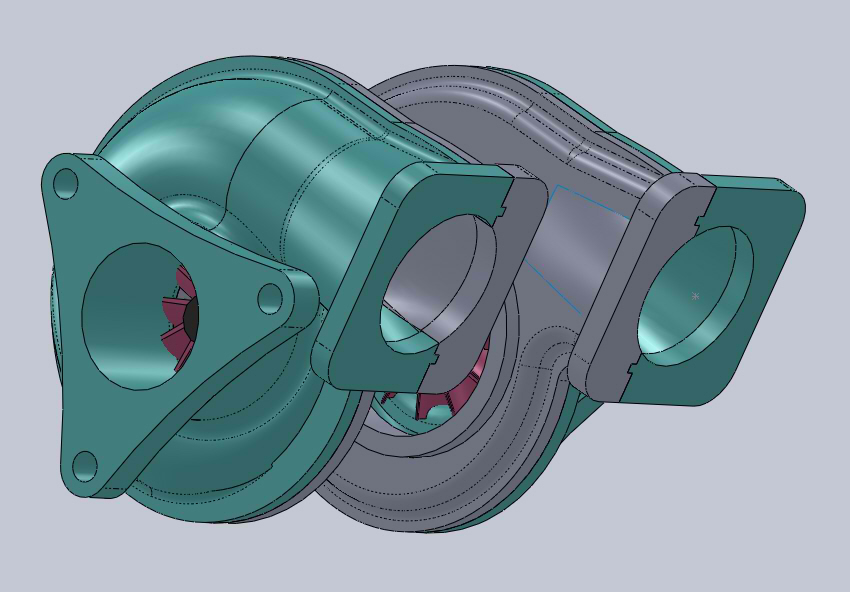
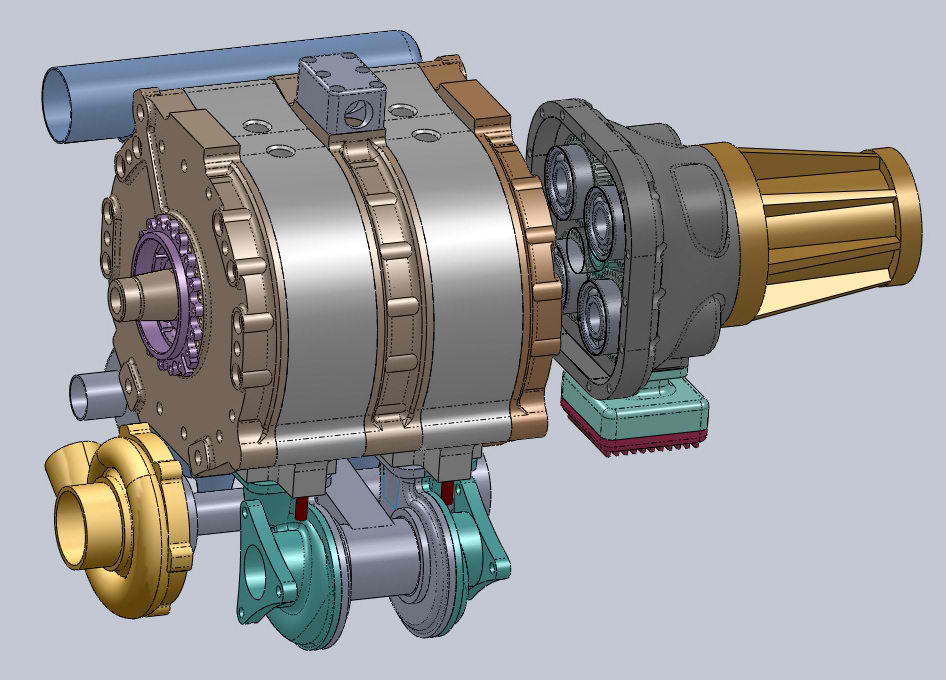
If you remember about 6 weeks ago I proposed a concept of the remote
compressor, in this case driven by 2 turbines....other than the
complexity, the one potential flaw you mentioned, was the heat
dissipation of the compressor wheel taming the migration of the heat
through the shaft. A valid observation to be sure...In the book "Maximum
Boost" by Corky Bell he highlights the fact that 2 turbos deal with
approximately half the heat signature than a single....with proper
oiling and water cooled bearing housing, this I believe could be
controlled.
On my design one turbine housing would need to be reversed and of coarse
the turbine wheel as well.....I also built in a possible Turbo compound
drive..
I could build both of the turbine housings, thinking of titanium. but
the wheel would need to be obtained. Check out the pictures you can
see the the turbine housing has been split for machining...
*Compressor Wheel*: 16G Reverse Rotation
*Turbine Wheel*: TD05H Reverse Rotation
*Turbine Housing*: 10.5CM2 Single Puck
*Part Number*: 49378-01550
certainly all this is conceptual but I like the idea of a single
compressor and cherry pick the proper housing size for optimum aircraft
performance.....Ultimately this could be an efficient option..
just a thought
jeff
The SLDPRT file was too big to publish but if anybody
wants it let me know.
Paul Lamar
--
The Rotary Engine NewsLetter. Powered by Linux.
ACRE NL web site.
http://www.rotaryeng.net
Youtube key word PaulLamar2
Copyright 1998-2010 All world wide rights reserved.