Hello Paul & Group,
There was an "Ultra-squirt" project going on about two years ago. Seems
that it didn't materialize, but the hardware choice was interesting:
Freescale MPC55xx - 32-bit PowerPC core, programmable eTPU timer for
ignition + injection, DSP knock indication built-in, CAN bus, plenty of
i/o, good set of driver/sensor circuits.
What's interesting here, is that - if i understood correctly - the eTPU
unit offloads the ignition/injection timing task from processor, and it
is still fault-tolerant (ie. missing teeth, no CAS signal etc.)
Here's some video clips. Not really a proper product introduction, but
gives an idea how eTPU works.
Using the Engine Position eTPU Functions - Freescale Application Note: 3769
http://www.youtube.com/watch?v=a1NplNEAaww
eTPU Set 2 Simulator Demo
http://www.youtube.com/watch?v=Mu_zBkoByVQ
Link to Freescale eTPU user guides:
http://tinyurl.com/2wzw45p
Back then, the required CodeWarrior version cost $5000, now it is $955
or $1955 - the difference seems to be the "Optimizing C/C++ compiler"
Runs on Linux or win2k - 7, new version 10.0 within Eclipse. Yes that's
more than OSS price, but... it ought to be good.
It seems that this is the best platform to develop a really capable
FADEC product for rotary engines.
...Just that there should be someone involved who could (and will ;)
make neat C code...
Anyone tried 55xx / 56xx?
Petri Flander
I have code warrior for some of the smaller Free Scale chips but what
I don't like about it is the C or assembly language required.
Atmel ZBasic is an order of magnitude easier to learn and
faster to program. There are some trade off as a bit more hardware
is required. It is fast enough for simple AC engine EFI and EFIS.
Paul Lamar
Yes, that Freescale route is laborous... but the end product could be
just wonderful. Knock sensor alone is very appealing...
Personally, i don't enjoy to clear my way through a maze of interrupt
vectors and badly behaving pointers ;) - but some fellas have become
very good at it. It's just how to attract them to work with something
like this...
sometimes open source approach can solve this kind of dilemma.
What's your current configuration with Atmel, how did you solve the
timing issue? By using hardware timers? Then i guess you have a bit
similar setup as Freescale's MCU + eTPU, right?
Cheers,
Petri
Yes I agree true real time processing requires one to know
precisely how long any series of instructions require to
execute. This normally eliminates or discourages the use of any
higher level programming language such as C or BASIC.
I avoid the critical timing situation wherever possible
and use an easy to learn and quick to program BASIC.
The ignition timing is done with capacitor discharge circuits
rather than inductive circuits. Inductive system requires the
software to anticipate when the coil current will be interrupted
to form the spark. If this is not done the present coils
available tend to over heat due to excessive long term current
flow.
A CD system on the other hand merely discharges a capacitor
that can stay charged for as long as necessary. This is achieved
my multiple low cost Hall Effect sensors and a small rotating
magnet. Also the capacitor can be recharged nearly instantaneously.
Ignition advance is a manual advance system which is only needed
when on long cruise periods at high altitudes. 90% of the time
a fixed advance of 22 degrees BTDC can be used.
The RPM module is stand alone as RPM determination in a timely
manner is one of the toughest things to do.
Also multiple processors are used to distribute the computing
chores using existing software. For an example; a low cost netbook
PC is used as the display device for an EFIS and data gathering
or acquizition system. This processor is indepentent of the engine CPU
so future rapid developments and cost reductions in netbook PC's
can be taken advantage of. This is a big picture holistic approach.
The Atmel BASIC has means to encourage this approach
by a single simple command that sends any data to the PC using the USB
interface. It is up to the PC software to format and display
the data using existing serial terminal software or Visual Basic
or other software.
This is a classic trade-off of hardware verses software.
---------------------------------------------------------
Petri,
The built in hardware floating point on the MPC55xx is a great
feature.
Here is a web site that shows the number of processor
cycles it takes to execute 6502 assembly instructions.
Yes the 6502 is an obsolete processor but the point is
you know how long, in terms of clock cycles, it took
to execute every instruction. This is a whole nother
dimension the real time programmer must deal with.
http://e-tradition.net/bytes/6502/6502_instruction_set.html
The fastest available clock for the 6502 was four megahertz as I
recall. Since most instruction took 2 clock cycles that means the
instructions completed in 500 nano seconds. Not bad for 1975 :)
For awhile there every hard disk drive in the world used a 6502
to control the heads. I don't know what they are using now.
You are probably now typing on a keyboard that has a similar
processor built in :)
Check this web site out.
http://www.zbasic.net/
This stuff is a bargain as all the software and IDE is
free along with the ZBasic compiler.
I have done a lot of testing with my Tektronix 2430
150 Mhz storage scope on how long it takes to do various
things and much of it is plenty fast enough.
I have turned off the ZBasic real time
clock as that will tend to screw up the timing. Most of the
rest of it (less the floating point math) is determinate as
far as the time it takes to execute instructions.
In some cases it takes only about 100 nano seconds.
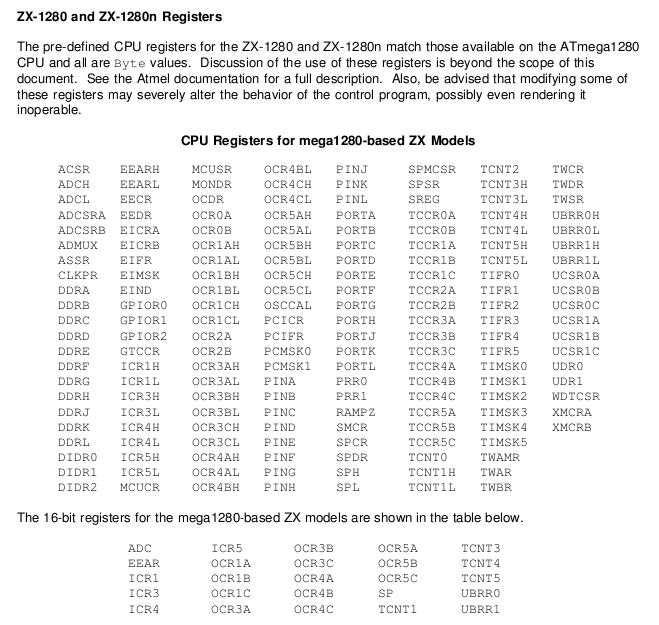
Here is an example. This is peeking port H.
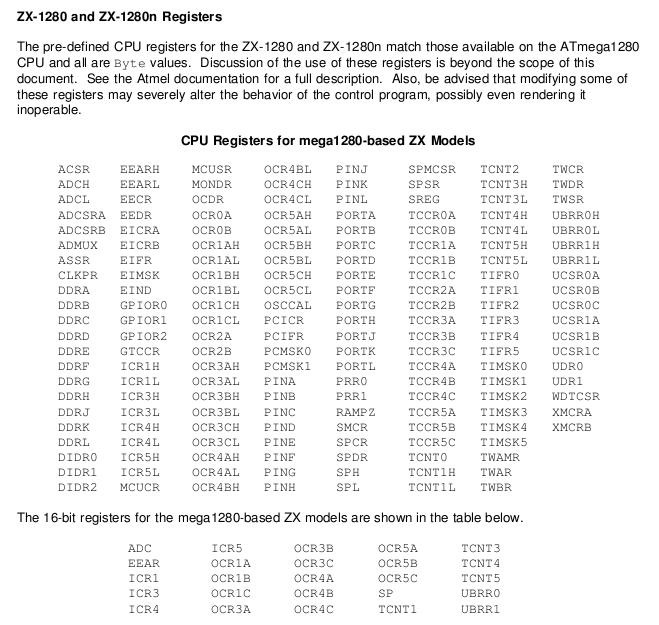
Register.TIMSK2 = 0 'turn off RTC
Register.DDRH = &H00 ' set the direction
Register.PORTH = &H00 ' turn off pullups
val = Register.PinH 'peek 8 bit port can have any value.
debug.print "val = " & val 'send the port data to the PC screen
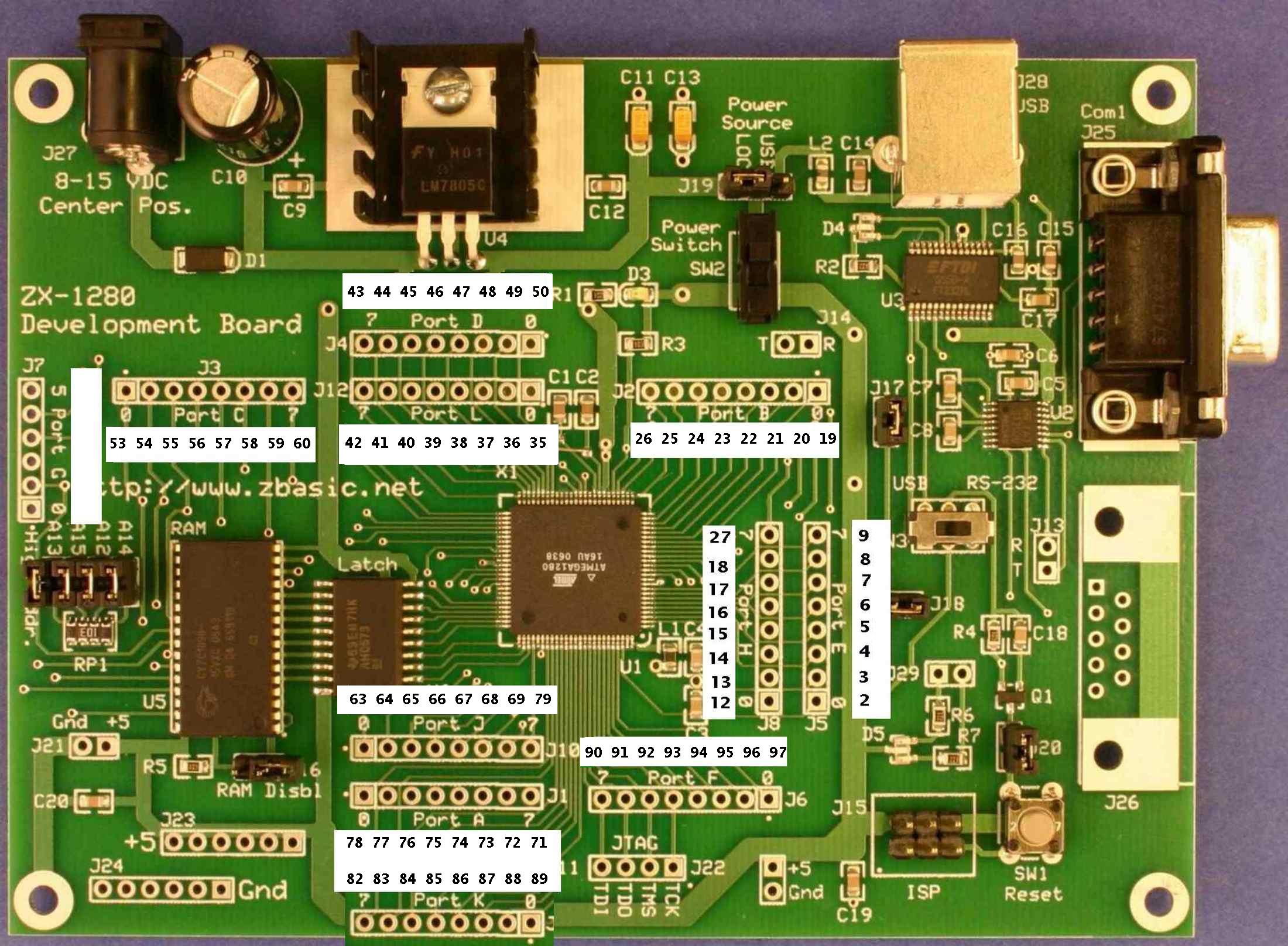
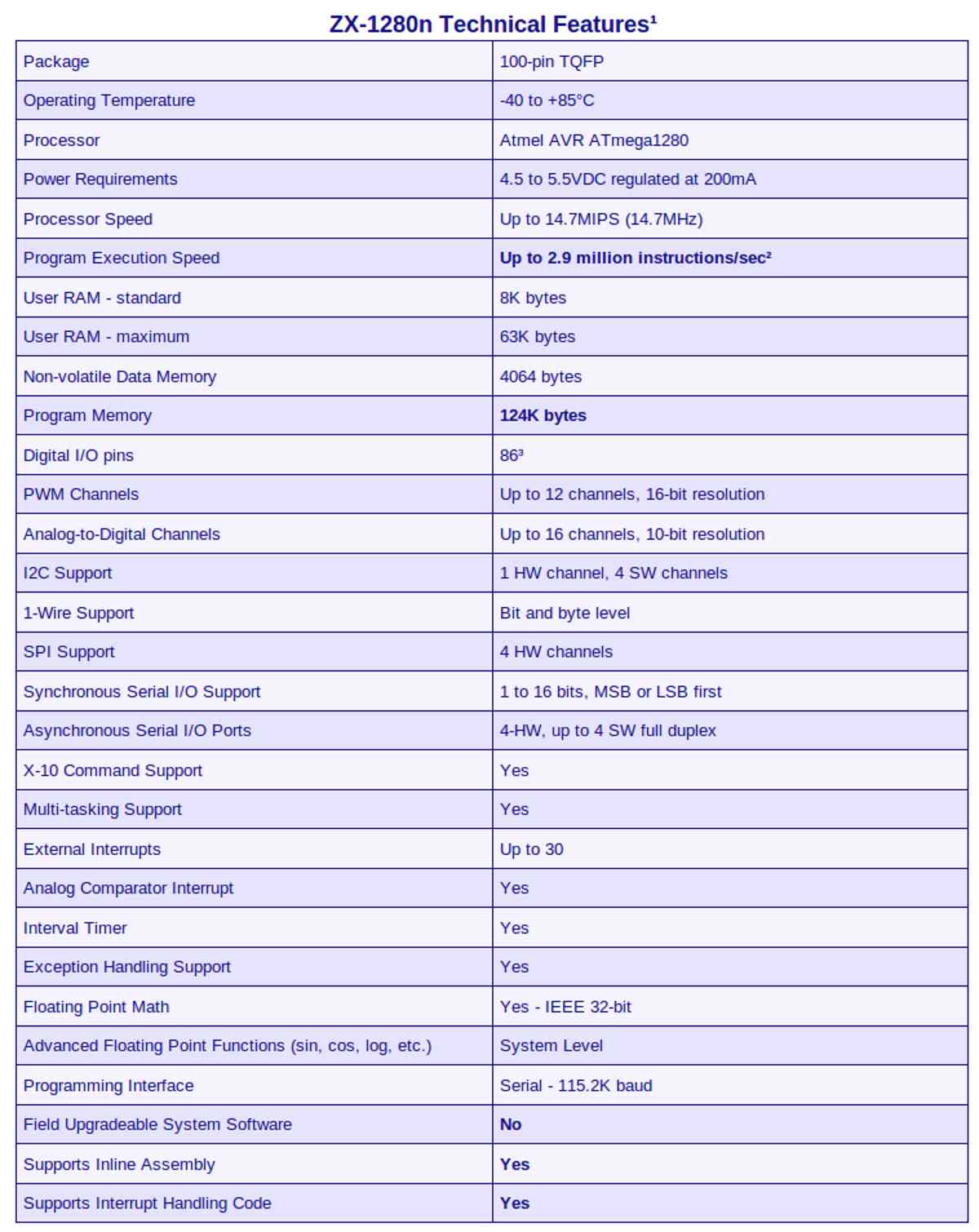
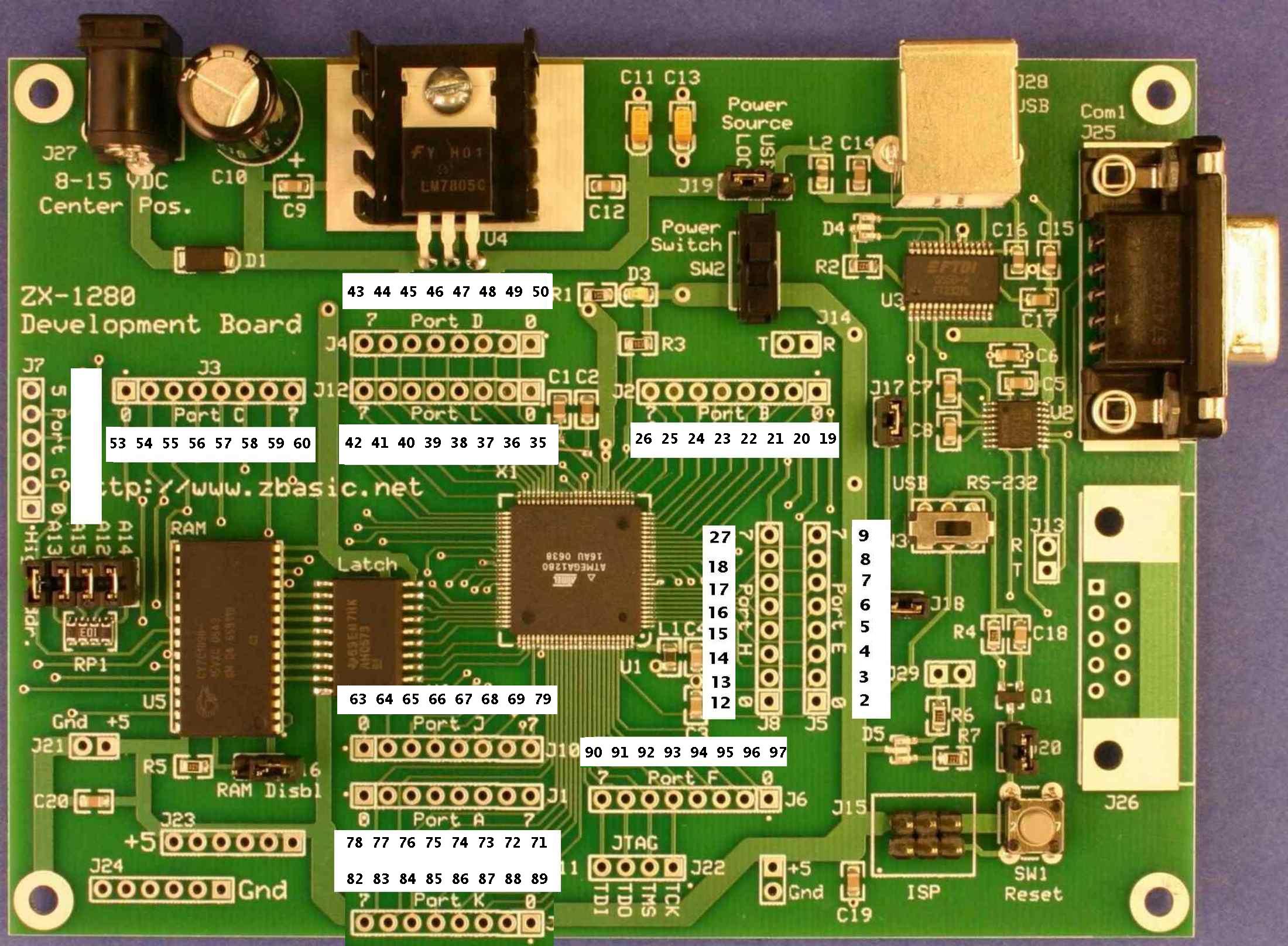
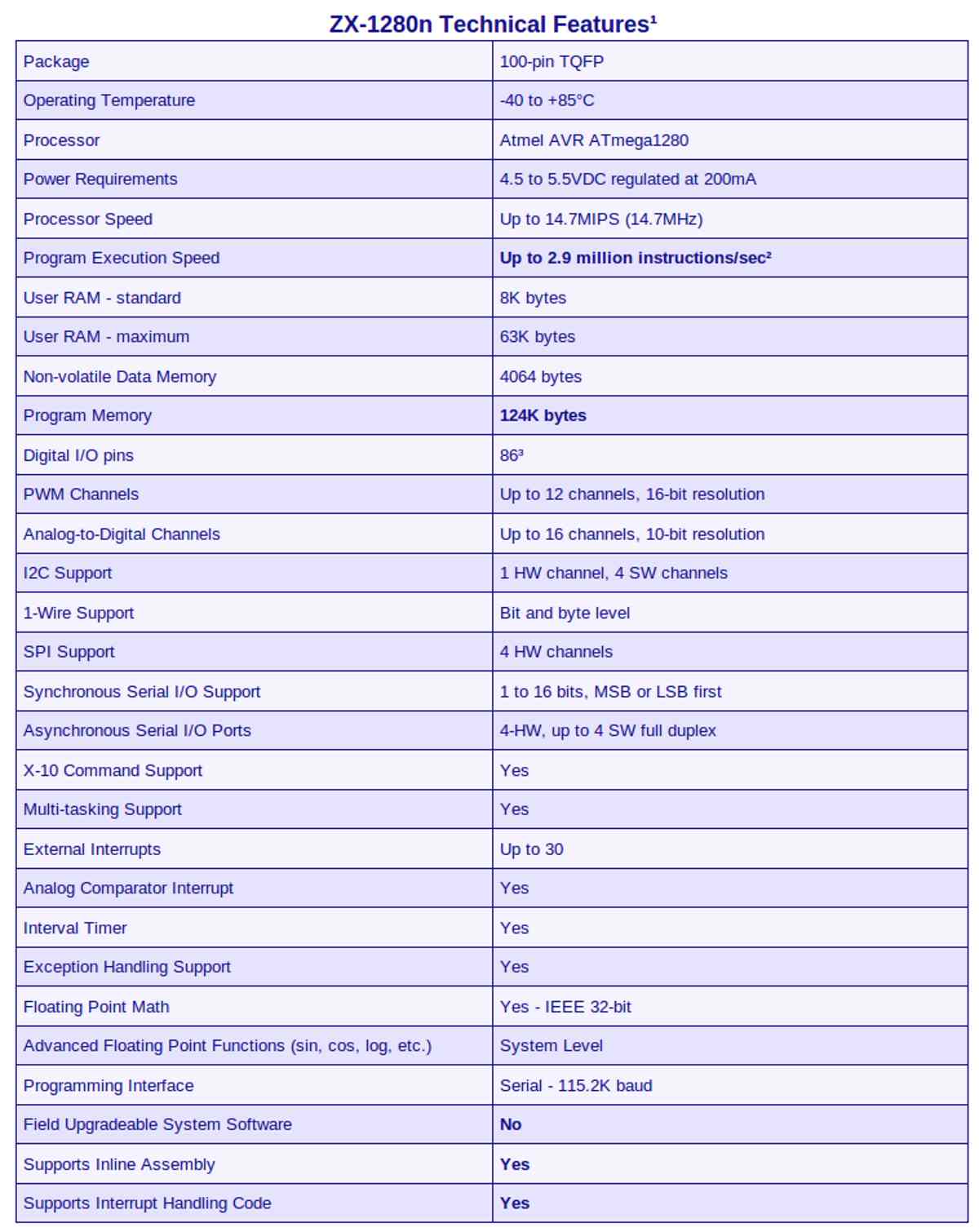
In the $90 SBC 1280n I am using there are 86 I/O pins
in the form of 8 bit ports.
Here are some of the specs.
I have also gone beyond the Atmel and looked at a so-called
Parallax propeller.
http://www.parallax.com
This is a chip with eight 32 bit processors built in.
One would think it would be a real time programmers dream
come true however it lacks enough I/O pins and there is no
built in A to D.
I have gone back to the Atmel.
Paul Lamar
--
The Rotary Engine NewsLetter. Powered by Linux.
ACRE NL web site.
http://www.rotaryeng.net
Youtube key word PaulLamar2
Copyright 1998-2010 All world wide rights reserved.