Folks,
Few bits on turbos:
- All turbine wheels made in at least the last 30 years will be cast
Inconel unless otherwise stated, regardless of manufacturer. No
worries on melting stuff!
- Most automotive turbine housings are cast iron (obviously), though
some are made of higher temp stuff than others. The good higher temp
ones are high sil. moly or D5 Ni-resist, assume low grade D3 for
off-the-shelf after market. For some Garrett turbos after market
automotive companies have made stainless turbine housings of various
A/Rs, this is the way to go for a high duty cycle rotary IMO. Don't use
V-bands if you can help it, they are difficult to seal and are
expensive. Do use high temp bolts (B16 is terrific stuff!)
- First thing to worry about when matching is the compressor, it is
the most performance sensitive (turbines are like big paddle wheels
compared to compressors). Special consideration will have to be taken
for the high Pressure Ratios (PR) experienced at altitude however, so
you're going to have to choose where you want efficiency (take-off or
cruise)
- Rotaries are good at spooling turbos, but don't assume they are TOO
good when choosing a turbine A/R (you will end up with a supercharger
like boost curve. The Hitachi turbos used on s5 RX7s do use the
waste gate like any proper match, just after torque peak. All matching
work is validated on engine, so expect to try a few A/Rs before getting
it dialed in where you want (I agree with wanting a large AR for
pressure equalizing, you will have plenty of turbine power with the
expansion ratios you can get up there! Especially if you are not
concerned with take off power)
- After market waste-gates are not terribly reliable, using an
adjustable built-in is the way to go for A/C, but a standard one may
be difficult to keep closed at altitude unless you install a higher
rate spring (you can build an adjustable pressure actuator with a
turnbuckle and some clamp plates, I'll try to find a link to an
example)
- TEST YOUR LUBE SYSTEM!!! Make 100% sure it flows oil quickly and at
the rate specified by the manufacturer, poor oil supply (& dirty oil)
is a major killer of turbos. Return lines should be above the sump!
- Water cooling is mostly chosen in non-A/C applications to prevent
oil coking during a hot-shutdown, but I agree that it should be
considered mandatory for a high duty cycle application (with tight
packaging). Return lines should be as high as possible in the cooling
system to aide thermal siphoning
- Typically ball bearings are only chosen when transient performance
is crucial, as journal bearings will get you 80% of the performance
with better steady state efficiency, but ball bearings are better with
low oil conditions and can handle higher loads. IMO unless you have
the $$ burning a hole in your pocket standard bearings will do just
fine, and they have MANY more hours of design history behind them.
(eg. To my knowledge no production engine uses a ball bearing turbo
except the Garrett on the new Ford Scorpion engine.)
I saw someone ask about cooling system additives. Redline Water Wetter
is well thought of.
FWIW unused oil has a thermal conductivity of around 0.1 W/(m-K),
water is around 0.6, ethylene glycol around 0.2
Cheers,
Zach K
Guy that works in the industry
Thanks Zach. Some of the best info we have received so far.
Paul Lamar
Thanks Zach,
I learned a few new things. What part of the industry are you involved in?
Doug in Japan
No problem, turbos are a tricky device and real information is very
sparse in the aftermarket world.
Fundamentals of Turbocharging by Dr. Nicholas C. Baines is an
excellent text for turbo knowledge.
http://www.conceptsnrec.com/Education/Engineering-Textbooks.aspx
Near the bottom of the page is a picture of an actuator with
replaceable spring where the 2 halves of the actuator are held together
using clamp-plates.
http://powerenterpriseusa.net/products/turbo/list_spec/index.htm
I do applications and development for a turbo OEM.
Cheers,
Zach
Zach,
Is there significant performance difference from a TE04E turbine
housing with a tangential inlet compared to a more centrally located inlet?
In the size I want, the tangential turbine is not offered with
a split inlet, however the central housing is. The central
housing (like the old Raja turbines) has some advantages to get a close fit.
The sales rep. says I can order the unit with Inconel shaft and
turbine (extra) as well as ceramic bearings. I am considering
P trim and 1:15 turbine AR, Compressor 50 which I assume is
the nominal size. Not sure which size turbine to get. Several options.
Housing unfortunately is ductile cast iron and having the housing
cast in Ni resist may not be possible. Only a few of the GT 28
series used that alloy. E-85 will help cool the inlet charge as
well as a log type exhaust manifold. Good news is this size of
turbine is in the 15lb range.
External waste gate is necessary.
Doug in Japan
http://tinyurl.com/26zwdgf
Doug,
The tangential inlet will provide slightly better performance, more so
with a pulse tuned exahust, as opposed to constant pressure method
which would be less sensitive to center/tangential (peripheral exhaust
rotaries are so perfect for pulse tuned turbocharging it's like Dr.
Wankel and Mazda intended it). Though as you have found central inlet
is often easier to package.
In the end, being able to properly match the turbo is MUCH more
important than tangential/center, twin-entry/single entry. Choose the
option that gives you the AR you want first, the other stuff is fine
tuning. Even with a single entry turbine it would still be worthwhile
to design the manifold such that the turbine inlet runners are equal
length and blend together nicely. (w/ as small an manifold volume as
possible).
Lower grade cast iron will work, it just may not last as long before
cracking, and not allow as of high turbine inlet temps, steady state,
before creep becomes a worry (TIT, thermal cycles, vibration,
mechanical loading and time are the levers for durability outside of
turbine housing design). IMO aircraft turbos should be Magnafluxed &
inspected as often as an exhaust (will need to torn down to properly
inspect the turbine). The place cracks usually first appear is in the
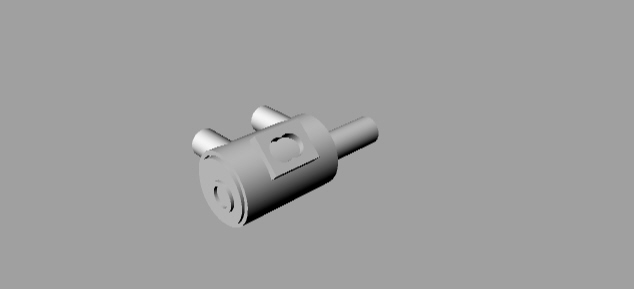
tongue of the volute. (see attachment, not my image) The divider
between volutes in a twin entry is also one to inspect.
Without running numbers the 1.15 you mentions sounds in the ballpark
(perhaps even larger at altitude), though AR is also very dependent on
the turbine. Hot side matching is still as much an art as science, and
typically requires a couple iterations to get things right where you
want. (less so if you have VGT) Aircraft would seem to be a bit easier
if you are mostly concerned with cruise (1 operating point), and in
the aftermarket you really only have AR as a lever for tuning.
I am surprised by them not having Inconel turbine wheels standard. The
turbine should be Inconel and the shaft some other steel, do they mean
the "upgraded" option also has an Inconel shaft? That is unnecessary.
Though if the aftermarket turbines are not Inconel the extra cost is
worth it for many reasons (the only reason not to have it Inconel is
cost).
http://www.tialsport.com
Is a good quality source of aftermarket turbo bits for Garrett (they
even have water cooled wastegates! Durability enhancer).
http://www.turblown.net/home.html
Are fabricators of fantastic quality (the cost reflects this)
made-to-design tubular manifolds, and rotary savvy, ask for Elliot.
From my memory they also have an ex-Garrett engineer that consults.
FWIW, I don't work for Honeywell but they have the most options for aftermarket.
Also, apologies for the long winded response, there is a lot to consider.
Cheers,
Zach
Zach,
No apologies needed. You obviously have forgotten more than I
have ever learned about turbines:) I'll check out Honeywell as
well but initially my options are Turbonetic or Garrett.
Ductile cast iron is the only choice at the moment for either of
these companies and I'm not thrilled about it at all. These
turbochargers may be fine for short runs on the dyno and for
turbine sizing verification but I'll need to upgrade to a
better alloy to fly for 8 to 15 hours continuous duration.
I just found a site were a disgruntled Garrett tells how the
company has gone downhill since Honeywell bought it 12 years
ago. He indicates most Garrett turbines are cast in China and
assembled in China, or Mexico and a minimal work is down in USA.
That would explain where China got its technology from.
Probably another case of duplicated production, duplicate
marketing avenues.
http://www.syty.net/forums/showthread.php?t=75502
After normalized engine testing at a high altitude using a
small hyberbaric chamber, I would like to move on to seeing if
the output of the turbo-charger turbine can be coupled to the
central inlet (tangential outlet) of a axial turbine made by Jet
Beetle in Taiwan. At 18K- 22K feet the turbocharger part may
work fine until its output is diverted through the single stage
turbine.
Heat is my biggest concern with the turbocharger seeing a
possible 1800F inlet temps. RPM is the second bogeyman but it
can be kept within reason with the proper bypass valve and
compressor/ turbine sizing. That and the ability to take the
turbo charger and/or turbocompound completely off line and be
continue to fly N/A If either would malfunction though that may
be a pipe dream. Ie any malfunction would entail bearing
problem and/ or overheating.
This and even normal functioning would imply the need to
1. Cool the inlet charge down a 100 to 150 degrees and of
course take the losses that entails. 2. Have the waste gate
set-up to by pass the hot exhaust before the turbine (turbines)
The manifold will be a custom one. And need to be able to
channel rammed outside air through and/or around the exhaust
manifold, through a controllable flow valve. I have two
designs in mind.
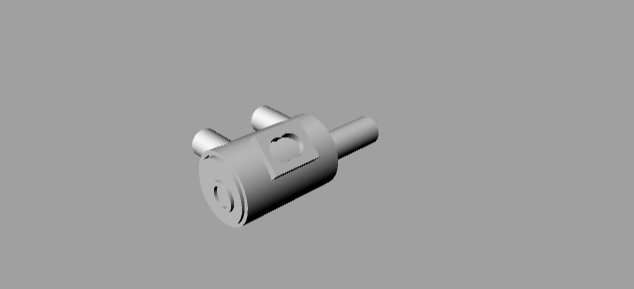
The first rough illustration is attached here. It is out of
proportion. The outer pipe needs to be reduced in diameter, the
inner pipe does not protrude from the front side, and the
turbine inlet flange needs to be move up near the top for the
gases to scroll around the inner pipe effectively. Call in a
log manifold, or call it N/G. Hot gases exit through square
tubes from the exhaust ports and spin around between an an
inner perforated tube and the outer 4 inch chamber wall before
entering into the turbine on top. Perforated baffles to direct
the gases but allow interaction with sound waves may or may not
be needed. This needs to be tested. All materials are either
Inconel or stainless 316L. In operation, opening the bypass on
the one end of the offset internal 42mm ID tube would allow the
hot gases to be bypassed over board.
Surrounding the outer pipe would be a thin metal enclosure and
rammed air can be introduce between it and the log manifold.
I'll have a heater muff on the last part of the exhaust pipe for
the aircraft's warmth and a rammed air source installed so
basically it is a plumbing challenge to route the air through
the exhaust log manifold or not. Advantages are a robust mount
and possible further sound reduction with minimal flow
restrictions.
Reading your last post I am concerned the kinetic energy may be
lowered too much.
The other option is to weld up a short linked tubes splicing in
a central waster gate pipe and enclose this in some sort of
housing to cool it off. I doubt is would have enough surface
are for cooling to have much of an effect though. Turbos like it
hot. Just not to hot.
Your thoughts would be appreciated.
Cheers
Doug
--
The Rotary Engine NewsLetter. Powered by Linux.
ACRE NL web site.
http://www.rotaryeng.net
Youtube key word PaulLamar2
Copyright 1998-2010 All world wide rights reserved.