http://www.autoblog.com/2010/08/30/mazda-shinari-concept-debuts-new-face-of-the-brand-in-style/
Mark Steitle
I hope so but here are a few suggested improvements.
If Mazda builds it it will be road raced. These aerodynamic
modifications are essential as a lot of racing classes do not
allow after market body modifications.
Paul Lamar
It would only work as an RX-9 if it had a three rotor. Would make a
great BMW 5-series killer. But I wish it had a greenhouse.
jd
Paul, And its a 4 door! If they built a 3 rotor version of a 16B
wouldn't that be 2400 cc? With that power to weight ratio their racing
season would be one race no mater how they classify the displacement. Might
as well put sequential turbo charging on as well since there is nothing to
loose at that point. Stock car racing outlawed the Dodge hemi and Ford
super
cobra jet ( the Ford before the Daytona 500) as well as two stroke and gas
turbine engines before they were built. If we get 250 HP per rotor with a
P-Port that should be about 830 Hp for a race version 3 rotor NA engine. No
telling what a 24B could make.
It would be nice to be able to get all new aluminum 3 rotors at OEM
pricing to put in aircraft but if they aren't allowed to race them would
Mazda continue to build them.
george grimes
A 13B 2 rotor is 2.6 L. RX8 intake manifold is 250 HP at 8500 RPM.
A 16x 2 rotor is 3.2 L. RX8 type intake manifold is ~ 300 HP at 8500 RPM.
A 20B 3 rotor is 2.6 + 1.3 = 3.9 L. A P-port is about 450 HP at 10,000 RPM.
Not likely to make that much in a street car. I would say more
like 330 HP but lots more low RPM torque than a 13B or 16x.
All normally aspirated. 25% to 30% more HP for turbo compound.
Now if they use my idea for a trap door P-port they may get
close to 400 HP NA or more in the 3 rotor street version :)
http://www.rotaryeng.net/RX8-p-port.html
What they really need now is a Formula 1 type transmission with
super fast paddle shifter. That would make the RX8 a lot more
fun to drive. It would be a blast to drive. It would also help the
16X and the 20B. The rotary engine comes alive after 6000 RPM.
Mazda is racing the 20B 3 rotor in RX8's in the Rolex GT race. In fact
They dominate the entries with 7 or 8 and usually either win or
finish on the podium. P-ports are outlawed in SCCA racing as
being unfair to piston engines. Stock 13B RX8 engines are
used in Star Mazda open wheel road racing. Typically 30 or more
cars in each race.
Paul Lamar
Paul,
I must have missed something and now I'm confused! You again listed the 13b
as 2.6l and I was thinking it is 1.3l or 650cc per rotor. (and etc, for more
rotors) What's up with this?
Dan F
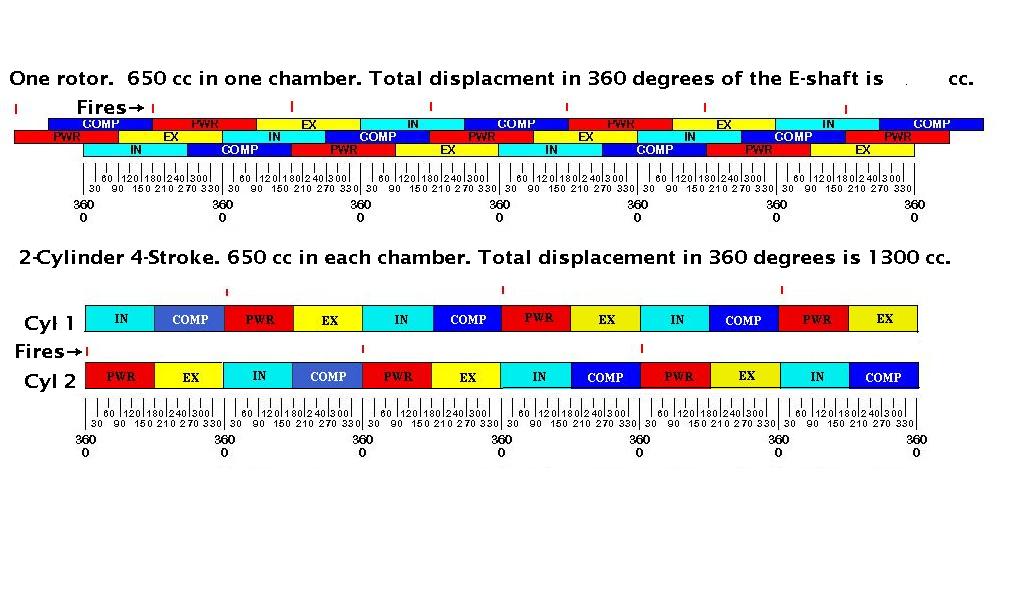
Lets turn it around. How much air would a 2.6 liter two cylinder
TWO STROKE engine pump in one revolution?
The rotary is not a two stroke. It is a four stroke.
As far as 4 stroke HP is concerned the ONLY thing that matters is how much
air a four stroke engine pumps in ONE REVOLUTION at 100% Volumetric Efficiency.
This is definition of displacement, as far as 4 stroke engines are concerned,
and is only valid in context with 4 stroke engines. A two
stroke will generate twice the power as it processes and fires
twice the air for a given rev and physical chamber volume.
The use of the term "displacement" itself suggest this rating criteria.
13B rotaries are raced in the 2.6 liter class world wide
for a good reason. The only reason they generate more power
than a 2.6 liter four cylinder engine is they turn faster
and breath better. Lately that is less true as the piston
engine RPM has been raised by detail development and the
use of high strength to weight ratio materials like titanium
rods, better aluminum alloys for pistons and pneumatically
controlled valves. Valve springs are not used. Also four
valves per cylinder has improved the breathing or Volumetric
Efficiency. They are barely good for two races. Eight engines
are allowed for each driver for the entire season.
It is very rare for any 2 valve cylinder to have a VE over one.
The RX8 engine is just over one and P-ports are typically
1.2.
Formula One (2.5 liter as I recall) V8 engines are now
turning 18,000 RPM. Four valves per cylinder are used with
a very short stroke so larger valves can be used for a given
physical cylinder volume. You will not find the details
of a competitive Formula One engine anywhere. Its a well
kept secret. However I would not be surprised if the VE's were
well over one. Applying the RPM difference to a 2.6L p-port rotary
making 340 HP at 10,000 RPM would equal the Formula One engine
at about 18,000 RPM. 18,000/10,000 times 340 HP or 612 HP which
is about the right HP for a Formula 1 engine give or take
a few. A wider rotor would help as it would allow a larger
P-port.
However in the real world HP per displacement
is not important. What counts is the HP per pound of weight
and the HP per cubic foot of external volume. Here is where the
Wankel shines.
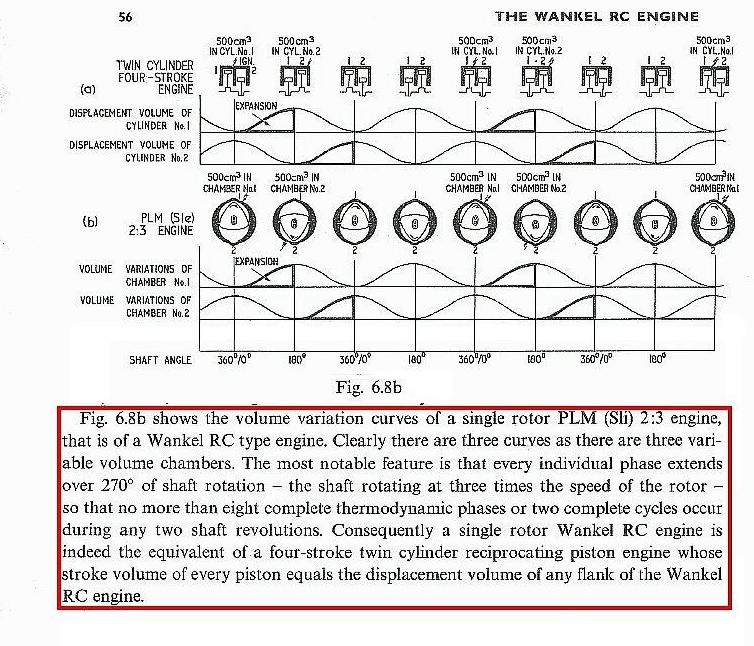
Here is what Ansdale has to say it in the attached jpg.
The Wankel rotary is a subtle engine and very few people truly
understand it despite some people using it for years. It is
the best combination of two stroke and four stroke
technology. If some CEO's in the world truly understood it
they would invest more money in Wankel R&D and improve the
amount of HP per gallon of fuel burned. Right now it is about
5% to 10% worse than a piston engine for a given HP. Turbo compound
anyone? Rotary engine specific ignition systems?
BTW Kitplanes tells me my article, "The Rotor Verses the Piston",
will be out in the December issue so get your subscription
now.
Paul Lamar
--
The Rotary Engine NewsLetter. Powered by Linux.
ACRE NL web site.
http://www.rotaryeng.net
Youtube key word PaulLamar2
Copyright 1998-2010 All world wide rights reserved.