I use RedHat Fedora 13. I have it on a high end 7 year old laptop.
1.3 Ghz / 2GB / 1440x1080 resolution. At work I have 64 bit Fedora 13
on a modern 64 bit laptop: Duo CPU 2.50GHz / 4GB / 1280x1024 and I
use a desktop monitor.
They both perform well. I use Sun's, now Oracle's VirtualBox, to
run XP. VirtualBox is free software virtual machine. It is a no
brainer to install and run. I mostly run VirtualBox at work for
Outlook email client. We have Exchange mail server and to take
advantage of all the features requires Outlook newest version.
I was using Crossover Office, (pay version of WINE, Windows
emulation) for Linux to run Outlook, but I couldn't get the new
required version of Outlook to work. So, I dedicate 1GB memory to a
virtual machine running XP/Outlook.
I use Google Chrome (web browser) and it is very snappy; loads and
runs fairly fast. I also use Google Mail, and of course Google web
apps run real well in Google Chrome.
I do not know of a virus that I have had in the last 13 years of
RedHat. Of course I am sure I have had them, they just do not affect
the OS/machine. The problem with that is: you can have a virus in a
jpeg image, send it to a Windows luser and infect their machine.
Blake
You brought up a very interesting subject.
I was surprised that a jpg could contain a virus. I have no doubt it
is possible. In my ignorance on this subject I just thought
a jpg was a collection of bytes that another program, called
a viewer, read one at a time and copied them to a section of screen
memory.
How does the viewer lose control?
How does the virus buried in the jpg become a program and
start executing?
What part of the jpg does the virus reside in?
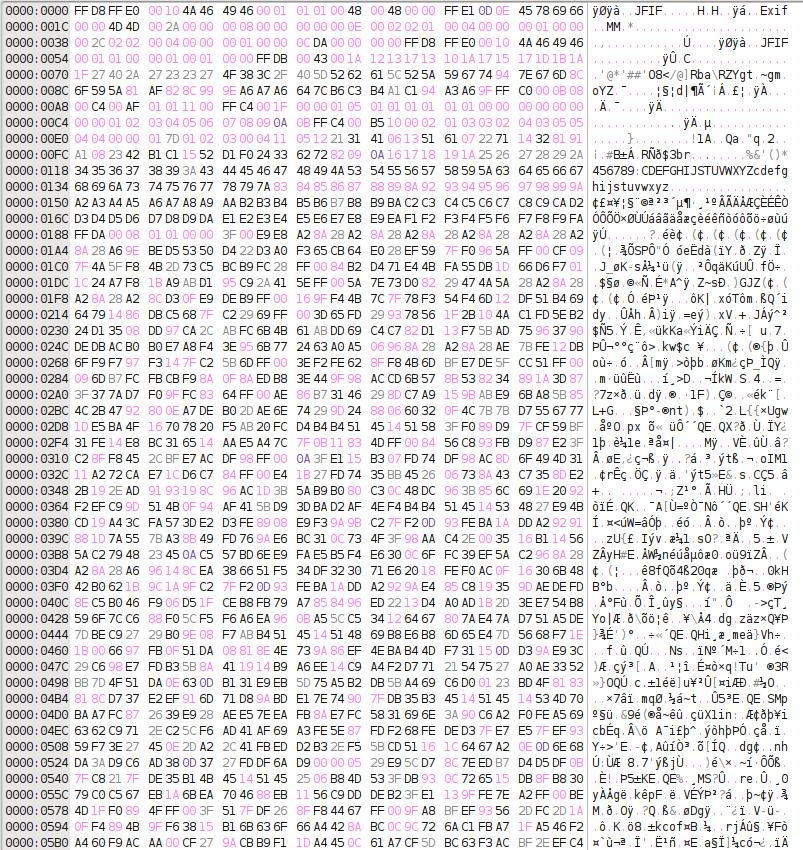
Here is a screen capture of a hex editor looking at a jpg.
I would like to know how to determine if a jpg actually has
an embedded virus because as you know we send out a lot
of jpgs. I don't want to be sending them out if they have
a virus of course.
Paul Lamar
--
The Rotary Engine NewsLetter. Powered by Linux.
ACRE NL web site.
http://www.rotaryeng.net
Youtube key word PaulLamar2
Copyright 1998-2010 All world wide rights reserved.