A link to the article follows:
http://www.sportaviationonline.org/sportaviation/201010#pg94
Potential viewers may need to be EAA members to view.
I would be interested in the Rotary community's assessment of the
article, particularly as it equates the weight of a rotary's firewall
forward to be approximately equal to that of an equivalently powerful
traditional setup.
Cheers, JLM
I thought it was a poorly done article. It is a reflection
of the knowledge and experience of the Director of Publications
& Editor who obviously does not know the difference between
a rotor and a piston. Would the Air Force send a liberal arts
major to test pilot school? Is this not the Experimental
Aircraft Association or is it a wanabe AOPA?
I submitted an article on aircraft turbo compounding years ago and
the EAA mag rejected it. Anybody that knows what aircraft turbo
compounding is and has been in the past should have been interested
in that article. It played a significant role in post world war II
military aircraft. I am not the best writer in the world but that is
no excuse. It is the content of the article that counts and a good
editor can fix anything. The KitPlanes editor was knowledgeable enough
to published it and the World Motorsport Symposium held in Oxford
England in 2008 invited me to give a talk on the subject.
http://www.rotaryeng.net/Oxford-Race-Tech-art-Dec-08.pdf
I have been advertising this newsletter in Sport Aviation mag
classified section for 12 years and they failed to mention this news
letter in the article. I tried to get my cooling book in the EAA book store
at OSH and the lady in charge refused to carry the book. Apparently
she thought the title "How to Cool Your Wankel" had sexual connotations.
That says a lot about how she thinks :)
The article did not explain why the rotary is better than a piston
engine. The rotary is equal to the weight of a Lycoming O-360 firewall
forward but it can put out 250 HP instead of 180 HP. A 250 HP six cylinder
Lycoming would be at least 100 pounds heavier. If expensive aluminum end
housings are used the weight would be 100 pounds lighter than the
Lycoming O-360.
There is also weight to be saved in a better designed gear box and
the substitution of aluminum rotors for cast iron.
Paul Lamar
Paul,
I will read the EAA thing, but I already know what to expect. Years
ago when I suggested rotary at a local EAA chapter the members all but
laughed at me.
This may be a good time to ask my next big question:
What is available now (or soon) that can reduce the weight of a Mazda engine?
I'm thinking seriously about a 1 rotor (Atkins has the e-shafts and
oil pan). Aluminum end housings are justified for me, then aluminum
rotor, Everything possible, practical and safe needs to be done to
have a serious weight reduction. What about the center section?
Atkins quotes 220 lbs for the single rotor engine complete. What would
such an engine weigh if all possible were done to reduce the weight?
Thanks,
John McEveret
Racing Beat in Santa Ana Ca. sells aluminum end housings which
would be necessary to make the Mazda one rotor competitive.
http://www.racingbeat.com/
The Atkins weight sounds like it includes the PSRU and a carb.
PSRU's are 40 to 50 pounds unfortunately because nobody has
attempted to optimize the weight. My guess is half that
with careful design. The Ford gear set alone is only 8 pounds.
This becomes more important when considering a one rotor
Mazda engine. Bare one rotor weight with alloy end housings
should be under 70 pounds.
Rotor housings are 13.5 pounds, Rotors 9 pounds.
Cast iron end housings are 30 to 40 pounds.
At least half of that can be saved with alloys.
A two rotor e-shaft is 15 pounds. Lots of other
stuff like phasing gears and oil and water pumps.
Paul Lamar
Paul,
I wonder if any of these people have ever seen the
SuperLite built by Steve and Everett
Their claimed weight was 166 pounds FWF! I have seen
the engine parts and I believe it.
Amazing work, too bad they stopped because they thought
people wouldn't buy it for 20K.
208 HP BTW. We lost a great pioneer in Everett.
Bill Jepson
I agree he and Steve Beckham where years ahead.
That is why I started this news letter.
I think the failure to recognize the advantages of
the p-port retarded the acceptance of the rotary.
I myself did not realize that point when I started.
Something Everett and Steve already knew.
The P-port is the key to the acceptance of
the rotary as it gives a clear power to weight
ratio advantage.
The new Power Support made a serious error in not selling
parts to the troops in the trenches despite building p-ports.
They went for the $30,000 pot of gold. Mistral made the same mistake.
I now know it takes dozens if not hundreds of rotaries
flying to convince the very conservative pilots out
there. The way to do that is have a network of suppliers.
Tracy Crook has done a lot but much more can be done.
We need a lighter gear box, a good low cost carb set up
with a stand alone ignition and a source of good motor mounts.
sniped politics
Paul Lamar
Hi Paul......... love the information..... got a question for you..... is there
anyway to have the most recent comments appear at the beginning of the message,
instead of adding it onto the bottom of each message?
William V. Hill Jr.
FAA Safety Team-Lead Representative
www.faasafety.gov
2010 FAA Western Pacific Region Representative of the Year
19009 Freda Lane
Redding, CA 96003
wvhill@sbcglobal.net
530-410-9525
We have been doing it this way for 12 years. The reason is a chronological
record of the discussion is available to me when the subject
arises again. Question answer... rather than answer.... question :)
We have taken votes over the years and people like
it like this once they get used to it.
Paul Lamar
ok....... majority rules....... thanks
William V. Hill Jr.
Paul,
Greetings.
As I was reading the article,I was looking forward to the mention of
your name,the newsletter,and the pioneering work that you have con-
tributed toward the development of the rotary as an aircraft powerplant.
When I didn't see any mention of your work,I was shocked,for this
very serious lapse in informing the readership, of the work being
done by yourself ,and the rest of our community ,to advance and po-
pularize the acceptance of the rotary as an aircraft power plant.
As you mentioned,it says a lot about the the mindset of the powers that be at
EAA ,and their attitude regarding experimentation and true innovation.
Regards,
Dave Young
I think we are TOO experimental for the Experimental Aircraft Association :)
Paul Lamar
Paul et al,
Thanks for the feedback on the EAA rotary engine article. You
confirm my suspicion that the weight comparison between rotaries
and conventional engines was not addressed appropriately. Also,
there probably is a great deal of truth to the fact that
'rotaries are too experimental' for the majority of the EAA's
members as the organization is composed largely of folks flying
certified aircraft who have interests in general aviation that
aren't met elsewhere with smatterings of homebuilders and
antique aircraft enthusiasts thrown in for good measure. Therein
lies the challenge which rotary community can either accept or
decline.
FYI, my first exposure to rotaries in aircraft was at EAA's Air
Venture in 2008. Shortly afterwards, I stumbled onto the rotary
web site,
http://www.rotaryeng.net/. Regrettably, if there were
rotary related booths at Air Venture 2010, I missed them.
As pointed out on the web site and elsewhere, rotaries have
numerous potential advantages over conventional aircraft
engines. The major disadvantage is there is no place to buy one
that can be used in certified aircraft or even easily in home
built 'experimental' aircraft.
Rotaries could be an answer to the need for a solution to the
gargantuan leaded gasoline problem that the general aviation
community is facing. There has to be a huge market for someone
who could build a reasonably priced, FAA certified, rotary
engine and put it in firewall forward packages (FFPs) tailored
(with STCs) to the thousands of FAA certified aircraft that will
need a solution the leaded gas problem. A 200 HP, fuel injected,
dry sump FFP for the hundreds of RVs under construction would be
a fantastic first step toward entry to the billion dollar market
certified replacement market that is begging for someone to grab
from lethargic U.S. behemoths like Textron (Lycoming,
http://www.lycoming.textron.com/) and Teledyne (Continental,
http://www.genuinecontinental.aero/) or the more entrepreneurial
Austrian division of Bombardier, Rotax
(
http://www.rotax-aircraft-engines.com/default.htm).
Thanks for providing a forum for my this kind of brain storming.
Cheers, JL
The big aircraft engine builders are hampered by the certification
rules. It is very expensive to make improvements in an aircraft
engine due to the certification requirements. Mistral went bankrupt
after ten years of trying to certify the rotary.
The big mistake was biting off more than the FAA could chew.
If Mistral had used an aircraft carb and magnetos instead of EFI/FADEC
it would have breezed through certification.
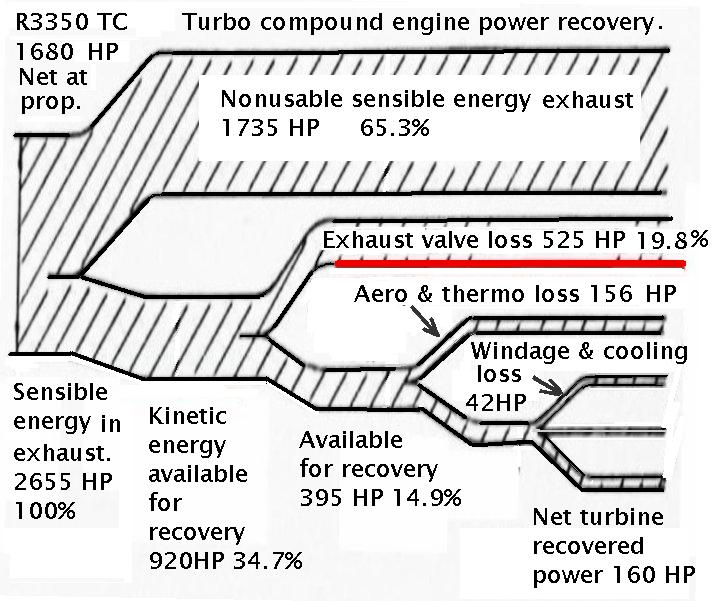
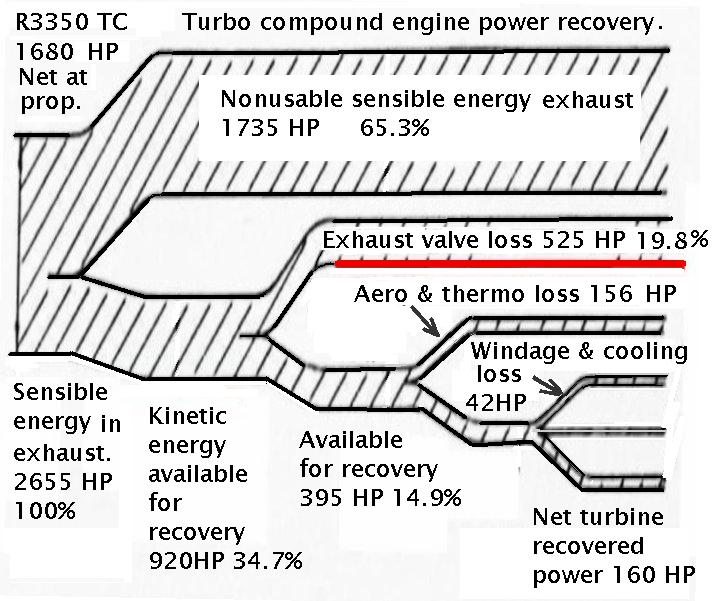
The rotary is potentially the most efficient internal combustion
engine of all time in turbo compound form due to the lack of exhaust
valves. The exhaust valves remove a huge portion of the exhaust
energy. Because of this energy absorption they are also the weakest
link in the aircraft engine. Most of the R&D money Curtis Wright spent
developing the turbo compound CW R3350 was spent on trying to
get the exhaust valves to live. If it were not for the exhaust
valves the CW R3350 TC instead of being 20% more efficient
would have been 40% more efficient.
http://www.rotaryeng.net/turbo-compound.html
Paul Lamar
--
The Rotary Engine NewsLetter. Powered by Linux.
ACRE NL web site.
http://www.rotaryeng.net
Youtube key word PaulLamar2
Copyright 1998-2010 All world wide rights reserved.