I'm in the midst of tuning my engine. I was getting the bogging and then
surging right at the point that the secondaries were turning on, and I
also
seemed to get good results by richening it up for the first 3 bins where
the
secondaries are cutting in. This is on the ground, of course. I think
that
I will see some need for tuning in the high RPM/ low MP mapping table when
I
am in the air descending. Or maybe not, as I recall the airplane was
making
a siren song to me that it was running smoothly as I was descending to
land,
calling for me to go around because it was now smoothing out.
My spark timing is right on the money.
Also, my primaries are 28 lb, and the secondaries are 40 lb injectors, so
my
staging point is at map station 89~90 right now. I think that might be a
little
high.
Here's another unrelated issue- I have an RV-4, with the fuel being taken
out of and returned only to the right tank. I have an AN-6 line feeding a
facet pump located just aft of the batteries, and it transfers fuel to my
right hand tank when I want to transfer the fuel. Both tanks are vented
separately. Here's the problem: I started out with 12.5 gallons in the
right tank, and 6.5 in the left. After running the engine on the ground
for
1 hour, I ended up with 12.7 gallons in the right and 1.7 in the left,
without ever having run the transfer pump. The only thing I can think of
having happened is that the plane was parked slightly- 1 degree or
so-right
wing down. The facet pump I believe has a one way valve which would allow
fuel to flow downhill to the right tank. That's my theory, can anyone
else
offer a theory as to why the fuel is self transferring?
Brian Trubee
RV-4
Your prop turns clockwise tending to lower the left wing
deflecting the landing gear so that is not it. Unless of
course you pull the power quickly and get some spring back
from the landing gear. Then the fuel could slosh into the
right wing through the one way valve in the transfer pump.
Double check the plumbing :)
Where are the fuel tank vents?
BTW sitting in the car the engine from the drivers
point of view the engine rotates counter clockwise.
Therefor when turned around in the tractor airplane
the engine rotates clockwise. Left wing down right
wing up.
The same as your prop so you must be running a 2.85:1 gear
box. Is that correct?
Paul Lamar
Yup, 2.85/1 so I'm turning clockwise from where I sit in the cockpit. The
plane
was sitting on a slight, very slight grade to the right, so that might
have
something to do with it. Both tank vents are located next to each other
near
where the right gear leg exits the fuselage. I ran it for an hour or so,
but
didn't see any evidence that fuel leaked out anywhere. There was some
engine
surging, so I guess the longitudinal rocking could have caused some fuel
to
slosh to the right, but the left tank was near full, and the engine takes
and
returns fuel to that tank.
I'm going to hold off on the taps for now, I think I might have the engine
running smoothly.
Puzzling.
Brian Trubee
I'll bet the tank vent is facing forward correct?
-------------------------------------------------
Never mind. I found a picture. They are indeed facing forward.
The prop blast is pressurizing the left tank and forcing the fuel
over to the right tank. This is fine but you need to control
it. If the vent is wrong on the right tank this could force
fuel overboard through the right tank. To prevent this
you can use a one way valve in the vent lines.
At 100 MPH prob blast the left tank will be pressurized
to .18 psi. 6 inches of fuel is about .2 psi.
so .18 psi will force fuel into the right tank
when the level in the right tank is about five inches or
lower. In theory both tanks should be pressurize the same
so the right tank vent may be plugged.
Good thing you noticed that as that could cause real
problems on a cross country trip cruising at a higher
speed. With a prop blast of 150 MPH the tank pressure
will be .4 psi. That could force fuel overboard
with a full right tank.
I would connect the the right tank vent into the left
tank. You could probably get away with no transfer
pump but you should try it first with the pump
off.
You have not begun to tune :)
Here is an old message on the subject perhaps you forgot about.
Paul Lamar
------------------------------------------------
-------- Original Message --------
Subject: EFI Fuel feeding system
Date: Sun, 12 Nov 2006 09:55:05 -0800
From: Rotary Engine <
rotaryeng@earthlink.net
To: AA-me <
rotaryeng@earthlink.net
snips......
I figured I'd go really simple and copy Tracy Crook's system- take the
fuel out of and return to the left tank, and use a pump to transfer
fuel out of the right tank to the left. The worst that can happen is to
transfer too much over to the left tank and pump the excess overboard.
Then you are left with the right tank empty and the left tank full.
(Unless someone can see some other scenario that I have overlooked)
I've got one of Bulent's 6 port valves left over, so any offers on it
will be considered.
Brian Trubee
That is fine as long as you don't get distracted and let
it pump fuel overboard.
Another scenario is if the right tank vent is pointing forward
it will empty the right tank to the left tank and force all fuel
out of the left tank vent in short order at over 150 MPH.
The safest thing to do is keep that valve you have and use it.
Paul Lamar ...No rotor no motor.
--------------------------------------------------
"My spark timing is right on the money."
Can I ask where you have that set?
Jay
Spark timing is set at 22~23 btdc @ 4000 RPM.
I think I'm going to try the easiest solution to the unwanted fuel
transfer problem first- that would be to put one way check valves into the
vent lines. But I think there will still be unequal tank pressures due to
the fact that fuel is being drawn out of the right tank, so the left might
have slightly higher pressure and want to contribute to the right. Anyone
know where to get smaller check valves which have a very light opening
pressure?
Maybe a simpler solution is to put a manual valve in the transfer line.
On second thought, putting check valves in the vents might be a real
bonehead move, since in climbing up from sea level to 17,000
feet(unrealistic, but possible) you'd be developing a pretty good pressure
differential inside the tank, at least if you were not to draw fuel from it.
I think the easiest solution is to put a manual valve in the transfer line.
Brian Trubee
Check valves in vent lines are SOP for some certified aircraft.
Compared to EFI fuel pressure of 50 psi a few psi
due to altitude is minuscule.
Paul Lamar
Hi Brian,
Congratulations on getting airborne. About check valves. They are only as
reliable as the fuel filter. Any grit in the fuel and they are defeated.
Most of the SeaWind builders have taken them out in favor of manual valves.
Set up properly manual valves can also act as an emergency fuel shut
off system.
Long flights require fuel management skills and pilots of really long
flights have been known to use kitchen wind-up timers to remind them to
change tanks every 30 mins.
I wouldn't restrict the vent lines with a check valve, What size lines are
the vent lines now?
All the best
Doug in Japan
I disagree Doug. One can lose fuel out of a vent line
when in uncoordinated turns and if the tank vent line happens
to have a low pressure applied or one tank vent is seeing
dynamic pressure and the other is not.
A check valve on the vent line is mainly a screw up preventer both
design and operation.
Paul Lamar
Paul, Why not have the vents connected to a tee with a single outlet.
Also Bruce Bohanan(sp?) who was setting time to climb records in the Exxon
sponsored "flying tiger" had a wing tank sucked out of shape/collapsed due
to a vent line and changes in barometric pressure with altitude while
descending.
george grimes
The only way that could happen is if the vent line became plugged
with something. The one way valves rarely, if ever fail in
that mode. They are more likely to just leak in the blocking direction.
Perhaps a large insect was sucked into the vent line.
Paul Lamar
Brian,
Which tank does the fuel come from and return to? You commented twice it was
the right side and once it was from the left.
I had some identical blocked vent problems in some industrial equipment I have
designed. One factor is the liquid, gasoline in your case, cooling off upon
shut down and creating a strong vacuums that pulls moist air into the vent.
line. If there is any dip in the line it condenses there and creates a water trap.
A tank spurting fuel upon shut down would indicate a partially plugged vent
line. Could be a mud dauber. What worries me is the thought of fuel vapor
finding their way into the engine compartment. Brian buddy I hope you take it
slow and figure out what is happening before flying again.
And as for Facet pumps. Some have check valves others models don't.
Paul
I don't know where you get your info on check valves but the only way they
effectively seal is to have a properly designed seat and proper spring force to
hold them closed. That force varies whether they are metal to metal or metal to
rubber seal or whatever. In the best of conditions, yes they work. But those
conditions I have found are In high pressure situations. In low pressure systems
Murphy will guarantee that grit ends up in the smallest diameter in the line,
the check valve, and cause it to leak. Manual ball valves are hard to beat and
the on /off position can be visually verified.
Doug in Japan
You may be on to something Doug given the fact the vents are
below the tanks. Most vent systems are well above the top of
the fuel. Another scenario is a siphon situation could occur
with the vent below the tank.
Here is the info on the one way valve. Given the price
they should be airline quality. If they fail 300 people could die :)
An AN6 is not the smallest diameter in a vent line.
I posted this jpg before so using a Mac you may not have seen it.
The Mac email program, for some strange reason, does not automatically
view attached jpgs. I have this problem with Robin's MAC all
the time.
Paul Lamar
My fuel is taken from and returned to the right tank. Fuel is transfered from
the left to the right. As it stands now, it is self transferring. I'm going to
put a manual valve in the line that goes between the tanks which is used to
transfer fuel. I think that should do the trick.
As far as the dicey proposition of fuel leaking out and vapors getting into the
engine compartment or any other unwanted conditions developing, yes, I am going
to take it slow. The self transfer of fuel occurs on the ground during running,
it just didn't become apparent until the tanks were topped off. So, after
installing the valve, I will do an extended ground run to check. I am also
looking at changing my staging point. Right now it stages at station 91 on the
injection map, which corresponds to 21 inches of manifold pressure. Tracy
recommends staging at around 19 inches. I've got it running smoothly through the
staging transition as it is, so I'll record all my settings in case I want to
change back to what I have now.
Brian Trubee
Check the vent on the right tank. If that vent is not open you
could starve the engine if you shut off fuel from the left tank
and perhaps collapse the tank depending on how well the HP pumps
suck.
You need to find out what is going on and why exactly before you make
any changes.
Paul Lamar
I sumped the right tank with my ear next to the vent and heard the air being
sucked into the vent, so I believe the the vent does open. Also, it was the vent
where the fuel was coming out when I shut down. Whatever is going on, it's going
on when on the ground or air, with the prop blast hitting the vents. So, some
extensive ground running is in order after I install the valve. One encourage
thing is that the temps are well under 200 degrees- around 180 on a 50 degree
day. I'm sure it will be a different story when it's 90 out.
Brian Trubee
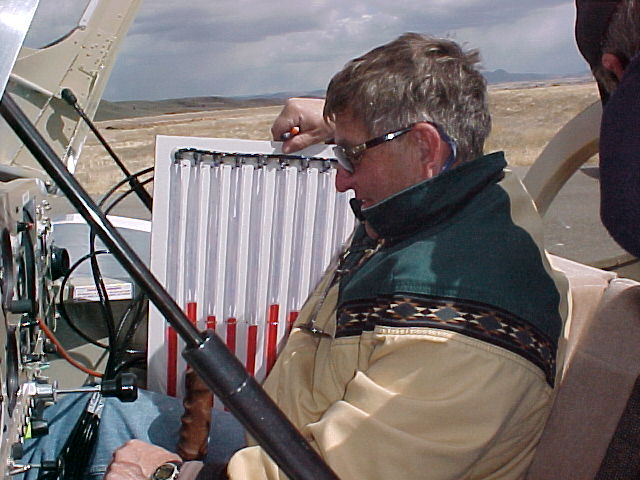
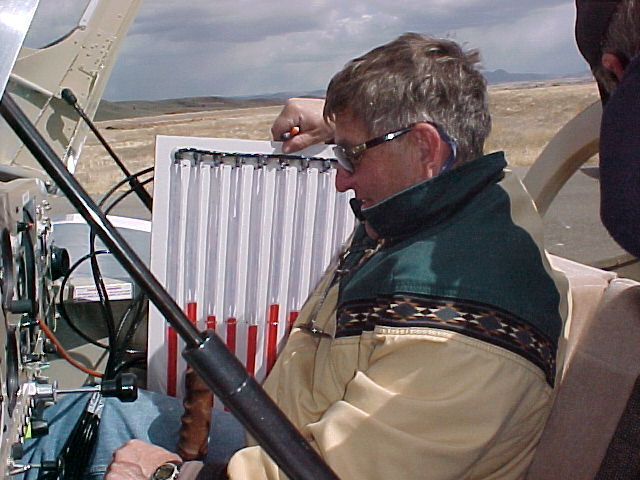
Very strange behavior indeed. I suggest the manometer test
to see what actual air air pressures are in the tank
when the engine is running. I use very low cost drip irrigation
fittings and tubing to make mine.
Paul Lamar
--
The Rotary Engine NewsLetter. Powered by Linux.
ACRE NL web site.
http://www.rotaryeng.net
Youtube key word PaulLamar2
Copyright 1998-2010 All world wide rights reserved.