Paul
My Norton Rotary story starts out many years ago when I first saw the Norton
engine being marketed by a company that is now defunct. the engine looked small,
and the stats (although no aviation engine had been produced looked impressive.
(I can only remember the colors of that companies logo as being green and the
engine being just a purposed minor part of their line)
That engine never came to market, and I put a VW engine in my dragonfly.
After my first flight, many years after I had seen that engine, because of oil
pressure problems, and a broken Canard, I removed the engine and rebuilt it, to
find the bearings totally shot (was a new aircraft conversion, built by the
converter incorrectly). After the rebuild, I had some spinal surgery (not
aviation related, from which the recovery was extensive and I went out to the
airport, sat and just stared at my project for what seemed like years.
Ultimately, I realized that I would, indeed walk again and decided to once again
address the engine. About that time, I read that the Norton engine was being
made available as the AE100R by an English company called Midwest and one was
available in the US (they had a rather strange distributorship system, with
sometimes strange people doing the distributing.) I felt that because I had
indeed survived and was learning to walk reasonably well, that I deserved that
engine which I had lusted over, but until now was unavailable.
I was able to get the two rotor. There was little factory or distributor backup,
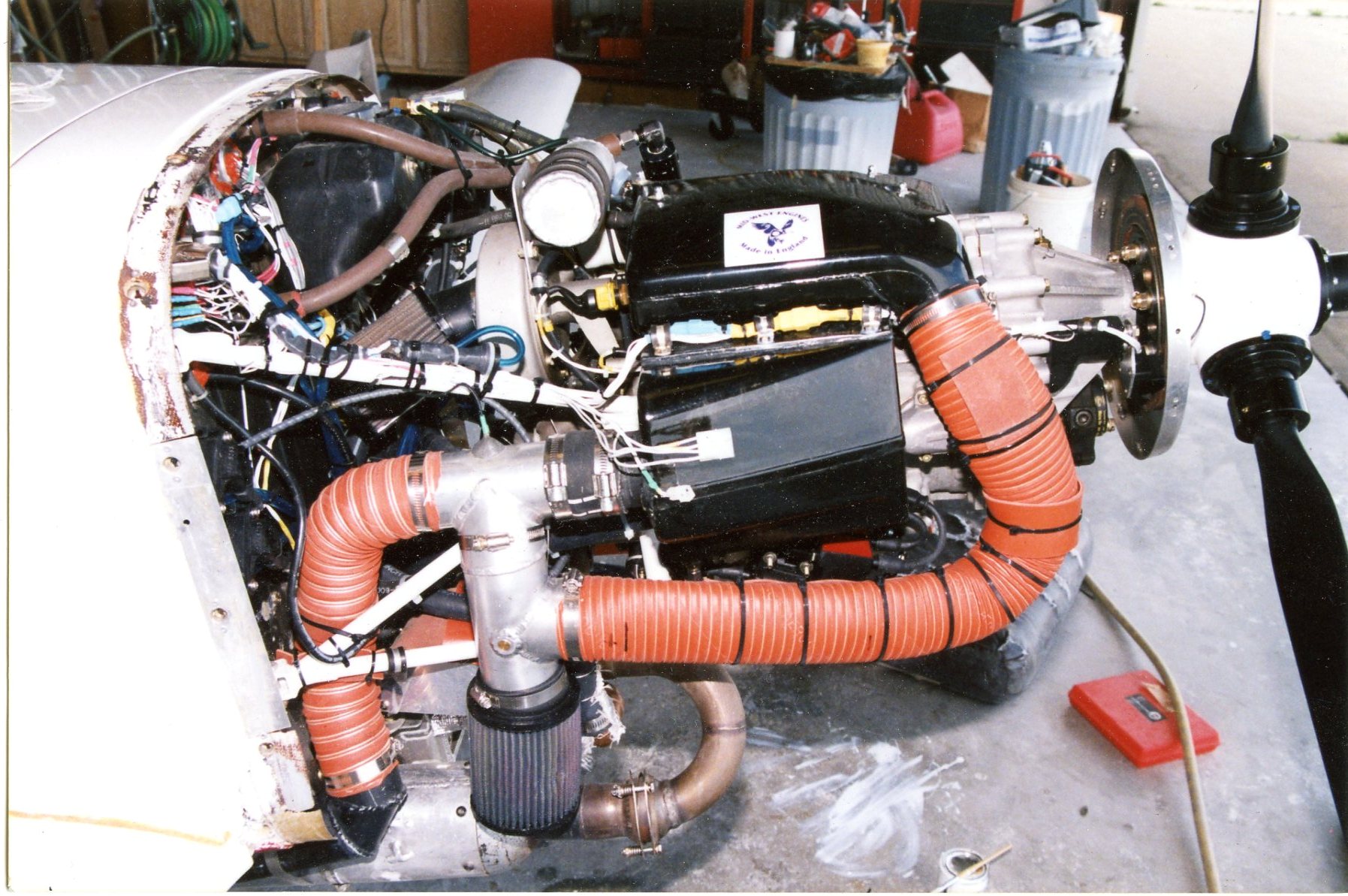
at that time. The engine had 2 carburetors and the lubricating oil lines were
plastic. The engine has a plastic(for want of a better word) induction manifold
sitting on top, under which was another manifold for the cooling air/oil mixture
to be expressed out of the engine.(more about this later) The intake manifold
was quite substandard and needed a lot of reinforcement, and the 2 tubes, one to
each rotor were similarly constructed. I believe the carbs were Tillotsens.
The engine was a combination of water and air cooled. The trochoids were cooled
by the standard H2O antifreeze method, water pump at the back of the engine,
directly driven off of the eccentric. The rotors were cooled differently.
Oil was injected into the trochoids, for obvious reasons. It was also injected
into the bearings (probably roller) for lubrication. There is no oil pressure or
sump in this system. It appears as if the oil, after lubricating the bearings,
weeps into the center of the engine at which point it is picked up by an
airstream created by a turbine, belt driven, and blown into the innards to cool
the rotors. This, then oil and heat laden air is exhausted out of the engine
coursing through the lower manifold indicated above. It is then routed to a
separator, basically an evaporator pad. Some of the oil (about 1/3 of that used
for the bearing lubrication and cooling) drips to the bottom of the enclosure
and is returned to the oil storage tank, and the rest blows overboard.. The
system works well, as long as proper ducting, etc is used. You cannot use premix
in the fuel as the bearings will not be lubricated and your flight will be very
short.
There are a couple of problems with the above mentioned system.
1. The recommended oil is very expensive (synthetic "Goldenspectro- Premix" from
what I remember. A Mobile Pegasus product is also approved ( I have a 55 gal
drum full of the stuff which serves as a table, in my hanger)
2. The oil laden air, exhausting from the engine (which can be used for Carb
heat or alternate air) has to go somewhere, and it coats any aircraft part
downwind from it. In my case, the Right wheel pant was always covered with
unburned goo after a flight.
After I installed the engine and had some flights with it, I had major ignition
problems with it (the installed system was crap, and in fact decided to remove
the engine. The Midwest company was quite wanky, seemed always to be on the
verge of bankruptcy and was looking for an angel. Response from them was, and
many that of the people related to the company, was less that what I wanted, in
terms of safety and backup. I did not like the plastic lines, the Carbs were
difficult or impossible to properly adjust. (by the way, there were 2 of these
engines on our field, mine being one of them, the other in a beautifully built
Kitfox, not flown at the time.. I don't know if has flown yet (several years
later, although it has changed owners). Because of bad feelings of the future of
Midwest, I decided to dismount the engine and look for other avenues of power.
As I was pondering this decision and after, frankly hugely negative feelings
that I got from the factory Rep at OSH, I heard the Diamond company had come in
as the savior. Elated, thinking that this would resurrect my almost abandoned
engine, I found out that they had made many modifications to it, based on the
few that were out in the field. These improvements included a different coating
of the combustion chamber a new EFI and ignition system, metal lubrication lines
and a much stronger manifold assembly. They also modified the cooling turbine
(which had been changed at least 2X before because, I believe, they were
disintegrating or breaking in use.
So I packaged my engine, sent it back to England to Midwest (Now thinking it was
Diamond) to have it rebuilt (after about only 25 to 20 hours, if that) to their
new AE110R. now rated, by the at 110 or 115 HP. configuration. and reinstalled it.
After about 75 or 80 hours of flight, on approaching a landing, in dicy weather
conditions, the engine refused to accept throttle on level off. It did not
stumble, but continued idling at 2K until my arrival in a way too short field,
and the necessary destruction of the aircraft to save my own bacon. The engine,
in effect was still idling when I stopped, and I shut it down normally (of
course, the three bladed C/s prop had fractured it's Warp drive blades.
Then the real fun began. I was made aware that the ignition system had a fault
log which could be downloaded and evaluated, however only Diamond had the
software to do it, and they refused to release it due to proprietary reasons.
They said that I could ship the engine to them and they would send me a
report---Ya Right.
Although by this time, my contact person, at the company was great, I hit a
brick wall. Shortly thereafter I got a letter from a Barrister, of the company,
that Midwest, a company whose stock was wholly owned by Diamond had, in fact
been closed (bankrupted) and basically was told to "Pound sand". A personal
meeting between me and Christian Dries (Owner of Diamond) resulted in the same
pound sand philosophy. The engines did resurface at Austro later.
An additional problem with the AE100 is that the Champion spark plugs (surface
electrode) used are no longer manufactured. With the remanufacturing, they went
to a similar, but not directly retrofittable Bosch plug, which also is no longer
manufactured. (I have about 100 of these plugs, still in their original boxes if
anybody is interested. They were used on the BMW, M1 (I believe that is the
model) as the originals supplied.
Because of my experience with diamond, I personally would certainly have great
misgivings about dealing with them in any capacity. By the way the 2 rotor is
not certified, the 1 rotor was.
I actually loved the engine, despite the oil problems. Reminds me of the joke
"Other than the third act, Mrs. Lincoln, how did you like the play?
If you still want one, I suggest you contact a man by the name of Richard Nagus,
(once working for Diamond/midwest) he is involved with Nortons in England, and
he can give you more info on the current status of parts availability and
support. The fact that you saw parts at Diamond does not necessarily mean that
you can get them.
My suggestion, if you want to use this engine, get a 110R, design your own
electronics and prepare not only for no factory backup, but because of the
relatively small number of 2 rotors in the field, practically no support from users
If you do get the 100R, make sure that the turbine [blower] is the proper one as
when it sheds blades or whatever it does, you may find yourself in a world of hurt.
Engine itself ----when running ---3 canards up (out of 5)
Support and recommendations,10 canards down
I have attached a photo of the installation (early photo)
Rich
What year was this Rich?
Paul Lamar
The Rotary Engine NewsLetter. Powered by Linux.
ACRE NL web site.
http://www.rotaryeng.net
Youtube key word PaulLamar2
Copyright 1998-2010 All world wide rights reserved.