Matt-
I have never built a Rutan type composite airplane but
I wonder why one cannot sand the foam before applying the
wet layup to insure an accurate surface.?
Paul Lamar
One can absolutely sand the core before applying the wet layup.
I understand that Berkuts were built starting with cores that
were hot wired oversize and which were then sanded to precise
dimensions.
Matt-
Well then what about bonding on pre curred skins with
a finished smooth surface? The spar handles all the bending
loads.
One advantage of the sandwich skin idea above compared to a solid
foam core is you get more internal volume in the wing for fuel,
control linkages and perhaps landing gear.
No need to make separate hollow strakes.
Paul Lamar
The hollow strakes are to allow the fuel to be carried over the
CG on a twin lifting surface aircraft. This way, the CG doesn't
change as fuel is burned.
Your method sounds very similar to how the strake tanks were
built on the LongEZ. Precured skin bonded to prebuilt ribs.
Task Research built strake skins and ribs for the LongEZ. The
bottom skin was bonded to the center section spar, the fuselage
and an end rib. Baffles were added, and then the top skins were
bonded in place.
IIRC.
The prefab strakes are more time consuming to build than the
solid core wings, even if you excluded the fuel-specific portion
of their construction.
A lot of starry-eyed, Star Wars wannabes jumped into building
Variezes, LongEZ's, and Cozys. Way more than jumped into build
Van's RVs before the RVs became prepunched kits. Many of those
people didn't have any business jumping into the construction of
a flying machine. Because of this, much ado has been made of
the finishing process of the foam and plastic birds. My
experience with the stuff is that if you have the right
materials, and the right sand paper, it's really pretty quick
and easy to come up with an acceptable result. Trying to
cheap-out will cause the result to suck, which is dumb because
the right materials aren't that expensive.
Matt-
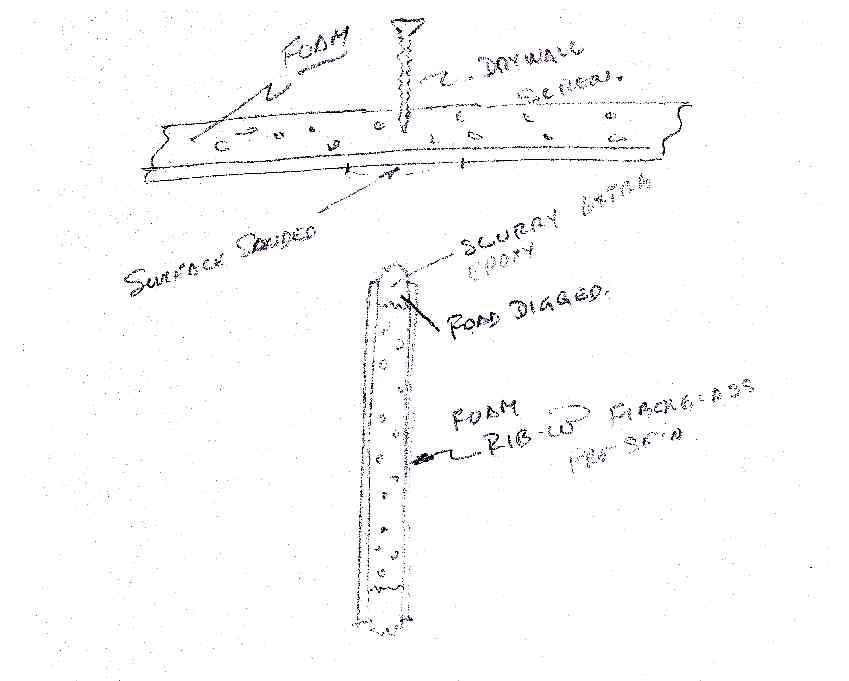
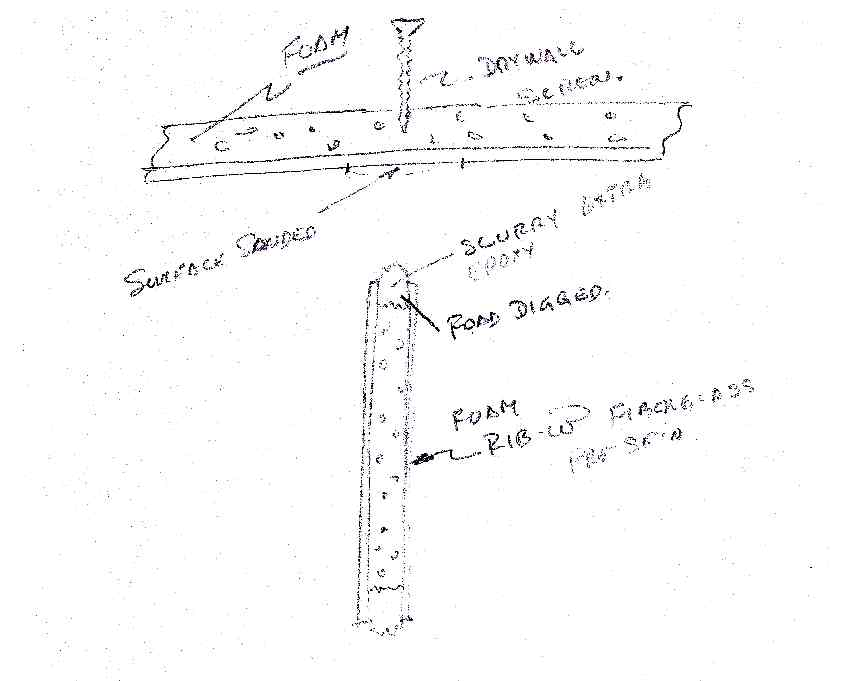
I plan on some strength test with the nylon dry wall anchors
screwed into blue foam ribs. It may be possible to
program a NC lathe and spit out thousands at low cost optimized
for attaching skin to foam ribs like nailing plywood
to 2 by 4 studs. I think they can be just pushed into
the foam. A large diameter will increase the shear
strength of the joint. It will take a little experimentation
to find the right diameter.
I checked with my expert consultant on composite construction
namely Alex Kozloff who has taught me all I know about everything
:) He has just finished building and flying a Pulsar with pre
curred foam sandwich wing skins made in a female mold.
No attempt was made to compartmentalize the foam so it is
just foam up to the top skin.
He says to cover the top of the ribs with fiberglass
tape. Don't worry about the joint between the top
of the rib and the glass side of the rib as that will be taken
car of the adhesive that bonds the skin to the rib.
He also loaned me an excellent book called "Composite
Basics" by Andrew C. Marshall 1985 written from an engineering
point of view.
---------------------------------------------
I found a low cost source for pre curred epoxy fiber glass
skins .016" (1/32) thick which is enough for a sandwich panel.
It is called Garolite Grade G-10/FR4 in McMaster Carr.
Part number is 8667K55 36 by 48 is $23.74
I am building a test panel with 1/4 inch PVC and 1 inch
thick styrofoam ribs.
Total wing cost for material will be about $50 a foot
however time to build will be reduced by a factor of ten
I hope.
---------------------------------------------------------
Here is a tension pull out test of the dry wall anchors in blue
Styrofoam. This is 4 pounds but it feels like it
will goto 10 pounds no problem. Four pounds is
plenty for holding the inner skin to the Styrofoam ribs until
the epoxy sets up. There is no real need to dip these
in epoxy before screwing them into the foam ribs
but it won't hurt.
The analogy here is fastening an aluminum
skin to an aluminum rib with sheet metal screws.
Once the top of the rib has a layer of fiberglass
tape it will be stronger yet.
Paul Lamar
Paul
when i built several Velocity i was using drywall screw to hold foam or
fiberglass parts together during the epoxy curing and was easy to removed and
with small perforations and been fill with filler before applying the fiberglass
layer
Jean Prudhomme
There is the drywall screw and a drywall anchor. I think the drywall screw
will hold part together but not apply much pressure.
Paul Lamar
The advantage of drywall screw is you do not damage the foam and you can put as
much as screw you want at narrow spacing,you do apply enough pressure to bound
pces together and when you removed it after curing it let small hole and easy to
fill and less weight as per filler
Jean Prudhomme
I'll have to try that. Do you dip them in oil or are they easy to remove
after cure?
The idea with the nylon drywall anchors is they are cheap and light weight
and they can be left in. If they are left in they add to the
strength of the joint as they go down deep in to the foam adding
a lot of bonding area due to their relatively large diameter. They also provide
a mechanical shear connection much like a bolted joint would. The large diameter
is a huge advantage transferring the shear load to the lower thin skin of the
sandwich panel. The technical term is bearing strength.
"Bearing Strength"
"The maximum bearing load at failure divided by the effective bearing area. In a
pinned or riveted joint, the effective area is calculated as the product of the
diameter of the hole and the thickness of the bearing member."
Do you want to add to this definition Chris Cosman?
http://www.astm.org/Standards/D953.htm
Paul Lamar
Hi,
Zeke Smith's book describes in detail how to install steel fasteners on thin
composite skins. It is really worth reading.
All the best,
Alex
Which book what page?
Paul Lamar
Paul,
Crane Composites makes FRP panels in varying types and thickness for the
transportation and other industries. Some of their trade names are "Filon" and
"Glasbord". Filon is used extensively in the RV industry as the smooth exterior
surfaces for motor homes and trailers. It comes in several thicknesses and
colors, (mostly shades of white...) in rolls up to 50' long and 5' to 8' wide.
Their website has PDF data sheets on all of their products.
A bit more convenient that McMaster Carr and likely cheaper although you have to
buy through their distribution network.
Scott Carroll
Lakeside, CA.
I am familiar with flat sandwich panels. Unfortunately we need
curved sandwich panels for wing top and bottom surfaces.
I think I landed at your airport at least once or twice
about 30 years ago.
There was a stream crossing the middle of the dirt runway.
It it paved now?
Paul Lamar
Paul,
Filon is very similar to the Garolite that you mention and comes in thickness
down to about 0.020" (with .062 - .032 being most popular) with a minimum bend
radius (I have been told) down to about 4". One of the many projects on my
plate is building a small Tear Drop trailer. I plan to use a
"Filon-foam-plywood" sandwich for the curved top and sides. I got the idea from
Zeke Smith's book as well.
I fly out of SEE Gillespie Field in Santee. No Creeks for the past 40 years
that I know of.
Bst rgds,
Scott Carroll,
Lakeside, Ca.
Kind of hard to find engineering info on this product.
Paul Lamar
Paul when we attach and other precure fiberglass surface to a foam rib which
have already fiberglass surface on both side we do dig the foam about 1/4 \"
deep and fill the gap and over fill will epoxy paste made like micro baloon or
other and before it cure we apply the upper skin wetted where ribs are and
secure with screws and obtain a very good adherence and surface strength
.
Use the screw as it this from the box no oil add and it came out easy.
Jean Prudhomme
--
The Rotary Engine NewsLetter. Powered by Linux.
ACRE NL web site.
http://www.rotaryeng.net
Youtube key word PaulLamar2
Copyright 1998-2010 All world wide rights reserved.