Paul,
I read about P Porting on the turborx.com site, and they say that
1. the engine won't idle much below 2000 rpm
2. shorter engine life
3. "needs an exhaust system designed to produce excessive noise"
As I recall, the 13B can produce about 180 HP at 6K [with PP?]
and perhaps 250 HP with turbo and PP at 6K rpm. I hope I am
remembering those correctly.
Anyway, if I wanted to retain better idle characteristics, and also
wanted a very QUIET exhaust system [like a car], what HP could
I achieve with just a "mild" or "street" [side] port and turbo?
Thanks again.
Gene Kahn
A p-port RX8 engine idles just as well as an old perip
exhaust port 13 B engine.
Forget all you know about auto engine RPM. A rotary is
just getting started at 6000 RPM.
They are wrong on both counts. The p-port engine will produce
300 HP at 9500 RPM. A turbo street car engine can and has been
built with as much as 450 HP.
How quiet it is for a street car depends only on the muffler.
It all depends on how much HP you want for your street car.
Paul Lamar
--
The Rotary Engine NewsLetter. Powered by Linux.
ACRE NL web site.
http://www.rotaryeng.net
Youtube key word PaulLamar2
Copyright 1998-2010 All world wide rights reserved.
Gene,
My p-port 20b will idle at less than 1000 rpm, and sounds really cool doing
it too, although I usually idle it around 1600 rpm. I actually saw 860 rpm
on the tach while doing some tuning recently.
I have been trouble-shooting a symptom of power dropping off above 6000 rpm.
On Friday I removed the tangential muffler and replaced it with my old
3-into-1 design which incorporates a DNA muffler (the same exhaust system I
was running on my old side-port motor). This was a big improvement in
performance, but was considerably louder. Climb rate is noticeably improved
and I picked up a good 10-12 mph on the top end. It is evident that it is
breathing much better with this low restriction exhaust system. With that
said, I would hate to have this exhaust system in a street car. You would
need to wear ear plugs to drive it around the block. It is way too loud for
driving on the street, unless you like getting tickets.
I believe the p-port motor is more sensitive to exhaust back pressure than
the side port motor is because of the overlap between the exhaust and intake
ports. It needs a low restriction exhaust to optimize performance. Free
flowing exhausts are louder by nature, but that's what ANR headsets are for.
Mark Steitle
Lancair ES n/a p-port 20B
Mark's 3 rotor has peripheral exhaust ports.
Perhaps that is one reason the P-port RX8 engine
runs so well as we did not have a low restriction
muffler on the dyno. We had a regular automotive muffler.
The p-port intake RX8 engine is the best of both worlds.
Muffler effectiveness/verses back pressure is pretty
much a function of size.
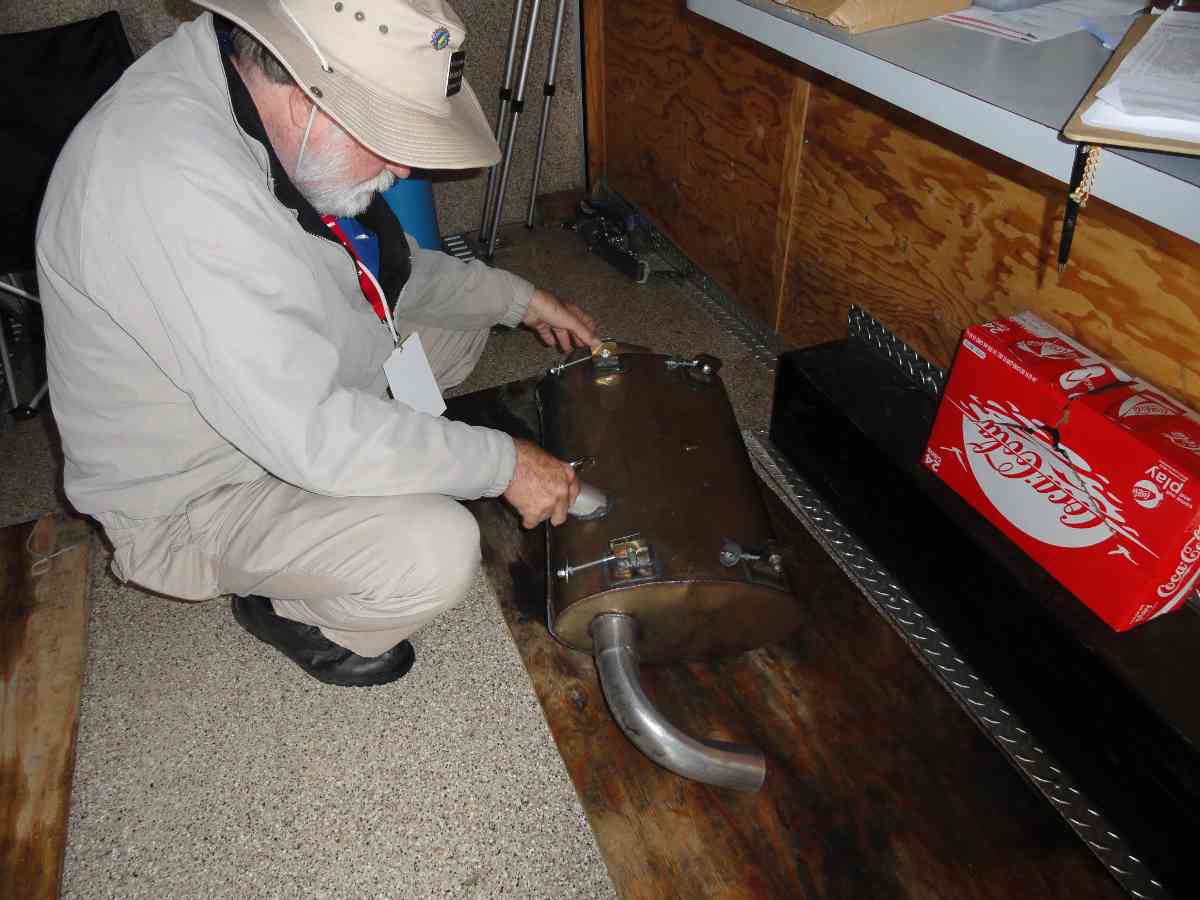
We used this giant empty muffler on our race car and it
had a db reading of only 102 db about 30 feet away WOT.
We also had it on the dyno and it had little
or no effect on power.
If you look underneath the back of an RX8 the muffler
is huge.
Paul Lamar
--
The Rotary Engine NewsLetter. Powered by Linux.
ACRE NL web site.
http://www.rotaryeng.net
Youtube key word PaulLamar2
Copyright 1998-2010 All world wide rights reserved.