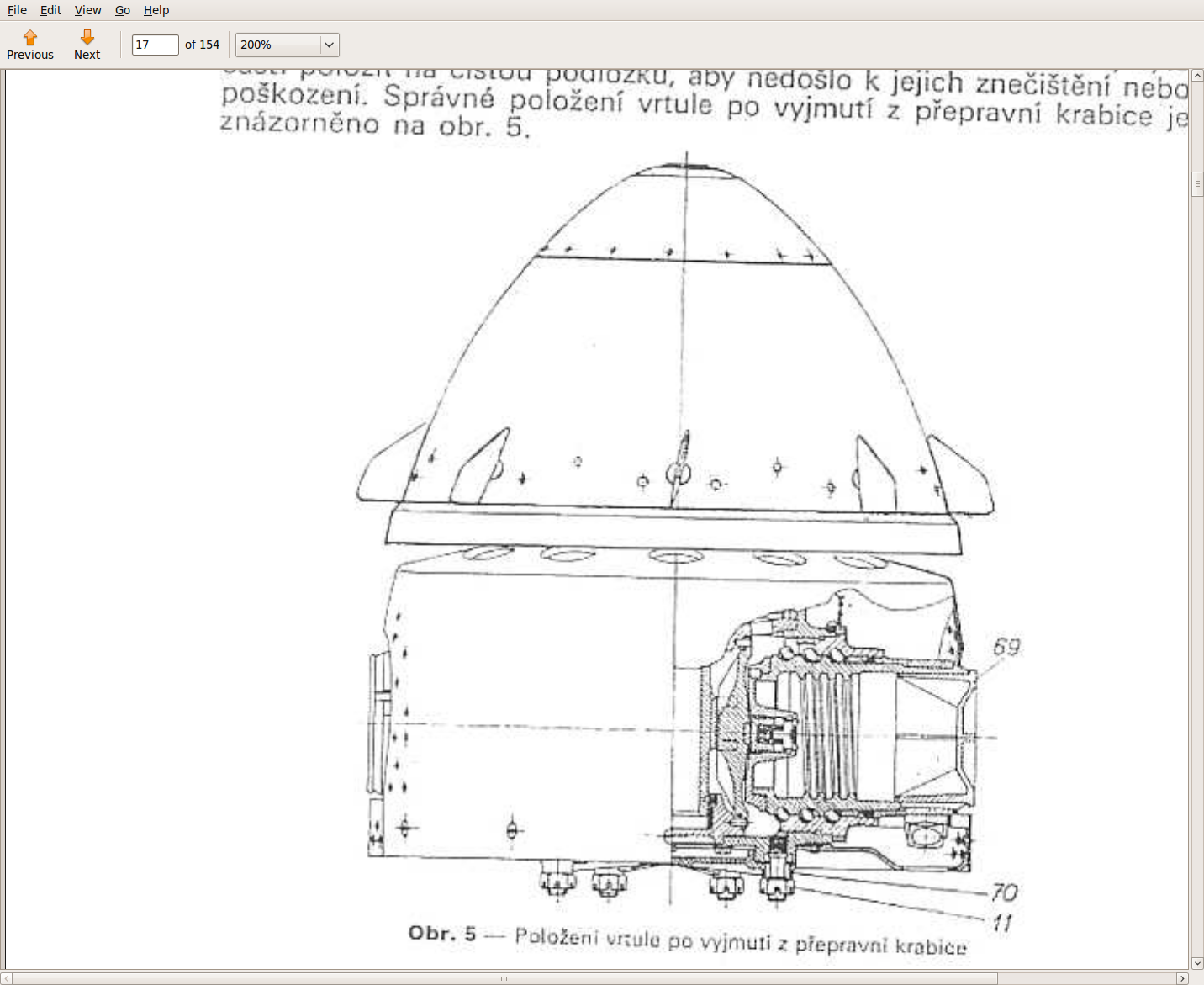
This is an old idea that I had a while back but
it took me awhile to refine the idea.
There is but one moving part other than the blades
themselves. There is a 14 inch diameter air cylinder piston
and cylinder built into a 14 inch diameter spinner. Fourteen
inch diameter spinners are a good idea for rotary powered
aircraft as they give more room under the cowl for engine
and cooling systems. More specifically they give more
room over the engine for the intake manifold.
The stroke of the piston is 4 inches because that
gives a 20 degree change in pitch from climb out to
top speed. About what one needs.
The piston is fed by dynamic air pressure entering a small hole
in the front of the spinner. At 100 MPH that is about 26 pounds
per square foot. At 200 MPH the dynamic pressure is about 100
pounds per square foot. A 14 inch diameter piston is about
1.1 square foot so the force on the piston is 27.8 pounds at
100 MPH and 106 pounds at 200 MPH. More than enough force
to increase the blade pitch with about a 7 inch lever arm.
Paul Lamar
Paul i think your blade action is on reverse,
cruise hight pitch and climb fine pitch
Jean Prudhomme
Congratulation Jean. you found the secret error. I throw those
things in from time to time to find out if anybody actually looks
at these messages :)
Paul Lamar
14 inch spinners are good, but 16 inch spinners are better- Like
the one from a Midget Mustang. The first 8 inches of a prop
don't do anything other than hold the rest of the prop on the hub.
Brian Trubee
Here is the corrected design and 3 blade version are possible.
This is a 14 inch version but an 18 inch version would work
much better. The piston area is almost twice as much at 1.77
square feet. Force at 200 MPH than would be 177 pounds way
more than enough to change the pitch.
Paul Lamar
Interesting, elegant, entirely self-contained. A few observations:
- As rotational speed increases, the acceleration ("centrifugal force")
will
tend to force the control arms on the prop blades farther to the outside,
decreasing the blade pitch. Not a showstopper, just something to be
designed
around (perhaps with counterweights)
- Failsafe: Users would want some means to assure all blades could be
returned
to some satisfactory (and equal!) setting if something in the piston
mechanism
failed. (??A strong spring that pushes all the blades against the
"minimum
pitch" stops, released by a solenoid catch/melted nichrome wire after a
triggering signal from the cockpit?? Power supply?)
- Higher density altitude at same airspeed= less dynamic pressure and
lower prop
pitch, when what we'd want is greater prop pitch (right?). So, the
design would
have to be optimized for a particualr density altitude and conditions
outside
this would be somewhat non-optimum. Just a compromise, like so much of
engineering.
- As everyone realizes, the devil is in the implementation--bearings,
seals,
vibration tolerance, flutter control, etc
Mark W.
I figure we would set it up for cruise at 12,000 feet.
Another trick is to dive the airplane briefly and force the
pitch to increase then slowly level out. Pitch is proportional
to speed squared.
This technique is kind of an urban flying legion but in this case
it could work.
I also think the piston and cylinder are best done in carbon
fiber composites. A small diameter center cylinder can guide
the large piston.
The pivot axis of the blade is best done at the 1/4 cord point
to minimize the torque required to change pitch. If the pivot
axis is ahead of the 1/4 cord point the pitch will tend
to flatten automatically. If the pivot axis is behind the 1/4 cord
point the pitch will tend
to increase counter acting the acceleration tendency to force the
control arms on the prop blades farther to the outside, decreasing
the blade pitch. Small adjustable trim tabs on the trailing
edge of the blades can be used for fine tuning.
Paul Lamar
If the mechanism were designed so that the piston pulled (rather than
pushed)
the blade control arms against spring pressure, then simply breaking the
"pull"
linkage would allow all blades to spring back to the "safe" climb-prop
pitch
setting (though I don't know how quickly we'd overspeed the engine, PSRU,
or
prop if this happened). Setting up for a "pull" configuration might mean
putting
the prop blade and control mechanism in front of the piston.
Mark Waldron
I think that the rotary engine is ideally suited to be robust enough to
shrug
off overspeed conditions.
C. Smith
Even at zero pitch the engine is not going much further than 7500
RPM. The prop tips hit a supersonic brick wall. This is not a delicate
piston engine that self destructs at 100 RPM over the red line.
Paul Lamar
Yes, pro(p!)bably the overspeed situation might be self-limiting and not
an issue.
- Pulling the control arms (rather than pushing them) from a single
central location has four advantages:
-- As mentioned: In case the prop misbehaves, a pilot-initiated
severance of that one linkage and all the blades would go back to the
"safe" low-pitch setting automatically
-- All the blades are certain to move the same distance, even if the
piston binds up on one side and gets pushed out of a perpendicular
orientation to the cylinder walls
-- By simply adjusting the pull linkage length we'd get the ability to
adjust when the blades began to move in response to the piston travel, and
how far the blades go (max)
-- Lower friction. As shown in the (very helpful) drawings, the control
arm lobes would rub on the piston (friction could be miniimzed with
bearings/wheels, but that's "more stuff". If instead the piston pushed a
central rod that then pulled the control arms through a linkage, then very
little rubbing would take place during movement (except for the movement
of the rod within a rod sleeve, which is easy to lube and keep grit-free.
Anyway, all this is just "gilding the lily" of a cool idea.
Mark W.
Would there be an issue for the piston when you pull up into a climb and the
down going blade goes to a higher angle of attack ? This is when you want
the piston to move but there would asymmetrical pressures on the blades.
John
Not a problem if the piston is adequately guided.
Paul Lamar
Paul,
What would be wrong with putting better blades on an Avia 503A? It has an
interesting mechanism and is proven in countless aerobatic applications.
It's the primitive Clark Y airfoil on the blade that prevents it from being more
efficient.
Thanks.
Bruce Smith
Nothing but as I recall it is not cheap.
It is complicated with a lot of moving parts.
I think the company was bought by Hamilton to
keep the price up:)
http://www.aviapropeller.com/
Paul Lamar
The Rotary Engine NewsLetter. Powered by Linux.
ACRE NL web site.
http://www.rotaryeng.net
Youtube key word PaulLamar2
Copyright 1998-2010 All world wide rights reserved.