Randy here is that stuff on the Ellison carb.
----------------------------------------------
Here is some stuff from back in the days we were considering
incorporating the Ellison idea into our stock Teflon slide
throttle. What discouraged us was the cost quotes we received
on the laser cut holes. If you can find someone to cut all the holes
this is a real good way to go.
Paul Lamar
Paul, or anyone, is it critical for the holes in the tube to be oriented
in any
spedific way, like radially to the tube axis, or can they all be
oriented to one
plane?
Just asking, a friend of mine has a laser machine for etching granite.
It has a
YAG laser if I recall, probably plenty of power to make holes in brass
tube. If
you guys are interested in pursuing this route, I was going to ask for a
bid.
C. Smith
You change the hole pattern at your own peril :)
I think it is largely empirical.
That is a complicated air flow field inside that throat.
Note the Rotec is an exact copy.
Paul Lamar
Greetings all,
I may be talking completely about another subject as I have not been
following this string.
If you are talking about the holes in the brass tube which spans the
throat of the Ellison, their orientation is critical.
The way Ellison adjusts the mixture is by varying the orientation of
these holes with respect to the airstream going through the throat.
When the holes are orientated into the oncoming airflow, the unit is
essentially at idle cutoff. As the tube is rotated, with respect to the
airflow. more and more relative vacuum is created over the holes. As the
orientation of the holes goes from into the airstream to 90 degrees to
the stream the relative vacuum increases from almost 0, (actually
positive) (idle cutoff) to maximum (full rich). The control lever, for
mixture, merely rotates that tube to achieve these results. The throttle
slide controls the amount of air passing. As it opens, more holes are
uncovered. The mixture function is the same, independent of throat opening.
Rich
Very well explained Rich.
Randy has a spare I am going to copy.
Paul Lamar
Paul,
I'm sorry if I am not communicating properly. I tried to send a JPEG to
illustrate my question clearly. I'll send it again.
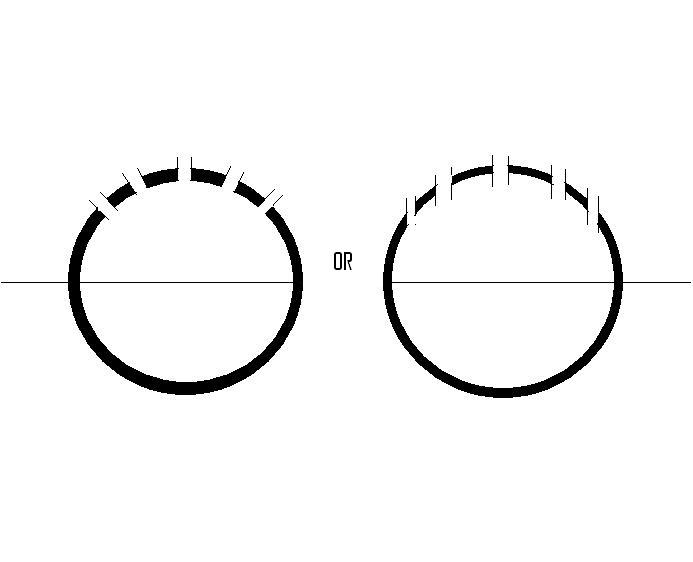
There is an image of one of the fuel delivery tubes (Hole-pattern.jpg) where
there are three distinct sets of holes.
There is a single row, then a double row, then a quadruple row.
My question, was how the hole axis orients to the axis of the tube. It may or
may not be critical to proper operation. However, if it is, then fabrication
process is important. The answer is not in the patent.
Please take the time to look at the jpeg, as it shows there are 2 ways to make
these holes. A simple 2 axis laser system can only cut the holes perdendicular
to the x-y plane, so if the holes need to be radially cut with their axis normal
to the tube surface, then the process for fabrication on a 2 axis laser machine
is a bit more complicated. The work piece must be rotated for each distinct row
of holes.
If ALL of the holes axis can be parallel, then the all of the holes may be cut
during one pass of the machine, and no adjustment of the work piece orientation
is needed.
I'm no physics major by a long shot, but it does seem that in terms of
micro-flow dynamics this difference just MIGHT have an effect on proper
operation.
If no one knows the answer that's fine. My image is a cross section of the tube
looking through the ID.
C. Smith
I would say the sketch on the left but I will look at it tonight
with a jewelers loop and see if I can determine how it was done.
BTW I called Steve Bennitt and he told me the Rotec was not as good
as the genuine Ellison. He has tested the Rotec and the Ellison.
This could be the reason.
Paul Lamar
--
The Rotary Engine NewsLetter. Powered by Linux.
ACRE NL web site.
http://www.rotaryeng.net
Youtube key word PaulLamar2
Copyright 1998-2010 All world wide rights reserved.

![Attachments-52/tubeProf[1].JPG](Attachments-52/tubeProf%5B1%5D.JPG)