Some of you may get the impression we are going to equal the accuracy
and response of a full blown computer system with half a dozen input
sensors. Not true. We are looking for a low cost easy to fix aircraft
carb replacement that requires the pilot to adjust the mixture. No
throttle position sensor which is needed for high speed acceleration
response. No accelerator pump which many automotive carbs have but few
aircraft carbs have.
However here is a simple trick I thought of awhile back to enrich the
mixture when you slam the throttle home for a go around.
It is a small air cylinder that sends a shot of air to the manifold
pressure sensor to trick it into thinking it is getting more air
than it really is. It will then send more fuel. Of course on approach
you can set the mixture to full rich which you were trained to do anyway :)
The air cylinder is connected to the throttle cable.
Paul Lamar
The pump that goes to the intake manifold and give extra pressure could
be utilized with a T coupleing and a back valve to go to water filled
sodabottles, that are filled to 3/4 and are mounted underneath the
wings. The pump could pump up the pressure in those waterbottles, and
when you need a go around, you can by a clever arragement pop the caps,
and get a water rocket.
A little vane in the beam of the water spout could be mounted to
something that spinns and give electricity, and thus provide the force
needed for a recharge of cellphones, Ipads, IPods, laptops, anal butt
vibrators or other portable devices of convenience.
Naaa, Paul an airpump in the intake manifolds will have very small
chances of doing anything to a pressure sensor.
In my case, ...an O-200, it will move 3.27 liter of air every second
revolution, lets say I turn it 2500 RPM, that means it will pump around
a filling of the engine, 1250 times per minute. Each filling is 3.27
liter , (Ok there is a loss here, but in this example it doesn't mean
much) so that gives 4087.5 liter that is shoveled through that pipe
every minute. Four cubic meters...( for you rednecks that have not
learned the metric yet, ...that's more than four cubic yards).....or a
cubic meter every fifteen second....thats the stuff that will affect the
airpressure, a little pump, even if it is made a little bit bigger than
first thought, will do something on the scale of an ant.
Rotaries can be seen the same, the displacement times RPM and there is
the air volume , it's a lot actually.
If we are talking about a non turbo, or non force fed engine, the
pressure the pressure sensor will feel is between 1 atmospheric
pressure, , at stand still, and then approaching ( but will never reach)
zero. so from our point of wiew as humans, suffering from hernia and
late payments, sitting in this pressure, the engine sees only suction
when the engine is running.
If the throttle is wide open, there is very high pressure in the intake
manifold, ..it's a straight pipe.
The whole wonders of our earth ( at least the gas part) will come
storming in, in the intake manifold. closing the throttle, the pressure
will go down , so if we are going on a slow, half closed throttle
approach, we will have very low pressure in the intake manifold , as
soon as we slam the throttle, (open the doors) the pressure skyrockets
up quick to very close to the ambient atmospheric pressure
So rather,... by temporary moving the pressure sensor from the intake,
to normal atmospheric pressure, that miiiiight do the trick. I don't
think it will be much of an advantage though to temporarily move the
pressure sensor, from the intake column, while the throttle is slammed,
the difference in the slammed throttle pressure, and ambient is very
small, so I rather try to get a pressure sensor that is quick in reacting.
Roger
Paul,
On the 555 system, wouldn't just a MAP sensor do the trick. It is
exactly what we are looking for, Manifold Absolute Pressure.
I am just in doubt if I want to go to an electronic component warehouse,
and send for pressure sensor after pressure sensor, until I get it
right, when there are a billion MAP sensors available, even in
junkyards, and they are designed in the first case to read just what we
want, the absolute manifold pressure.
By choosing one from a non turbo car, the pressure sensor would be set
to measure between atmospheric pressure,at WOT, and (approaching) zero
vaccum.at closed throttle.
They're mounted most anywhere on cars, all there is, is a hose going to
the intake manifold, and a nipple on the intake manifold, ....I'm
thinking about the same approach. The pressure sensor can be mounted
...maybe even on the FI circuit.
I'm just trying a short cut here, so we don't go about and reinvent the
wheel.
Thoughts????
Roger
Yes by all means. I think once you test them you will find they
put out the industry standard zero to five volts just like the ones you
can buy from Free Scale.Direct connect to the 555.
New ones are ten bucks from Digikey.
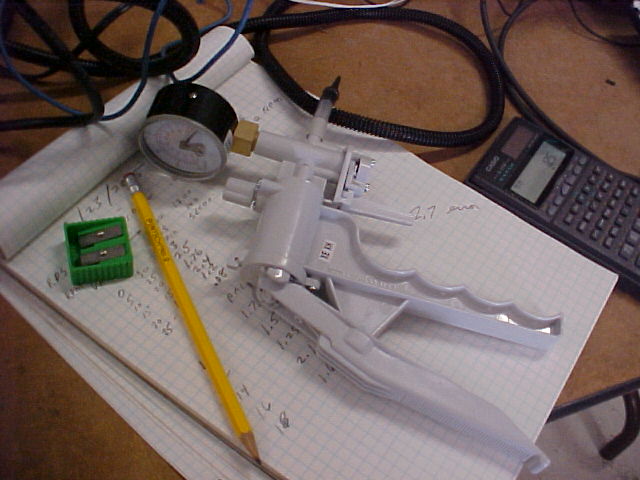
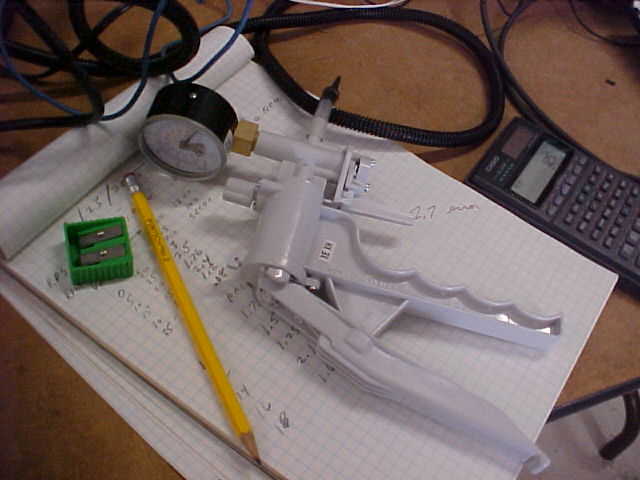
Let us know what you come up with. I use this device to test them. It is
standard tool in the automotive industry to test vacuum devices.
Paul Lamar
The Rotary Engine NewsLetter. Powered by Linux.
ACRE NL web site.
http://www.rotaryeng.net
Youtube key word PaulLamar2
Copyright 1998-2010 All world wide rights reserved.