This looks very promising for our use.
The coils can be mounted on a heat sink from the looks
of them. That looks like a huge advantage to me.
I'll have to get one to look at it and test it.
Paul Lamar
I just talked to MSD and they said the dwell time
is 4 to 4.5 ms which is an improvement on the 5 ms LS2.
Also the bottom is flat so it can be mounted on a heat
sink with two bolts rather than the RX8 coil which only
has one hold down bolt and would require an additional
clamp.
These points seem minor but believe me they
are important. The LS2 cannot be mounted on a heat
sink but it has a very small heat sink on it and
we are attempting to fire it twice as often as it
as it is designed to do and or see's in a 7500 RPM V8.
That means it is drawing twice the current and generating
twice the heat. The V8 cylinder fires every other rev rather
than every rev as in a one rotor.
The icing on the cake is these MSD coils have CD built
in and fire multiple times at low RPM.
Paul Lamar
Paul, The MSD coil looks like a nice part but the price at
performance parts.com <
http://parts.com is $92.95 each or $699.95
for a set of eight and the dwell time is still twice as long as
the RX8coils.I am not up to speed on the electronic circuitry
but a recentpost said you had eight RX8 coils on hand for testing
and then laterthat you were down to two. I was wondering if it
the test rig which isfailing the coils. Possibly not firing the
plug under compression isencouraging multiple sparks because the
spark energy needed is lowerjust firing in air. If the intent is
for developing multiple sparkignition then testing that should be
distinguished from standard systemsapplication. I have been under
the impression that Mazda coils cooled bya blast tube are a
reliable component and that if one were to fail it isunlikely
that the remaining three would fail on the same flight. Thecoils
with an outside air blast tube would be significantly cooler than
the underhood temperature when installed in the car.
Have you tested a Ford waste spark coil which has no internal
electronics since that function is in the driver (EDIS) module.
It might be interesting to see how it stacks up with the
secondary forthe secong plug grounded firing only one plug. These
coils are reportedto work up to 8300 RPM firing once per
revolution (due to the wastespark). If the coils are usable they
might be tested with the EDISmodule driving them first with waste
spark then with the second pluglead grounded.
george grimes
If you own a $15,000 LS7 what is another $800 for coils? :)
I am sure there is a huge retail markup. I notice Ebay has a
lot of MSD stuff much cheaper.
The dwell on the RX8 is 2.5 to 3 ms while the MSD is 4 to 4.5.
Not double.
Yes there is no question the test rig was failing the RX8 coils.
They don't like an out in the open spark anywhere around them
They continually re-trigger and the dwell becomes infinite.
Then they soon over heat lickity split and fail permanently.
The waste spark is problematic on the trailing coils
of a rotary but will work on the leading coils. The 2nd gen
RX7 engine was waste spark on the leading coils. I have not
bothered to test the Ford stuff as I must be sure it is
a long term solution and not based on obsolete parts if
possible. The coil on plug seems to be the long term
solution for the future.
Paul Lamar
Umm, Paul, would a simple coil check, almost possibly part of a
preflight be to simply swap the plug leads between leading and trailing
plugs and run the engine up. Won't a failed coil then reveal
itself? I guess it could be an in car test as well:)
John Evans
I think Tracy has something like that in his installation schematics.
I am still doing a heat sink mounting that will make the
coils more reliable. Silly Mazda mounted the coils on the hot
engine block with a steel plate. Merely making that plate out of
SS instead will reduce the heat transfer from block to coils.
Paul Lamar
I was wondering how MSD managed to get a complete multi spark ignition
system in just the coil.
"The history of the capacitor discharge ignition system can be traced
back to the 1890's when it is believed that Nikola Tesla was the first
to propose such an ignition system. In United States patent #609250
first filed February 17, 1897."
I was fascinated by the new MSD coil that combines a multi-strike
capacitor
discharge system in the same package as the inductance coil.
Where does the 500 volts come from to charge the capacitor?
Normally a very expensive switching power supply is required.
How do you squeeze a large 1 mfd, 500 volt cap into such a small coil
package?
Can anybody figure this out for me?
Paul Lamar
The documentation does not indicate a CD system, only a multi-strike
system.
A transformer works by having on one side (primary) a fixed coil thru
which is passed a varying current create a magnetic field which
varies according to the rate of change of the current. The other side
(secondary) contains a fixed coil residing within the varying
magnetic field created by the primary current, into which is induced
a voltage proportional to the rate of change of the magnetic field.
When the points make and current begins to flow in the primary, a
surge is induced into the secondary. The theoretical infinitely
short duration of the increase of current is stretched by the
inductance of the coil, which inductance is the product of several
factors including the ferrous mass of the transformer core.
An efficient transformer requires more
mass for lower frequencies, and less mass for higher frequencies. By
selecting materials for a high-frequency transformer, the core will
magnetically saturate very quickly, will have a low inductance, and will
therefore allow the input current and therefore the intensity of the
field to rise more quickly. Thus a spark can be produced when current
begins to flow, and again when it ends, for it is the change in the
magnetic flux, whether increasing or decreasing, that induces voltage
into the secondary.
Another way to multi-spark an inductive system is to use a semiconductor
bridge to reverse the current flow in the primary to amplify the
"ringing" which occurs during the spark event. By alternating the
current direction in the primary at the resonant frequency of the coil
(several times per millisecond) the secondary voltage would
increase dramatically and would spark on each reversal.
Coils designed for multi-spark have a lower ferrous mass and lower
primary resistance. The primary resistance of these MSD coils
appears to be about one-third that of the D-580. The ferrous mass
appears much less than the 580. I am sure their engineers are much
cleverer than I, and could have used some other method to achieve
the multi-spark. I strongly suspect it is inductive and not
capacitive energy they are releasing.
Victor
I am counting on you Victor to think out of the box.
Hint: supposed we tapped off the secondary winding for the 500 Volts
to charge a capacitor?
Paul Lamar
Lets start with a points ignition because they are dead simple; maybe. There
is a lot of stuff going on there. As Victor said, when the points close, the
current starts to flow. You do not get a spark then because it takes the rapid
magnetic collapse to create the spark. When the points start to open the
electrons want to keep going. Like inertia. The condenser gives a place to go
some the points do not try to weld themselves. By the time the condenser is
full, the points are open enough the electrons can not jump the gap. They then
come rushing out of the condenser backwards and stop the current flow dead in
its tracks. The magnetic flux collapses instantly, inducing the high voltage
in the secondary windings. This also induces some voltage in the primary
windings that is higher than the 9 volts supplied to the coil. A DMM connected
to the negative post of an inductive coil and set to record peak volts will
show this. Electronic ignitions replace the points and condenser with silicone
parts but work the same way.
Dale Davies
Not what I was talking about Dale.
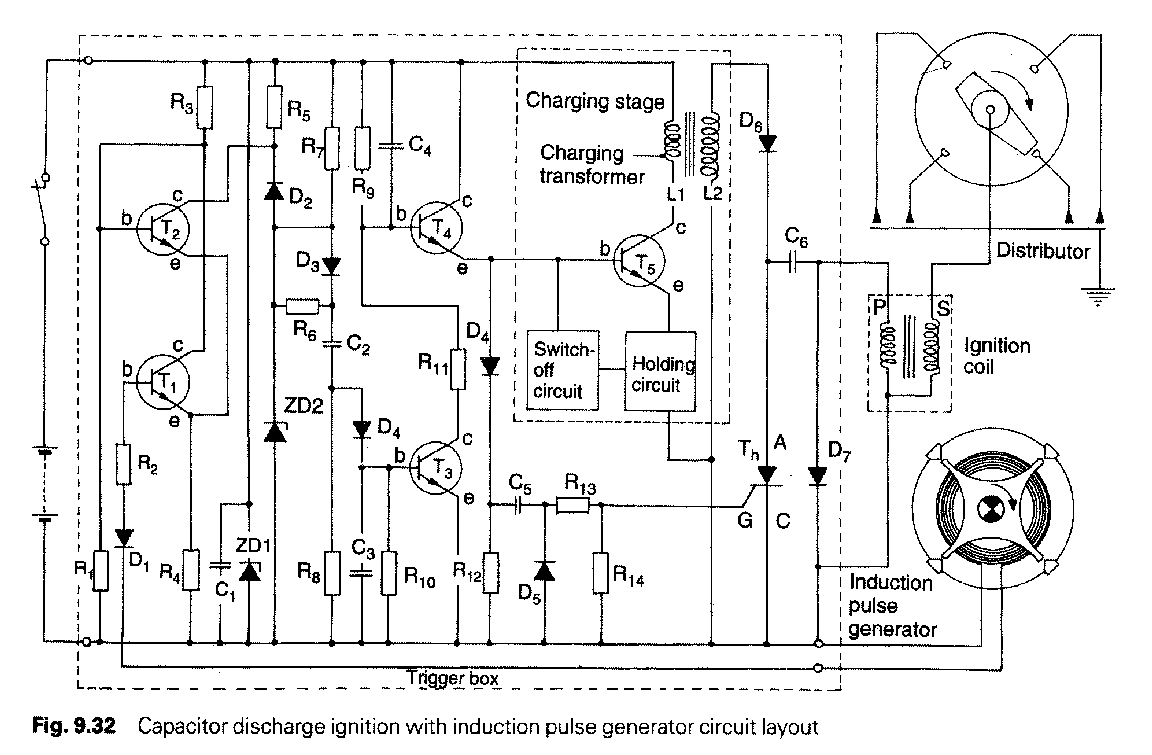
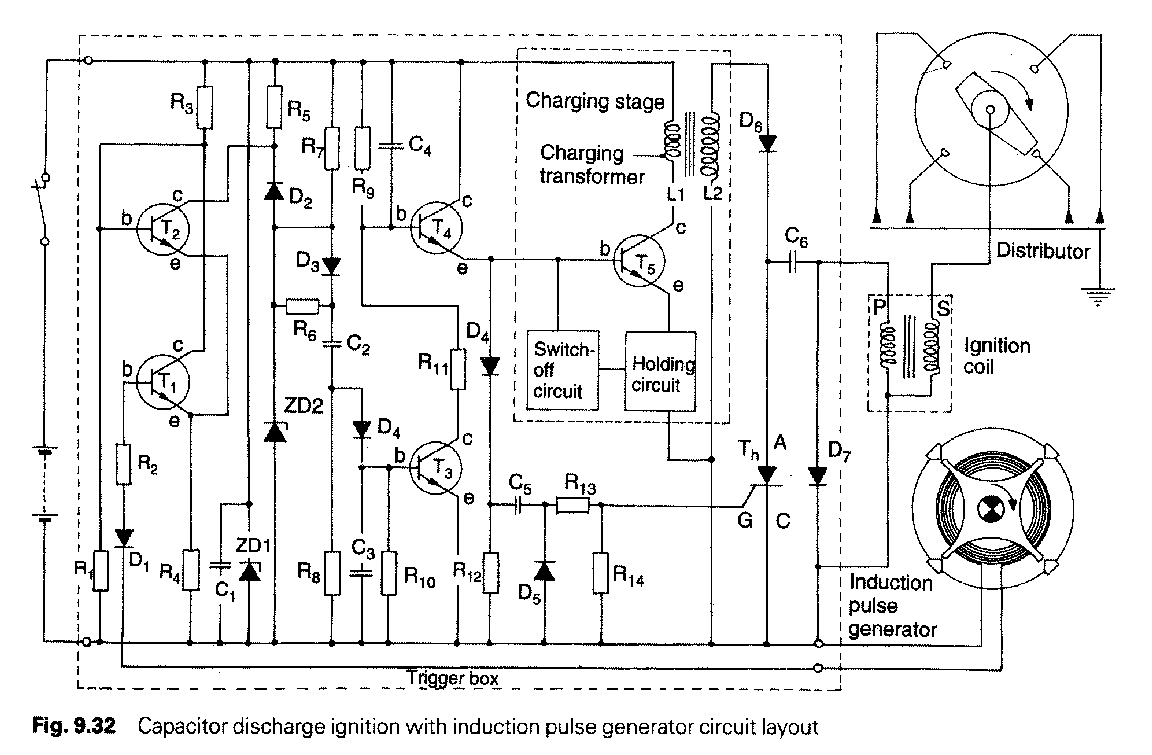
Here is how a capacitor discharge ignition works.
Quote from Heinze Heisler. Advance engine technology.
"Capacitor discharge ignition systems provide ignition sparking which is
effective over the entire speed range of any engine, right from cranking
speed to well beyond the maximum speed of even higher performance engines. There
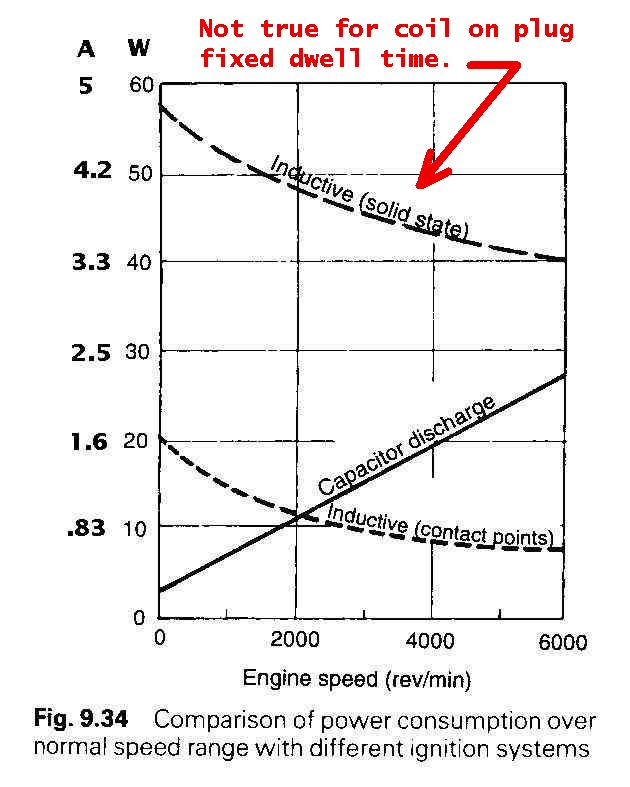
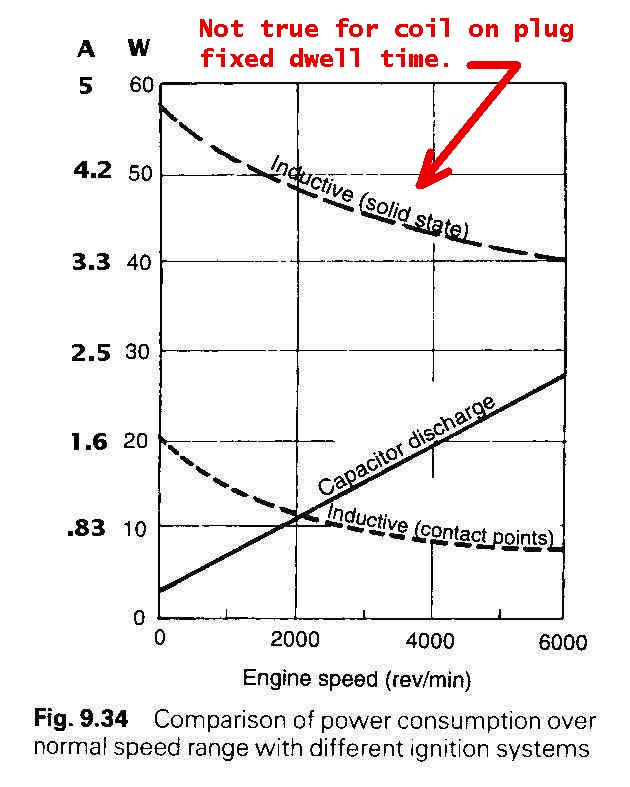
is a linear power consumption increase with engine speed from about 3 W at stall
to around 28 W at maximum engine speed (Fig. 9.34). As can be seen, the power
characteristics are very different to the inductive ignition system where the
power consumed is highest at low speed and then decreases with increasing speed.
[Except with coil on plug systems with a fixed dwell time. PL]
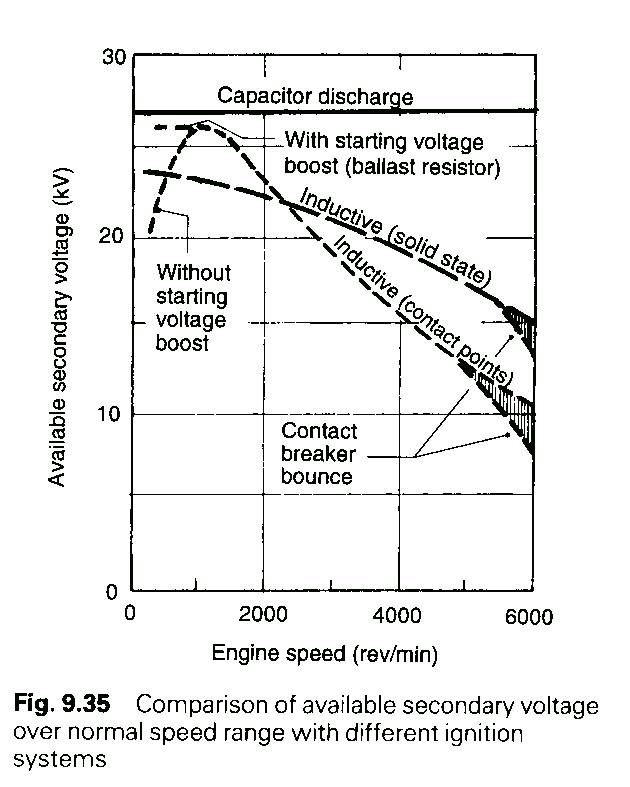
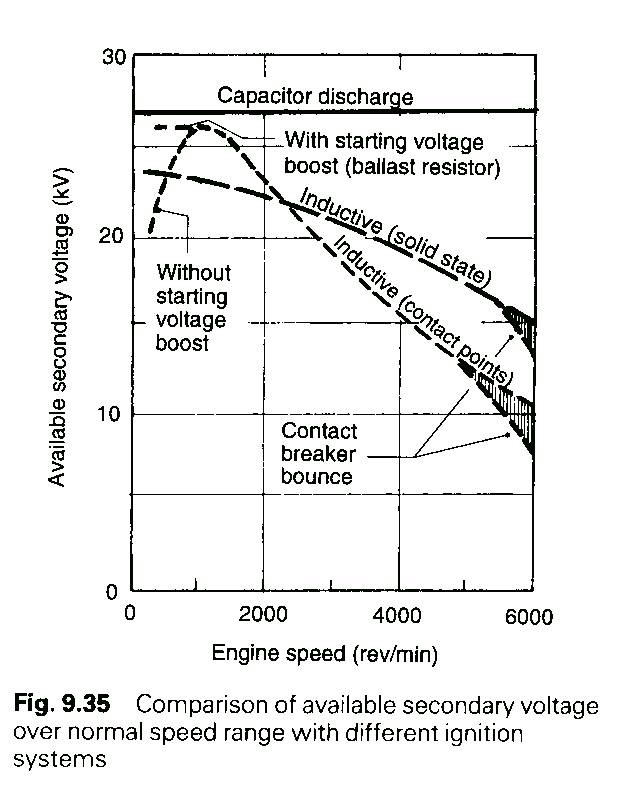
The efficiency of this system is such that the available secondary voltage is
higher than for any of the inductive systems and it remains approximately
constant over the whole speed range (Fig. 9.35) at something like 27 kV, the
sparks thus produced have a relatively large and desirable energy content.
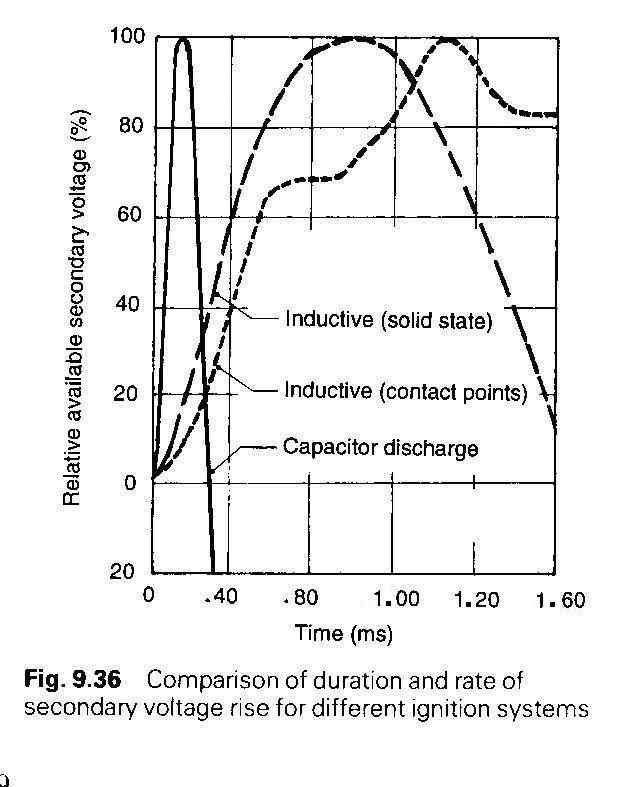
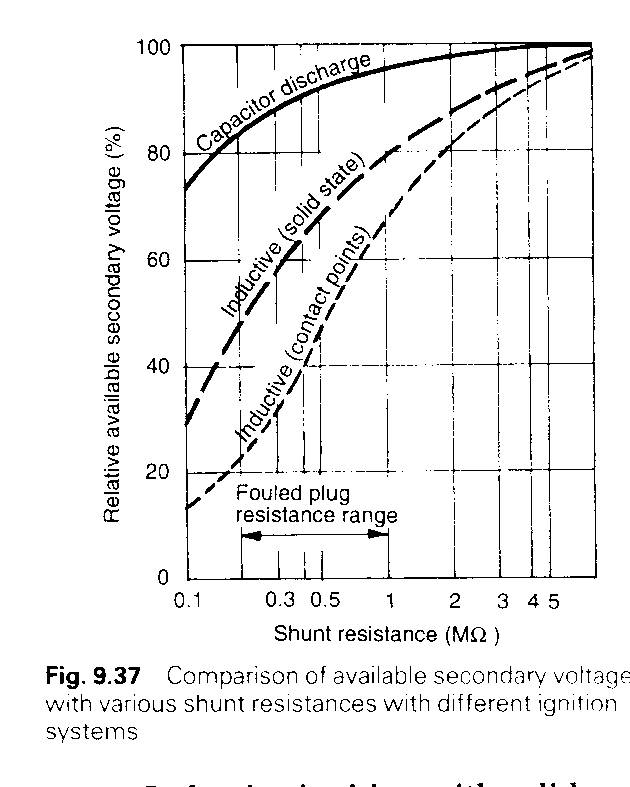
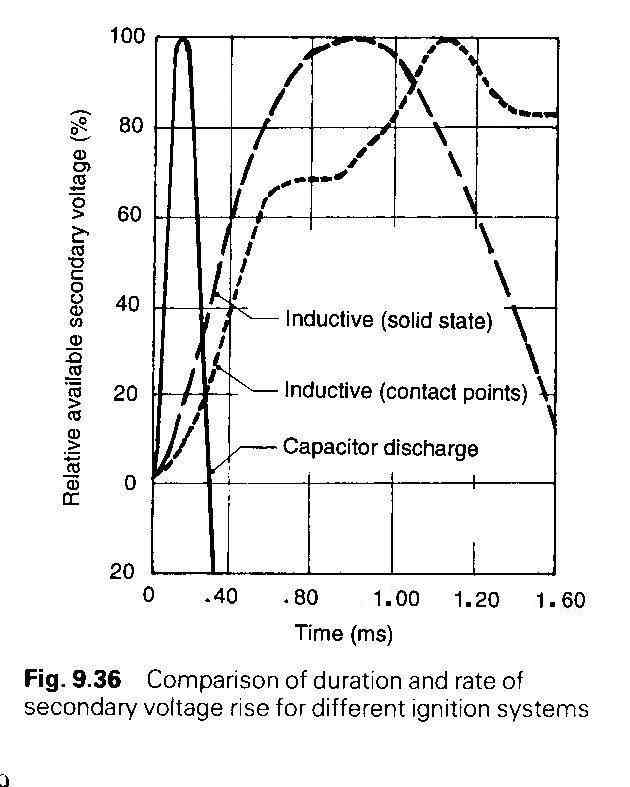
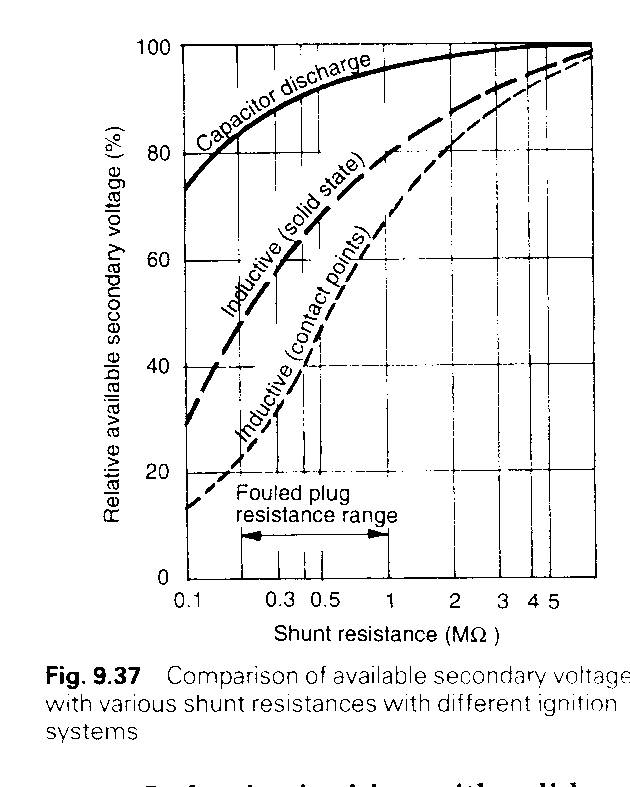
Because the discharge of the storage capacitor is so rapid, the voltage rise is
extremely fast (Fig. 9.36) making the secondary system (that is, the distributor
cap), leads and spark plugs insensitive to electrical shunts (shorts) (Fig.
9.37). Thus, even when the spark plug electrodes and insulator have conducting
deposits over their surfaces, the secondary voltage surge is so rapid that
sparking is not hindered."
"An inherent limitation with the capacitor discharge ignition is the duration of
the spark, which is extremely short 0.1 to 0.2 ms, which might make it
unsuitable for certain types of combustion chamber designs. Conversely, the
large surplus in secondary voltage permits much wider spark-plug electrode gaps
to be used, compared with other ignition systems and, as a result, partially
compensates for the short time available to ignite the air-fuel mixture. Again,
as with the breakerless solid-state switch, there are no moving components.
Therefore, all wear is eliminated and no service is required over the entire
life span."
Unquote.
Paul Lamar
--
The Rotary Engine NewsLetter. Powered by Linux.
ACRE NL web site.
http://www.rotaryeng.net
Youtube key word PaulLamar2
Copyright 1998-2010 All world wide rights reserved.