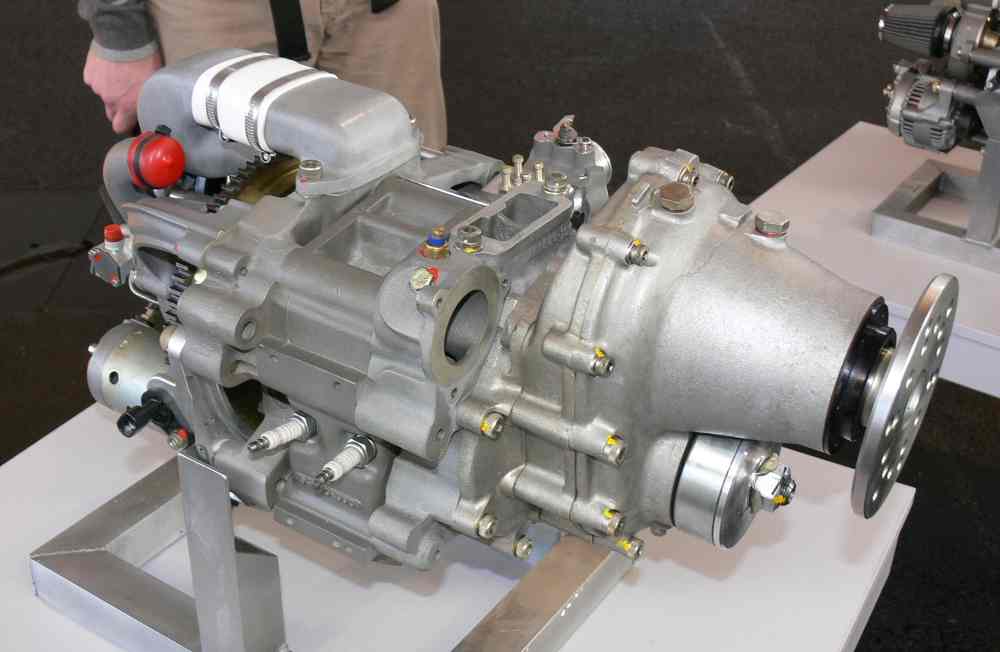
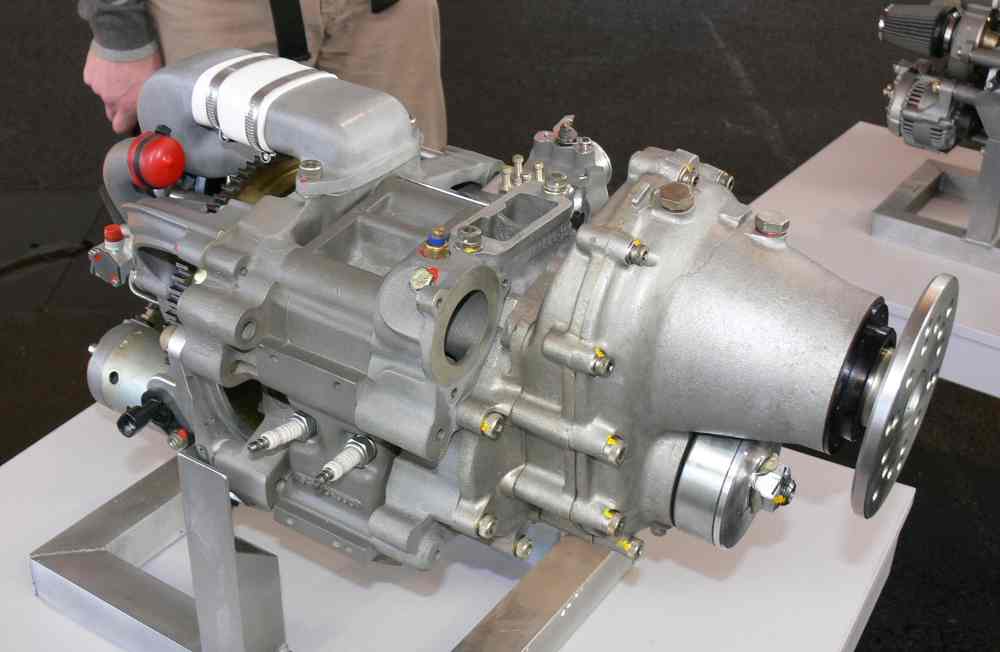
"The up and down bobbing triangular center body."
There is no up and down Roger. A common mistake many make.
The rotor CG orbits around the center of the e-shaft much like
the earth orbits the sun. That is why it is sometimes called
a planetary engine. Have you read the Kitplanes article yet?
Here is a good one to read as well.
http://www.rotaryeng.net/how-wank-works.html
"Actually what is happening is the center or CG of the rotor is
moving in a
circle around the center of the output shaft while the output
shaft rotates."
"Since there are no reciprocation parts what so ever it is
possible to completely balance the Wankel engine just like a
turbine or electric motor and unlike any piston engine despite
some claims to the contrary. The rotor is balanced around it own
axis. The front rotor balances the rear rotor as they are 180
degrees apart on the output shaft. That leaves a small couple which
is finally completely balanced by the counter weights."
Also go on youtube and watch many Wankel animations as there are
dozens.
The only limitations on the RPM of a rotary are due to centrifugal
load of the rotor weight on the e-shaft rotor bearing.
Paul Lamar
--
I'm no expert, but the two areas in which the Wankel would need to
be improved to significantly improve BSFC are 1) Reduction of
waste energy in the exhaust (higher in the rotary than in a piston,
as evidenced by higher EGTs)
2) Reduction of waste heat lost to the housing due to the
relatively inefficient shape of the combustion area (long, wide,
and very thin in a rotary= lots of surface area-to-volume,
relatively compact and cylindrical in a piston engine=less surface
area per volume.
It seems 1) could be reduced by turbocompounding, and 2) might be
somewhat reduced by optimizing the engine geometry, but real
improvements here await development of a practical ceramic engine
or other material breakthrough (or some miracle way of recovering that
low-quality waste heat in the cooling water--very unlikely).
Mark W.
The higher EGT is due to the fact there are no exhaust valves
to absorb some of the heat. The RX8 engine is proof as the exhaust
must make a right angle to exit so some of that waste heat goes
into the cooling system and the EGT is a couple of hundred degrees
F cooler.
In the R3350 turbo compound engine 22% of the total energy in
the exhaust went into the exhaust valve. Almost 50% of the kinetic
energy went into the exhaust valve. That is why a rotary is so
noisy. It is also why it makes an ideal turbo compound engine.
I am beginning to think the old surface area to volume ratio reason
is invalid. Both the 16x and the Wankel SuperTec engines have
worse surface area to volume ratios yet are more efficient
than the current geometry.
Paul Lamar
There could be a difference in the area if it is the end plates or
the rotor housing. If the fuel has a tendency to be pushed to the
rotor housing causing poor burn the solution may be in a narrower
housing with greater eccentricity. The side housing area is larger
but may not affect the burn the same. Also in reading, the flame
does not get all the way to the sides of rotors more than 76mm wide.
This seems to explain a lot of why Mazda would narrow the housings.
It gives more complete burn the same as the 3rd plugs in the 26B Le
Mans engine.
Dale Davies
Actually the fuel being pushed to the rotor housing is an advantage
as the engine will run with 20:1 air fuel ratio unlike a piston
engine and gain BSFC in the bargain.
I think you are right on the rotor width but that does not take
into consideration two sparks plugs side by side in the leading
position. Austro engines use this trick on their wider rotors.
Read Norton geometry.
Paul Lamar
You mean I am not the only one to come up with the idea to put spark plugs
beside each other, say at 1/4 and 3/4 of the rotor width? :-)))
Dale Davies
I am afraid not Dale. Sorry :)
Paul Lamar
--
The Rotary Engine NewsLetter. Powered by Linux.
ACRE NL web site.
http://www.rotaryeng.net
Youtube key word PaulLamar2
Copyright 1998-2010 All world wide rights reserved.