dear Paul Lamar,
I am mystified ..... with all the stated advantages, why has the
rotary/Wankel, turbo compound engine not superseded the piston
engine? It would have been ideal for say the Chevy Volt. Better
than so called Atkinson cycle engines .......
I know both Curtiss Wright and GM put lots of research dollars into
the concept and gave it up. I don't know why.
Do you?
So please sign me up for the newsletter ..... perhaps I will gain some
insight.
Thanks,
Steve Dorr
Orlando, FL
GM did not have the culture for it. They arrogantly thought they could
do it better while Toyo Kogyo merely perfected something NSU already
had working.
Toyo Kogyo (Mazda) was a young company with out a lot of history so
they were looking for something to put them on the map. Apparently
the Japanese people value perseverance highly and have that never
give up attitude. I also think the TK management was well founded in
physics so they better understood the advantages. They also seem to take
a longer view when it comes to business risk.
CW was never serious about going into production. They wanted to
get a contract from somebody to do it for them. I think they were
manipulating the stock to make money on the side.
Me too. It will take some R&D so car companies won't do it
until somebody does it first.
Pratt and Whitney is working on rotary TC here in socal at the
Rocketdyne subsidiary. Even to the extent of filing
one or more patents. Probably for UAV use.
I gave a presentation on the piston TC subject to a collection
of chief Formula 1 engineers. I offered a 20% improvement
in BSFC while all of the other papers presented talked
about a 2 to 3% improvement. It was well received and
the FIA Representative said they would change the rules to
encourage it soon. Formula 1 teams had been spending up
to 800 million US a year. Much of it on engine development.
The current vice president of the FIA is an old race car wing
customer of mine dating back to the late 1960's.
http://www.rotaryeng.net/Oxford-640-4802.wmv
Paul Lamar
Paul,
The rotary engine have a lot of advantages in it's simplicity, but how
does it stack up in efficiency?
How far do we get on a gallon of gas ( assuming the same displacement)
in comparison with a piston engine?
Will it ever be en engine that can favorable compete in cars ( or
airplanes) that will give us those high numbers in MPG.
I am pretty good with that we will have a very compact powerplant that
can crank out a lot of good power, but what I am getting at, the
survivability, and the social acceptance of the rotary has to come from
fuel improvements over the current piston engine, not necessarily in
power improvements.
I think that it just can't be equal with what is now on the market, but
actually has to show a distinct edge before they will start to retool in
Detroit.
Even if the rotary is the better engine, ...three moving parts, ( who
can argue) ...that in itself will not change the course of it. History
has shown many times that a lesser good system can indeed be the winner.
110 V system sucks, but it won....BetaMax was a much better system than
VHS, VHS won ... town center trolleys system was dismantled in
favour of the piston driven diesel bus.....etc etc...
Unless the rotary can give that edge, I am afraid that it will continue
to be a marginal engine, no matter how good it is per se.
If we swap a piston engine for an equal rotary and are getting 65
instead of 40 MPG...thats most probably the way this engine needs to go,
pure efficiency .
A development that I don't know if it is fully possible....maybe....the
rotary is not without it's faults.
The buzz word right now is "Alternative", and if a steam engine can be
made to run on wood and water, that will put it on the "alternative"
category and given it an edge right there.....( even if the efficiency
sucks, but hey....we cheated the Arabs...so in that sense, it IS an
alternative....thats how the thinking goes when it comes to alternative)
Stuff like that is what's is looked upon right now, as an oil based
combustion engine is today connected with a negative.....for all the
right and wrong reasons.
I think that the rotary engine is looked upon with the eyes that it is
"just another way to burn decomposed dinosaurs" , and is in the
"negative" category..the category of engines we want to get away from.
For the rotary to move into a positive, , into the "alternative"
category, it has to do a pretty good jump in efficiency.
Next hurdle if it does that, is to overcome the idea that it is
basically a 2 stroke, and about as efficient.
So I think it has quite a way to go , it might or might not blossom into
something and get a new birth in the future, unless hydrogen fuel cells,
or other technologies are taking over....who knows.
I do believe though that a lot more research and developments has to go
into this engine, an edge that the piston engine has been favoured with
for a hundred years, and it is a matter if the resources and the
industrys ( especially the automotive) interest is there, to put a bet
onto this engine, a doubtful proposition at best, considering how much
know how they are already sitting on, when it comes to the piston engine.
Lacking those big resources, the development may probably come from
racing industry, enthusiasts, and other intelligensias, and as usually,
improvements from that arena, have a tendency to get in on the
established market that way, via the back door..that I can see as a
possibility.
How it needs to be improved...that's another story, and a big scope,
highly time and resource intensive, but as with any other combustion
engine, it's a matter of how thermal efficient one can make it.
As with the piston engine in the Hot Rod field, tinkerers did a lot of
developments, that developed into a ...first a sub culture,... then
finally into an established industry...and out of that industry, today
the improvements are pretty much a bolt on thing, straight out of the
box, we all know what Edelbrock and Holley is.
...so with this rotary...we will see what gives.
Roger
Well according to Mazda they have solved the efficiency problem.
They now claim the new rotary is more efficient than the piston
engines they sell. We shall see.
For 50 years they have been building the same geometry.
Equivalent to the bore and stroke ratio. Not only that the displacement
has not increased. Nor has the compression ratio by much.
Compression ratio is a major factor in internal combustion engine
efficiency.
The rotary power has gone up from 110 HP to 280 HP in the Mazda
3rd gen turbo. The max RPM has gone up from about 6000 to 9000
in the RX8 engine.
Both Mazda (16x) and SuperTech in Germany changed the rotary geometry
to allow a higher compression ratio. SuperTech is claiming
diesel category BSFC's of .34 running on heavy fuel.
Low RPM torque has always been a desirable feature in car engines.
The US car manufactures have always known that and that is why
they build high displacement, low RPM, light duty push rod engines.
Same goes for light aircraft engines although of much higher
duty cycle. The Europeans on the other hand go for lower displacement,
high RPM engines, with dual over head cams and 4 valves per cylinder
and put the bucks into gear boxes. Due to the autobahn, with no
speed limits, the duty cycle of European engines tends to be higher.
Mazda is just now thinking of increasing the displacement from
2.6 L to 3.2 L in the 16x. In the mean time the Europeans have
developed the fast shifting, automatic manual transmissions without
the low efficiency torque converter common in the US.
The current Formula 1 engines are the epitome of this philosophy
with 19,000 max RPM, small piston engines and fast paddle shifting
transmissions.
Consequently there is a very interesting competition going on.
Paul Lamar
Paul,
Indeed there is interesting things going on, just hope to see the fruits
of it this lifetime.
The claim from Mazda that the rotary now are as efficient as the piston
engine is encouraging, but as always...we will see.
By running heavy fuel you will boost the efficency, the same as
comparison between gasoline and diesel engine, don't know if they are
running compression ignition though, like the dieselcycle on that engine
you described, usually it is a bit hard to ignite heavy fuel with a
sparkplug, so maybe they are actually running diesel compression.
Higher and higher compression gives a diminishing point of return. Raise
the compression from 5:1 to 7:1 and you will get a tremedeous good
return, raise it from 7:1 to 9:1 and you will get a decent return, raise
it from 9:1 to 11:1 and you will get a very small return.
Part of the gain is not from raising the compression in itself, but the
increased ability the engine will get, to clean out spent and inert gas
from it's last work stroke.
I can see two areas the rotary could need an improvement on, bigger
stroke, the stroke it has is very small, and are depending on the
difference in the center of the shaft to the center of the ofset roll
shaft each rotor is spinning around.
From what I understand you are saying, they are working out the
geometry better now.
The up and down bobbing triangular center body. it doesnt describe a
true rotation, but changes it's position where the center of mass will
be shifting between two extremes, and as I understand, it is made of
steel, right now. If you take a body like that, everytime two of the
three corners in the triangular centerbody , are on the outside, the
force inceases.
The energy it takes to change that mass back and forth between those two
main positions, got to be huge, ..as Newton says, everytime you change
direction, you pay for it in lost energy.
I don't know how it compare with forces in a piston engine other than a
lose comparison, as in a piston engine, the main mass that is
reciprocating is a steel rod, and an aluminum piston, part of the steel
rod is follwing the crank in a true circle, the crank itself is
follwing a true circle. You spin that up to maybe 3000 RPM, on freeay
speed, while the rotary has a much heavier piece that have a shorter
stroke, but much heavier mass, and perhaps twice the rotation...force
needed at twice the RPM is not linear, ...I dont know the exact number
as the baseline is an estimate, but I dont think that four times the
force is too much out of line.
If a rotary would be connected up to an electric motor, and the force
was measured to rotate it, the lower RPM bands would probably be very
good, , but the force needed to spin it in the upper bands where the
rotary works best, must be terrible.
I can understand it is a matter of structural integrity, but the weight
on that tringular rotor has to come down, and I don't know what material
that is lighter that can substitute the steel and still dont have
fatigugue problems, as it is a critical component.
Titanium perhaps, or perhaps a steel casing filled with aluminum, either
way, that up and down bobbing piece of steel is stealing a lot of energy
to do that movement.
True rotating parts can conserve and store energy, and even if a piston
engine has a lot of parts to it that moves, actually most of it's
rotating mass are both balanced and in true rotation, the majority of
the moving mass in a rotary is not in true rotation,...therefore in
direct correlation to it's mass and speed, it will steal rotational
energy.... therefore to get a distinct leap of efficiency with the
rotary engine, the mass of that part has to come down drastically.
How to do it and still keep the structural integrity...I don't even want
to think about it.
I bet ya in fifteen years from now we can order from Edelbrock a rotary
replacement that is made of a material we can't pronounce.
Roger
"The up and down bobbing triangular center body."
There is no up and down Roger. A common mistake many make.
The rotor CG orbits around the center of the e-shaft much like
the earth orbits the sun. That is why it is sometimes called
a planetary engine. Have you read the Kitplanes article yet?
Here is a good one to read as well.
http://www.rotaryeng.net/how-wank-works.html
"Actually what is happening is the center or CG of the rotor is moving
in a circle around the center of the output shaft while the output shaft
rotates."
"Since there are no reciprocation parts what so ever it is possible to
completely balance the Wankel engine just like a turbine or electric
motor and unlike any piston engine despite some claims to the contrary.
The rotor is balanced around it own axis. The front rotor balances the
rear rotor as they are 180 degrees apart on the output shaft. That
leaves a small couple which is finally completely balanced by the
counter weights."
Also go on youtube and watch many Wankel animations as there are
dozens.
The only limitations on the RPM of a rotary are due to centrifugal
load of the rotor weight on the e-shaft rotor bearing.
Paul Lamar
Paul,
I might have this wrong, but from what I see, we have a shaft, on that
shaft sits an ofset shaft on where a triangular shape is rotating.
No you're right it is not bobbing up and down, that would be a misnomer,
what I tried to describe is a dynamic force, a sinuswave.
That triangular body have a mass of it's own that is centered around the
offset center, a triangular body that is rotating on it's own offset
center, will shift position only in relation to it's offset center, and
the forces I am talking about will only manifest itself when considering
the true rotational center, versus the position of the mass.
The true rotating center is not the offset center, but the shaft, and
therefore it will determine centrifugal force according to the amount of
mass that is furthest from the true rotational center. As mass is
shifting around the offset center, even if it is balanced around it's
offset center, more or less mass will be shifted in relationship to the
true center, depending on position of the three sided body.
It seems to me obvious that any time that any time there is a position
of the rotary where two "horns" are on the outside, you will have more
mass further away from the true rotational center, no matter where it is
happening in the housing, thus more mass is moved to a longer orbit of
the true center of rotation.
See it like this.
Take away the housing, it does not ad or subtract to the force.
Freeze the picture of a rotor, sitting on an offset circle, that is
sitting on a true rotational shaft. Imagine it is rotating, but you will
see it like a still picture.
Now rotate the rotor so it has the most mass furthest away from the true
rotational center....( two points outwards and one point inward). Even
if it s balanced around it's offset center, a shift in mass has occured
outwards from it's true rotational center.
Now move the rotor to a point when only one point is pointing out.( from
the true rotational center) , a shift in mass has now occurred towards the
rotational center.
Scenario one has two "horns" in outer orbit, and one in inner orbit.
Scenario two has one horn in outer orbit, and two horns in inner orbit.
As the rotary are mechanically connected to the center shaft, those two
scenarios must present itself.
Difference in static and dynamic balance is forces that present itself
in motion but are invisible in a static condition.
Well...either way, I must say though it is a darn interesting engine.
The genious in it is it's few moving parts.
To make something work with a lot of parts is complex and not necesarily
efficient, to make something that has a function that have few or no
moving part, is genious.
I am interested in having long legs, economy( and of course power) and
are looking forward to see if the new Mazda claim is holding true about
better fuel efficiency compared with a piston engine. With the
rotarys simplicity, I am still looking at it's efficency as a major
point if interest. If it holds true the Mazda claim, and it will
actually beat the piston engine in efficiency, I may even become hot an
heavy on this engine, as a replacement for my current one.
Anyone ever tried thermal coating in these engines. In the field of
piston engines, it is by now a pretty established field.
Fifteen years ago me and a friend of mine had a lot of hair pulling
experiences with it, the products were pretty promising but not really
worked out then, but hear that now it is pretty much a routine job.
Professionally done, the gains are in the range of 4 to 7% with piston
engines.....I would say....I'll take it. I don't know how this would
translate into rotaries, but if we're burning stuff, and have hot gas
expanding, at least in theory it would translate to higher or lesser
degree.
Are picking away on my 555 system.
Roger
No sine wave. Pure rotation. No mass is shifted.
The CG of the rotor mass is traveling in a pure circle.
It is like the rotating earth with mountains on it rotating
around the sun. If the earth mass shifted you would feel
acceleration as you are fixed on the earth's surface.
Think of it like a merry go round with a large horse rotating
slowly. Then think of the path of the horse's nose.
The rotation of the rotor about the rotor bearing is synchronized
with the rotation of the e-shaft by a gear. For each rotation of
the e-shaft the rotor rotates about it's own rotor bearing one
third of a revolution. The path of the apex seal forms the shape of
the rotor housing.
This is one of the problems with the rotary. It is very difficult
to understand and describe how it works. IMHO this has retarded
it's acceptance.
One pretty much has to see one working.
Take a look at this video.
http://www.youtube.com/watch?v=yvri-fUNRyk
Paul Lamar
--------------------------------------------------------------
Paul,
I took you up on it, I looked and looked, froze the pic, took it frame
by frame, and still I just can not come to the conclusion that this is
in a continuous balance.
Ok I understand that you say this is in continuous balance, but I have no
understanding of it myself what so ever, I just can't see it.
Ok if it really is in balace, I need an indepth explanation of it.
I tell you what I see....so you can see where I am coming from.....and
please follow me step by step here.
Ok going to that video, I see the center shaft that is the center of
rotation, and I see the off center shaft from where the rotary rotates
around.
The position, when the excentric shaft ( the one that the rotary is
rotating around) will have two of the "horns" of the rotary furthest
out, will be in the position when the rotary hits the side, the right or
left side of the house, the most narrow part of the housing.
When the rotaries eccentric shaft is in the up and down position, it will
present only one "horn" that will sweep either the top or the bottom ,
respectively , so this particular phenomenon that I can see and want to
point your attention on, will therefore take place when the eccentric
shaft is either in it's far left or far right position.
Have a look at that particular sequence, and you can see what I am
getting to.
Go to the video, I am sure you've seen it , or similar ones a gazillion
times, but please , open up the video, do freeze frames and see it with
my eyes this time....when the eccentric is in it's far left position,
...then stop the video...you will see that two "horns" are towards that
end as well.
With that picture frozen, locate and find where the center shaft is
located right now,.....here comes the important part...and I am getting
to the point with this........... paint an imaginary vertical line
through the center shafts center, the true rotational shaft, not the
excentric shaft.
Just freeze it righ there, take a step back, and look at it.....you can
easily see that we have an excess amount of mass of to the left side.
Now, imagine you would take out the whole assembly now (everything still
in position) and put the center ( again not the offset shaft) axle on
two low friction roller bearings,....let it go.... and let it find
equilibrium.... there is no way this will balance.
I mean really...look at the picture again.
As the center shaft is fixed, to the ofset shaft, and the rotary is
fixed to the ofset shaft, lets say, just so we get a norm here, that we
are always looking at it with the excentric to the left.
(I like to take out of the box viewpoints, like if we were to be static,
and the whole universe is moving backwards when we take a sunday
drive.....do it next time you are out driving....you'll get a
kick.... It might not be the socially accepted viewpoint, but absolutely
not a wrong or a false one either, ..as Einstein said, it is all
realive. So by describing the shaft as always fixed to the left, it will
simplify the viewpoint of this issue.....what the heck, let the motor
housing rotate instead)
Skip all the other possibilities inbetween , instead lets just look at
the two extreme positions the rotary possible can have.
We have then, either the excetric shaft pointing left, and two horns
pointing left,( well slightly up and slightly down..but you get the
idea) and one horn pointing right.
Or the other possibility is , the eccentric shaft pointing to the left,
one horn pointing left and two horns pointing right...now on this last
possible position, here I can believe that the whole assembly can be in
balance, but not on the first scenario..it just can't.
Having a three pointed body sitting on an offset shaft, (always fixed to
the left in our example) of a center shaft, and moving the three pointed
body between the two above described positions and not change the center
of gravity in relation to the center rotating shaft is a physical
impossibility.
What do you say Paul, give it one more shot, if it doesn't resolve, it
might be an idea we talk over the phone instead, this issue is starting
to take some bandwith now....but I must admit I do find it very interesting.
Either way...got a set of four TLC555 with FedEx yesterday so I am
getting there.
Roger
Your not alone. A huge majority of people that have been exposed
to the Wankel do not understand it. If you will be at Sun n Fun this
year look us up in the engine work shop tent as Tracy usually
brings a cut away engine with a hand crank on it that you may hand
operate and study.
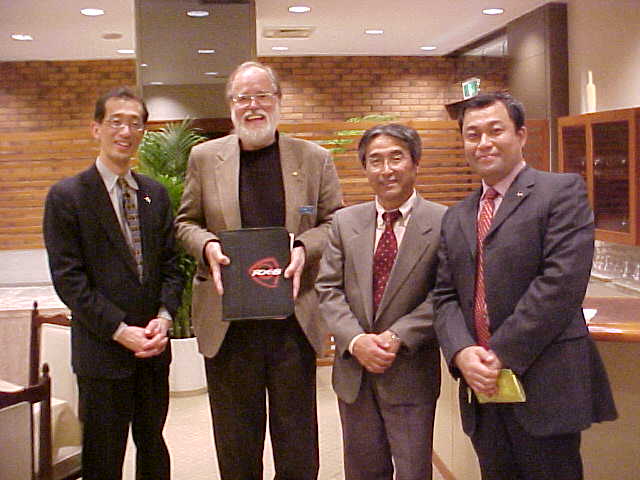
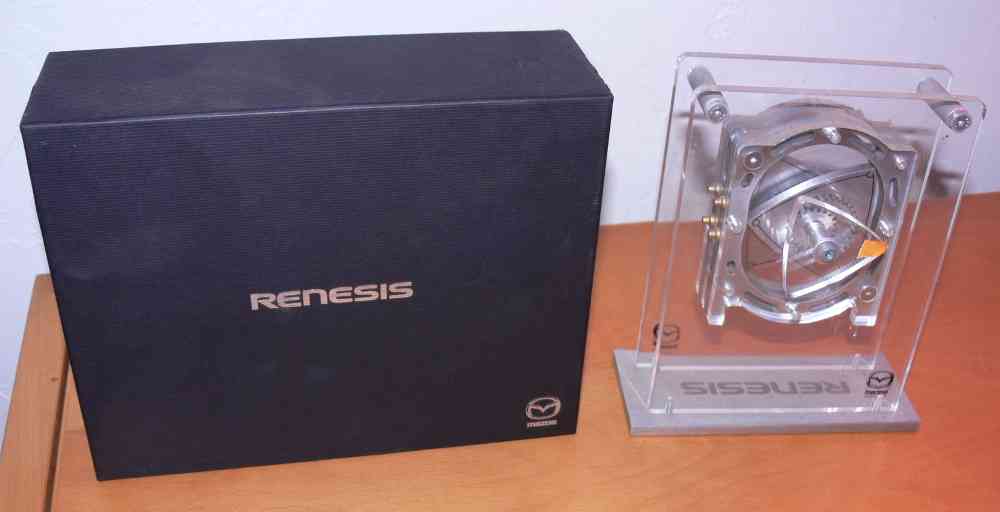
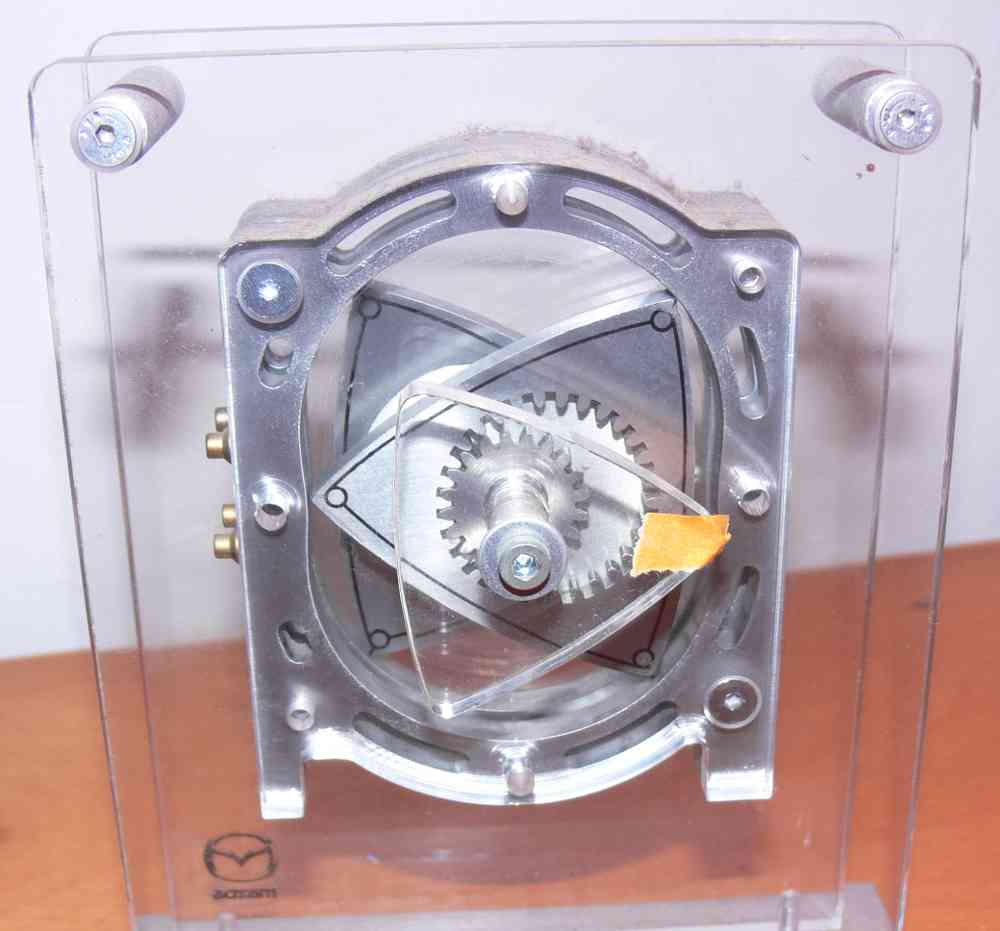
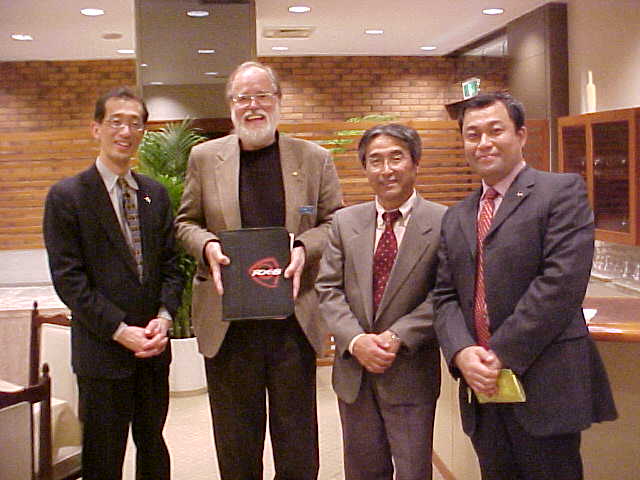
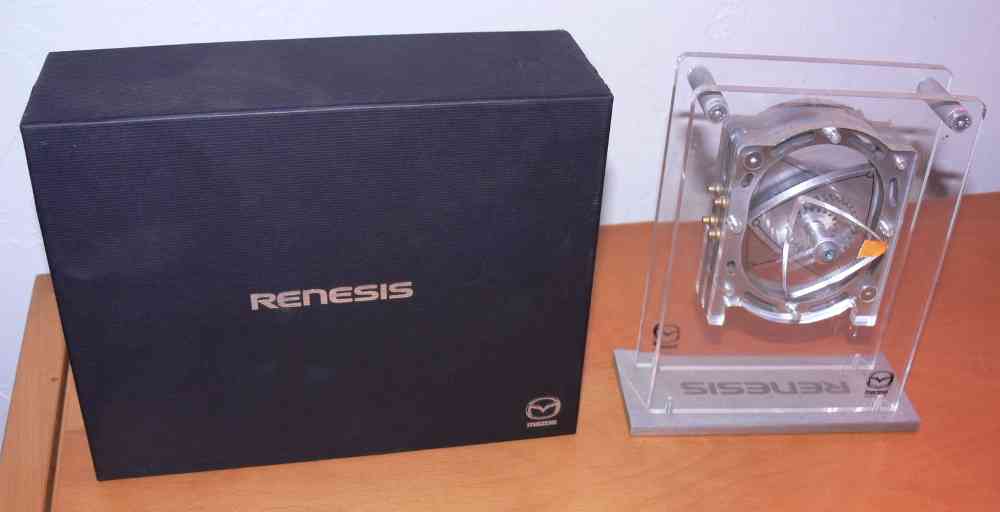
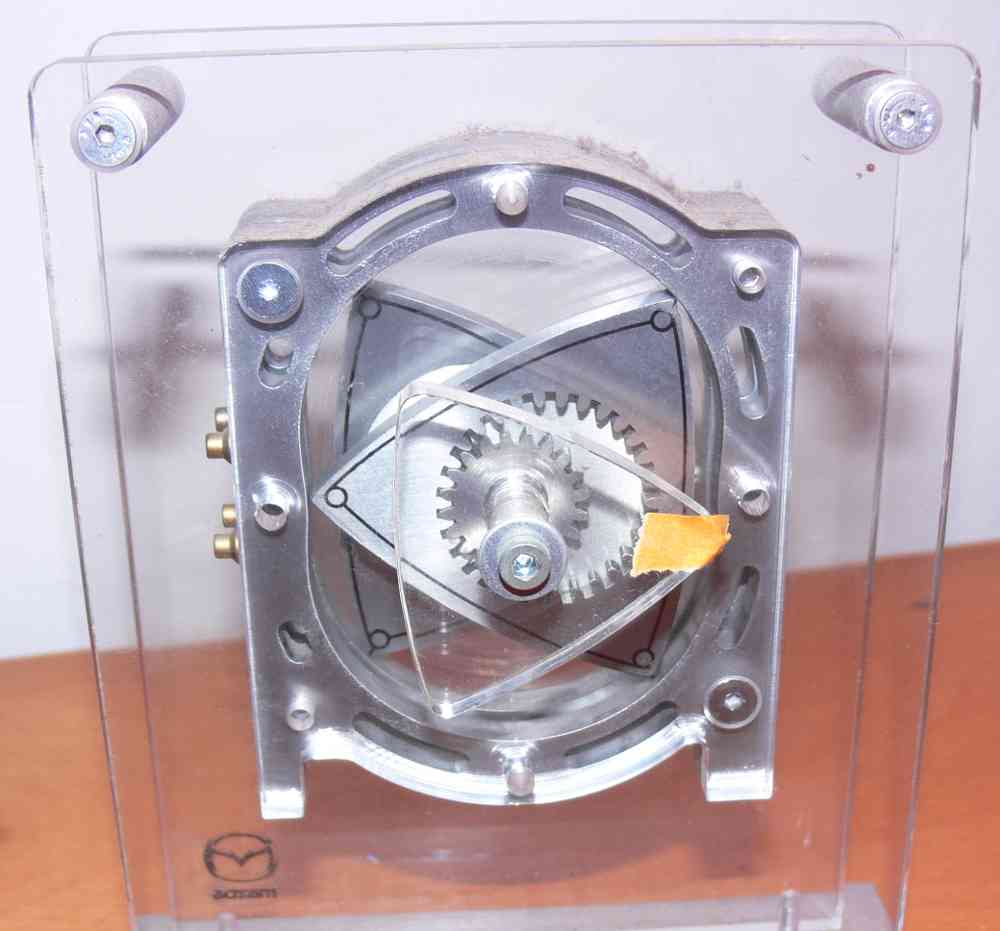
Another option is buy a Wankel model Kit. I was given a real high quality
one when I was at the factory. See the attached jpgs.
http://shop.ebay.com/i.html?_nkw=wankel+engine
Where are you Roger. We may have some people in your neck of the woods.
Paul Lamar
--
The Rotary Engine NewsLetter. Powered by Linux.
ACRE NL web site.
http://www.rotaryeng.net
Youtube key word PaulLamar2
Copyright 1998-2010 All world wide rights reserved.