I have some very basic questions. What is the output RPM? What is the
weight of the engine and any required PSRU? I read RPM's from 8 to 9
thousand and yet output of 2000. Is this with a PSRU? As you can tell,
I am completely ignorant about rotaries. My first decesion is, can
I, or
do I want to, use a rotary to put in my KR? I am assuming the weights I
am told will include all the necessary accessories including a PSRU if
required. Any help will be appreciated.
Thank you,
Dave Coulson.
Up to 11,000 RPM. But we uses only 7500 and a 2.85:1 PSRU.
240 pounds for p-port 250 HP part cast iron engine.
No cooling or exhaust. With 40 pounds PSRU.
190 pounds for p-port 250 HP with aluminum end and center housings.
With 40 pounds PSRU.
Don't even think about side ports. No suitable intake manifolds
available.
http://www.rotaryeng.net/fund-of-intake.html
Paul Lamar
Hey Paul,
Has anyone tried putting a center line splitter inside the elbows of the
round intake tubes? In ventilation design it is common practice to use
splitters inside elbows to reduce the pressure loss caused by the
turbulence induced by the elbow.
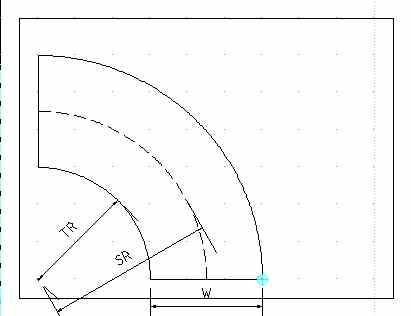
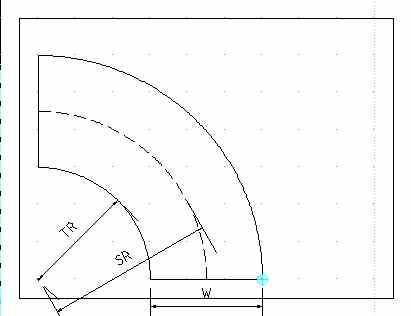
The radius of the elbow is measured at the inside edge of the elbow. If
you draw a 2d picture of an elbow sliced in half so that the picture
looks like two partial arcs drawn from a common center point the throat
radius (TR) is the distance from the center of the arc to the smaller of
the two arcs. When the width (W), or diameter in the case of a round
elbow, is equal to the TR then the elbow is said to have a full throat
radius. The equation is TR/W.
For a round elbow the splitter radius (SR)=TR+(W/2)
Research has shown that the least pressure loss occurs when elbows with
TR/W = 1 are used. When TR/W = 0.5 or less the addition of a splitter
will reduce the pressure loss in the turn by reducing the turbulence in
the flow down stream from the elbow. When TR/W exceeds unity the
pressure loss also increases.
The degrees of turn also effect the pressure loss. Up to 90 degrees of
turn results in pressure loss increasing more or less proportionally
with increase in turn angle. Beyond 90 degrees the pressure loss mounts
much more rapidly.
It doesn't matter to the air if it's being pushed or sucked through the
duct. If the pressure on one end is higher than the pressure on the
other the air will move in the direction from the high pressure end to
the low pressure end. Whether you have a fan, AKA tubo-charger, blowing
in one end or the pumping engine sucking on the other does not matter to
the air. It still follows the same rules.
I'm pretty sure that the same will apply to fluids inside the cooling
system plumbing. The pressures involved in the intake system make the
air behave as though it was essentially incompressible just like the
water in the cooling system. Of course there will be a variation in the
Reynolds numbers, but the principles still apply.
A good book on this, and many other air movement devices, is "Fan
Engineering" published by Buffalo Forge. Sadly it is out of print but
you can still find them on Amazon. My copy is on the shelf at work.
There are also publications by SMACNA and ASHRAE that a google search
will turn up.
Mark LaPierre
It appears that the attached image didn't come through.
Mark LaPierre
--
The Rotary Engine NewsLetter. Powered by Linux.
ACRE NL web site.
http://www.rotaryeng.net
Youtube key word PaulLamar2
Copyright 1998-2010 All world wide rights reserved.