All,
Thanks again for your replies and help. Since my
question piqued some interest, I have attached my
preliminary concept drawings. My thought is for a
fuselage similar to a sailplane, with 2 tandem seats.
Very narrow and only as long as it needs to be, but
with a more upright seating position.
I might have to sweep the wings for aerodynamic
center of lift / center of gravity purposes / and main
gear balance purposes. While
not strictly to scale, I have 'shown' a 60-inch dia
prop in the pusher version.
The high-nacelle "tractor" version is not to scale, but
I am concerned about high speed stability with the
prop thrust line up high. I want 350 knots cruise
AND reasonable stall speed!!
The 'smaller diameter prop' idea was mainly to allow
shorter main gear, and allow the engine nacelles to
be close together, thus keeping the overall size of the
airplane as small as possible, but small props are
not mandatory. I am trying to minimize the adverse
yaw effects of single engine loss, and use two
affordable 2-rotors in a marketable version.
I have read a little from Jack Norris and have seen
pictures of the Whirlwind props.
Thank you all for your help and comments.
Gene Kahn
If you are not the addressee, you may not copy, forward,
disclose
or use
any part of it. If you have received this message in error,
please
delete it and all copies from your system and notify the sender
immediately by return message.
E-mail communication cannot be guaranteed to be timely
secure, error or
virus-free.
Hi gene,
The 3 surfaces Piaggio P180 (aerodynamics were developped
with NASA)
Is a very efficient airplane (payload, speed, range vs
power) with 2 x
850 HP
A reduced scale version (about 1/2) with a little more wing
surface...
and 2 x 200 HP turbonormalized wankels
could be quite impressive...
Philippe
(France)
Jean Prudhomme is working on a scale rotary powered kit.
Paul Lamar
Something similar to the Rutan Pond Racer might be a good
configuration to consider. Though, I'm not sure why Burt put a
central cockpit pod on the aircraft. More intersection drag and
frontal area. It seems he could have instead done what he
did with
has later Boomerang design - put the seating in one boom (the
fuselage), and have a small boom with engine and landing gear
in the
other.
The Pond Racer:
http://en.wikipedia.org/wiki/Scaled_Composites_Pond_Racer
http://www.youtube.com/watch?v=66q4awWPArM
A 400mph lap time is still pretty fast. And that was done at
5000MSL.
The Pond Racer surely would have gone much faster at altitude.
The Boomerang:
http://en.wikipedia.org/wiki/Scaled_Composites_Boomerang
http://www.scribd.com/doc/36314339/Rutan-Boomerang-Popular-Mechanics-Nov-96
Lists max cruise as 304mph with 2 turbocharged 200hp
Lycomings. A
smaller cabin, and rotary engines would allow even higher speeds.
Matt-
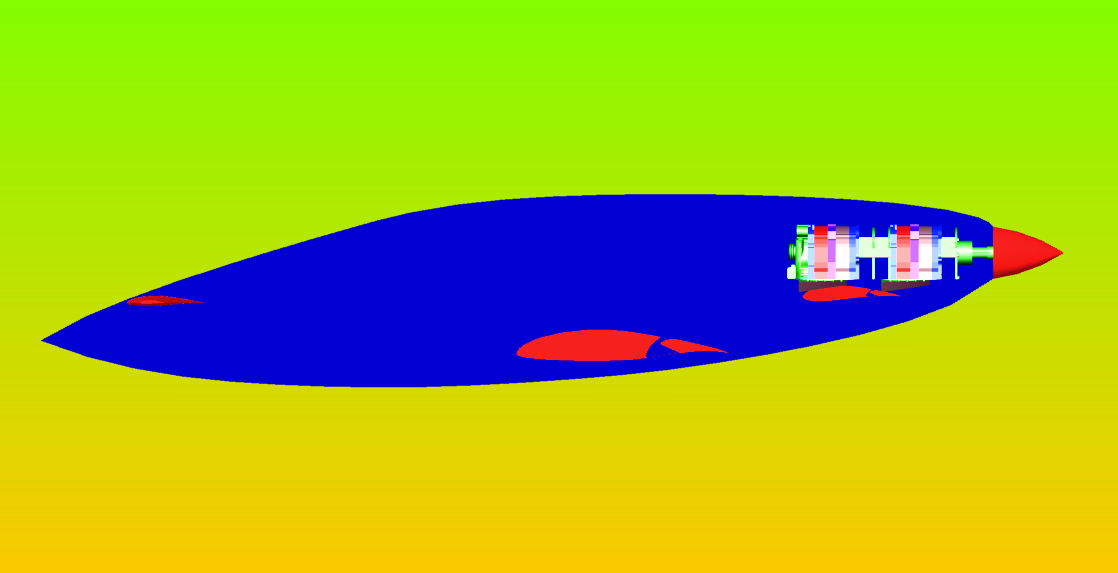
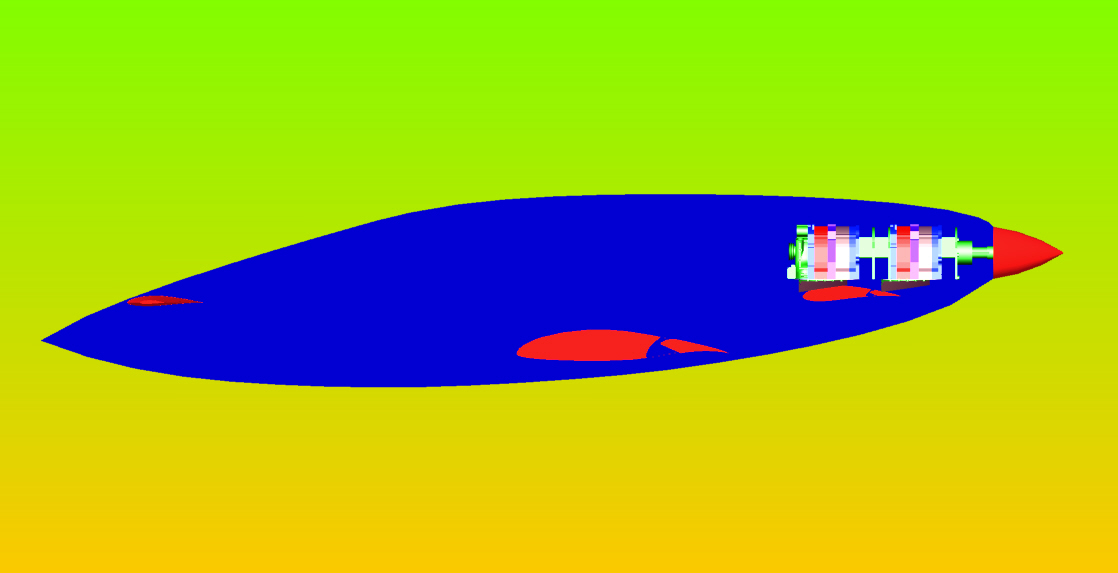
Gene Kahn, As long as we are talking airframes with 500 HP I
thought I might share my project which is named AURORA
The engine shown is two stock RX8 engines in tandem, however I
am making custom housings to join them together. This airframe
flies very well in X-plane and has a good CG range. The landing
gear will be piaggio inspired as was the fusalogue. The
horizontal tail is a lifting surface and the ruddervators are
down loaded. An extreme upset in pitch recovers in a fraction of
a second. The resuidual climb or decent from the upset returns
to trim in two cycles. The winglets have an enormous restoring
force in yaw upset with no oscelation. The roll is stable and
not divergent but stays wherever it is and does not relevel the
wings. I intend to solve this with an autopilot system. Some may
find this an ugly airplane, certainly not as showy as my T-rex
design but it flies much nicer.
The cabin is also large enough for more than two seats and
has a large volume of baggage area near the CG. The low wing
loading has negligable low altitude penalty but provides a short
take off roll with the full flying canard which is a control
canard. This plane apparently can not be made to stall even with
full aft stick power off. Early X-plane testing made it really
hard to get down which was a programming item of setting the
minimum engine RPM at 1200 RPM. The prop still overcame drag at
this power setting. This was solved by changing the constant
speed prop limits.
If you can't believe the X-plane predicted performance
try downloading a 172 or cherokee 140 from the database and fly
it, It will do what the real plane does, Then open up its
planemaker file and try to find any deviation in the data from
the real plane. The program flies this data and will fly yours.
I changed the height of the canard and CG on one test and
produced something that looked like a plane but would not fly.I
fly with all the force vectors and torque displayed in real time
and all relavent data displayed digitally. This allows
optimizing wing areas , sweep, angles of attack, negative twist,
wing position, CG and propeller geometry.
By changing one element at a time you can get to mimimum
drag at WOT and maximum lift at just above stall. In my case I
also pretty much eliminated adverse yaw as a result of the
ruddervator anhedral. They were originally mounted to guard the
prop at rotation with an 88 inch prop. That prop has since been
replaced with an 72" diameter.
I would suggest that you design your airframe directly in
X-plane and use the optimized data in the structural design of
whatever CAD or drawing program you use. Last year X-plane
retailed for $49 and can be found for less on E-bay.I use
version 9 although there is a version 10 available. From what I
hear a bleeding edge computer is necessary for version 10. I
have a 3.4 Ghz quad core liquid cooled mainboard and video card,
6 Gb of system ram with 1 GB on the video card with one 750GB
and two 500Gb hard drives. I may add peltier cooling on the
north side bridge as that is the current weak link. From what I
see posted in forums my system is marginal for X-plane 10 as far
as frame rate is concerned. I have an ASUS 220 video card with
120 processors somewhere but it is not liquid cooled and the
nvidia is working very well with everything I run. Keep in mind
that the unit of measurement in X-plane is in feet not inches.
There is four decimal place accuracy so you still can use small
measurements jou need windows calculator on the toolbar.
Paul, Sorrry, I just looked to see that the two attachments were shown
as JPEG and didn't look at the sizes. I haven't changed any render
settings so I don't know how I got one 100 times as large. I will try to
send an equivalent render with a normal size.
I was looking at the picture of the locomotive that tossed a
cylinder, apparently not a size related issue. I saw a kenworth toss a
rod, piston, wrist pin, oil pan and some iron parts on the 158 bypass.
I stopped to get the shrapnel off the road and made the mistake of
trying to pick up the wrist pin. That sucker must have been 300 degrees.
I made a hammer out of it. Also I have read about Jabiru 2200 engines
tossing a cylinder in flight from failed through bolts
I was wondering about tension bolts. Is there a point where
they should be replaced and if so are the Mazda parts the best choice. I
have seen adds for high strength bolts which are also high priced.
Would 3 rotors or turbochargers be a cause for concerns about tension
bolts or are there no real issues with them.
george grimes
Not limited to Jabiru. Over boost a flat rated turbo charged aircraft
engine and the head will go trough the cowling.
The thing with tension bolts is they resonate like violin
strings at certain RPM's, fatigue and fail in the root of the
threads. Take them out one at a time in the prescribed order
and put a spiral of red RTV around them and put them back in
properly torqued. The red RTV will damp the vibrations. If the
engine has a lot of flight hours have them magnafluxed first
or use new bolts. Does not happen in street cars. Does happen
in endurance car racing.
Perry Mick and I spent a couple of days in Palm Springs
looking for a coolant leak. Turned out to be a broken
tension bolt around 600 flight hours. That is back in
the days of his ducted fan so the engine was running a
steady 4500 to 5000 RPM drone.
The Mazda parts are the only choice. ARP is in SZP and
I asked them to make some but no takers :)
We don't have any history on RX8 bolts so Mazda may
have changed the design. The absolute and bigger hammer
approach is use 1/2 inch. Mazdatrix now has a jig
for drilling them out to half inch. Makes the engine
cannon prof up to 1000 HP :)
Paul Lamar
--
The Rotary Engine NewsLetter. Powered by Linux.
ACRE NL web site.
http://www.rotaryeng.net
Youtube key word PaulLamar2
Copyright 1998-2010 All world wide rights reserved.