Now that torsional vibration is being discussed let's get back to the
single rotor version. Does anyone know what would be a satisfactory
torsional vibration damper for these as they don't have the
overlapping
power pulses from the other rotor to smooth things out i.e. how much
flywheel do they need?
I note that Richard Sohn uses a Hirth reduction box on his - I think
they use a rubber dough nut like the Rotax 2 stroke reductions?
Are the rubber isolators used by Tracey suitable for the frequencies
of a single rotor, let alone the increased amplitude with no
overlapping
power strokes?
It would be nice if the collected wisdom on single rotors was
available
in one place, after all about 100 to 120 HP (Rotax 912 to 914
territory) is commonly needed for very light aircraft. I must admit
I'm not all that impressed with my 912, it only has 29.9 hours on it,
the fuel pump failed - leaked oil, coolant seems to ooze out
everywhere, and after all it still has exhaust valves to fail. I've
just discovered a pinhole exhaust pipe leak that was burning the
paint on the engine mount, it's not that far from fuel and oil
lines. Just what I need, an in-flight fire:( I think my old Subaru
E$A 81 is better engineered and cheaper.
John Evans
(Heretic)
I think you are going to have to make your own.
Tracy's system works well for a two rotor but a one rotor
fires half as often. Tracy's system allows the engine to idle
down to 1500 RPM. That should be your target idle RPM.
I would use his general design and increase the diameter
of the rubber bushings and use a lower Durometer rubber.
Silicone rubber is called for as it has a higher heat tolerance.
A lot of heat will be going into the rubber.
You can make the bushings out of silicone rubber sheet
from McMaster. Allow a bit of expansion room.
There may also be an off the shelf off road rear wheel
motor cycle part that might work.
The Centeflex is too stiff and they don't make a much softer
one.
Paul Lamar
Don't forget that the rotors still have longer time per cycle than a
piston
engine. 270* instead of 180* that helps torsional vibration.
Check Chrysler products for a damper similar to the one in
Attachement 4. It
is used on the drive shaft instead of a U-joint. Chrysler 300, Jeep
Gr. Cherokee.
Dale Davies
Generally that type is too stiff. The have a resonant frequency around
2000 RPM. A two rotor is firing 4000 times per minute or
66 CPS or 66 Hertz in the metric system. The one rotor would
be half that.
Paul Lamar
Paul,
Still fiddling with my single rotor. Will send pics soon.
It's removed from the plane and dangling from a hoist at the moment.
Don't want to tear into it before getting an accurate weight. A hanging
scale is on its way.
As mentioned earlier, the initial running of the engine was very rough.
There were a few tantalizing moments of smoothness, where it almost
seemed as though the engine was off, but overall the vibrations were a
match for something with a broken propeller. Less than a minute at idle
managed to crack my exhaust plumbing in four places, and crack the
engine mount as well. The engine is mounted plugs up. Engine mount is
hard pointed to the engine, with rubber biscuits at the aircraft
firewall, similar to volkswagen mounting for a Q2 airplane. I added a
little tubing to the mount for vertical loads, and it was one of those
tubes that broke.
I have not been inside the engine. Lou Ross built it a long time ago,
ran it for eight hours, and pickled it.
Will take your advice and thoroughly clean the tbi.
Also planning to completely disassemble the engine and see what is going
on. Will have it P-ported. Considering aluminum end plates if the
overall weight is much over 200 lbs.
Engine mount obviously needs work, too.
A while ago you sent a drawing of the Ross redrive modified with
a thrust bearing. Could you send those drawings, please? I guess that
needs to be done as well. My gear ratio is 3.17:1
Lewis.
Assuming it is balanced properly and the mixture and timing are right
it will be very rough below about 3000 RPM. Think of a one
cylinder huge 1.3 liter 2 cycle piston engine.
Paul Lamar
--
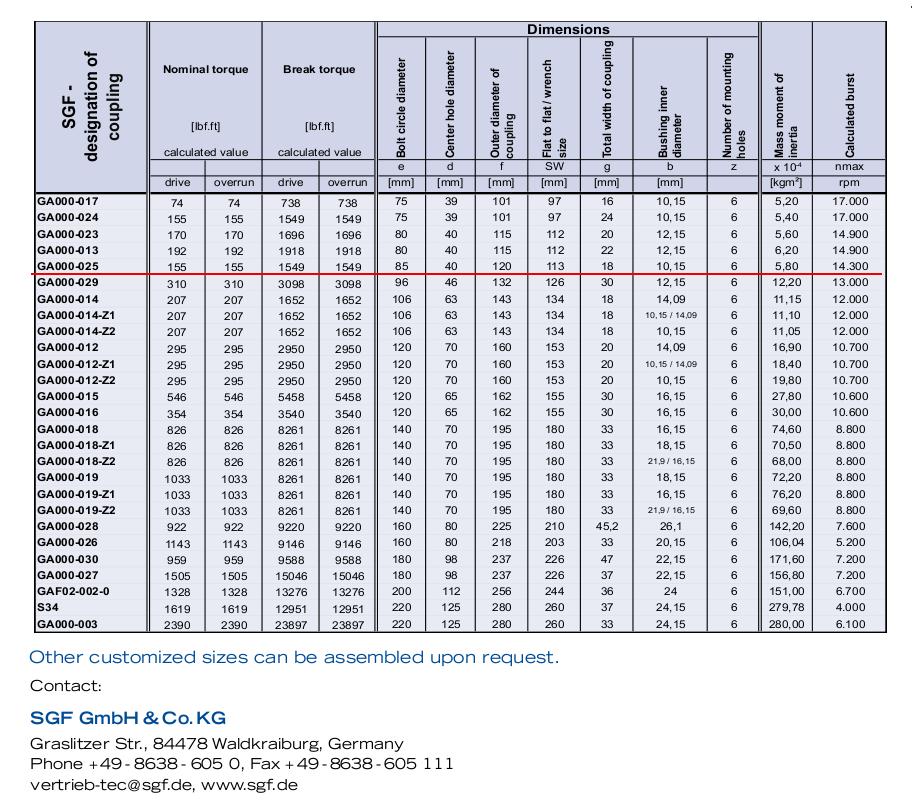
Hi, here is some info from the co that makes many of the auto drive
shaft couplings.
http://www.sgf.de/uppics/Datenblaetter_Industrie_englis.pdf
Murry I. Rozansky
Nice to have some English data.
Highest RPM rating I have seen so far.
I don't know what they mean when the say mass moment of inertia.
Is that of the coupling or the mass moment of inertia it will
drive? Anybody know how to convert Kg per meter squared?
The magnitude of that could tell us if it was just the coupling.
Paul Lamar
The Rotary Engine NewsLetter. Powered by Linux.
ACRE NL web site.
http://www.rotaryeng.net
Youtube key word PaulLamar2
Copyright 1998-2010 All world wide rights reserved.